Showing posts with label Heritage. Show all posts

Monday, February 2, 2026

Bill C-3 (2025) and Searching for Birth Registrations in Ontario

Ever since Royal Assent was granted on 20 Nov 2025 to Bill C-3, An Act to amend the Citizenship Act (2025), there has been a steady increase in the number of posts seen in the various Ontario genealogy groups on Facebook I participate in, and also by the branches of Ontario Ancestors.

Screen capture of the start of An Act to amend the Citizenship Act (2025), Assented to 20 Nov 2025 as Bill C-3 in the First Session, Forty-fifth Parliament 3-4 Charles III, 2025.

This change to the Citizenship Act (R.S.C., 1985, c. C-29) for Canada removed the first generation born outside Canada limitation of Canadian citizenship in some situations.

I am not a lawyer, nor do I portray one on TV. So I don't pretend to understand the gotchas involved not only when it comes to applying for a citizenship certificate but also who can make use of this claim of Canadian citizenship through descent beyond the first generation. If you have any questions about doing this process, I'm definitely the wrong person to ask. Instead, I recommend contacting a law firm that deals in Canadian citizenship and immigration for guidance. The money and time spent talking with a competent legal expert many save you grief and disappointment later.

One of the key document that folks are often having challenges with locating is evidence of a great-grandparent's birth. With birth, marriage, and death registrations in Canada being a provincial concern, each province started civil registrations in different years. You will need to first brush up on when registrations started where your ancestor was born and then figure out where to find those documents.

Since I deal with Ontario genealogy the most, although I am familiar with other provinces, I'm going to focus on those who are seeking to use Canadian citizenship through descent where their ancestors were born in Ontario. Although similar challenges exist for all the provinces when it comes to civil birth registrations.

The key thing to know about Ontario civil birth registrations is that it didn't start until 1 Jul 1869. What is frustrating to many is even then it took many years before there was full compliance with the law. As an example of that lack of compliance with registering births, it is estimated that the birth returns for 1898 were only 80% complete. It's no wonder we sometimes have challenges looking for an Ontario birth registration prior to the 1900s. I've written about finding Ontario civil birth registrations in my blog back in 2022 and I updated it in 2024. Please take a few minutes to read the post to understand what is available and where.

Also, don't just rely on transcriptions and indexes to find your ancestor's birth registration in Ontario. If you can't find the civil birth registration by using the computer aided search feature on the various sites, then take the effort to browse the digitized birth registration index created by the government of Ontario that is found digitized on FamilySearch in their "Births, stillbirths, and delayed registration with indexes, 1869-1912" collection. That digitized material is generally grouped by the first letter of the last name, and then by year. Within the those groupings, the names are order alphabetically.

If you do find the birth registration in the digitized material and you are wanting a certified copy, then read the "Birth, marriage and death registrations" page on the Archives of Ontario site in the section under "Order a certified copy of a registration".

However, if a birth registration can't be located, that means folks will be looking for church records in the hopes that a baptism was performed around the time the person was born.

The challenge then really begins since many of the parish registers are not online and name indexed for searching. If we are lucky, the ancestor might have been baptized by a Wesleyan Methodist minister. Why lucky? Wayne Bower has generously digitized and made available those Wesleyan Methodist baptism registers now held by the United Church of Canada on his page "Wesleyan Methodist Baptismal Registers
1825-1910
". You might also come across some parish registers on FamilySearch and Ancestry. But those are more the exception than the rule.

Instead you will need to research the family to figure out the following from around the time of the birth:

  • What religion was the family following?
  • Did the denomination the family followed practice infant baptisms?
  • Where was the family was residing?
  • What churches may have been in existence in the area?
  • Where are those records now held? 
  • Have the records for that time period been made available online? 

You might have noticed I emphasized the word "research". That is because the answers to those questions require us to find other documents such as census and land records, read and understand what has been recorded in those other records, possibly use maps to find the family on the ground to identify nearby churches, reading local histories to figure out what churches were in existence at the time, and contacting existing churches or archives to find out where the records may have ended up. You might even have to research that religion to get some of those answers.

For example, the Methodist Church, Canada, the Congregational Union of Canada, and about 70% of The Presbyterian Church in Canada came together to form The United Church of Canada in 1925. There have been other congregations brought into that union over the subsequent years. That means, for those congregations you might need to contact The United Church of Canada Archives to find the records. But what about the 30% of the Presbyterian Church in Canada that didn't join in that union? Then you might need to contact The Presbyterian Church in Canada Archives

What if the family attended the Church of England? You will need to figure out the diocese that church was in and contact the appropriate diocesan archives in the hopes that they will be able to locate a baptism record. 

One thing to keep in mind when it comes to families who followed one of the various Protestant faiths that practiced infant baptism, you might actually find a baptism of a child performed by a clergyman of a different Protestant faith. In my own research I've come across families who stated they were Presbyterian in the censuses yet several of their children were baptized by Wesleyan Methodists circuit ministers. So keep an open mind as to where you might actually find a record of baptism.

If the family was Roman Catholic you might find the parish registers in the digitized material held by the Drouin Institute on their site Généalogie Québec. Ancestry also has many of those same registers in their copies of the Drouin collection in "Ontario, Canada, Catholic Church Records (Drouin Collection), 1802-1967", "Quebec, Canada, Vital and Church Records (Drouin Collection), 1621-1968", and "Acadia, Canada, Vital and Church Records (Drouin Collection), 1757-1946". Ancestry also has a "Ontario, Canada, Roman Catholic Baptisms, Marriages, and Burials, 1760-1923" collection that includes Ontario parishes not found in the Drouin collection. Don't forget that FamilySearch also has digitized copies of various Roman Catholic parish registers on their site. 

Even Library and Archives Canada has a number of parish registers either on microfilm or made available in an online digitized format courtesy of their partner CRKN's Héritage in their "Parish and related birth, marriage and death records" collection.

There is also the "Church records collection (F 978)" available at the Archives of Ontario. A list of the churches and associated microfilms in that fond is found on the Archives of Ontario page "Church records collection data table: 1749-1981". Some of those microfilms have been digitized and made available for viewing on FamilySearch. When looking at the microfilm numbers in that table, the ones that start with "MS" or "GS" are from the Archives of Ontario. If the microfilm starts with just a "C" or "M" followed by numbers, those from Library and Archives Canada's collections.

Just a word of caution — I have found that when dealing with any handwritten parish registers, transcriptions or indexes can be a bit iffy. So you quite often have to dive into the weeds and actually browse the images for the parish in the hopes of finding the baptism of your ancestor.


Please note that this blog post may be updated periodically as more information comes to light. I do stress that, in my opinion, before embarking on doing the paperwork to claim your Citizenship Certificate you consult with an immigration and citizenship lawyer who is well versed in the Canadian Citizenship Act and the changes the bill made.

I wish you best of luck in your efforts to find those sometimes hard to locate birth and baptism records. And, if it applies, I also wish you luck in your endeavours to establish your lost Canadian citizenship.


  • [Update 3 Feb 2026: Added paragraph on baptisms by other Protestant clergymen]
  • [Update 7 Feb 2026: Added link to "Guide for Paper Applications for a Citizenship Certificate for Adults and Minors (Proof of Citizenship) under Section 3 (CIT 0001)" that may clarify the 1,095 days requirement for parents residing in Canada.
  • [Update 10 May 2026: Removed the Section 3 (CIT 0001) paragraph and commentary]
  • [Update 12 May 2026: Added link to the Archives of Ontario Church records collection F 978] 


Thursday, January 8, 2026

An Itch Needing Scratching - UE and The Unity of the Empire

Have you ever had a genealogical itch that you just needed to scratch but ultimately led you on an interesting research adventure? That's what happened when I got curious about the source of the UE post-nominal letters that some descendants of United Empire Loyalists choose to add after their name.

A number of years ago, I had applied to the United Empire Loyalists Association of Canada, UELAC, to get formal recognition that I was a descendant of Lieutenant Caleb Howe of the Queens Rangers who fought on the side of the Crown during the American War of Independence of 1775 to 1783. I undertook that task for two reasons. The first was that my great-grandfather, Joseph Edwin Howe, in 1939 had been certified as being of "United Empire Loyalist Descent" by UELAC and I wanted to do the proof myself since the standards for the evidence needed have changed over time. The other reason is that in 2012, when I did my application, I was in the relative early stages of my genealogy research and wanted external validation that I might actually be a competent researcher.

Over the years, my interest in genealogy research has moved beyond just the records we so often use in our efforts to understanding the source of why those records might exist in both the legal and historical sense. And that brings us to those "UE" post-nominal letters.

On the UELAC site on their Membership in the UELAC page they state:

Being a proved Loyalist descendant confers no special status in Canadian or other society, but many members use the post-nominal letters “UE” after their name, in consequence of Lord Dorchester’s Order in Council in 1789, conferring recognition of the service of the Loyalists in defense of “The Unity of Empire.” 

Just what really came out of Lord Dorchester's Order in Council in 1789?

On the UELAC's History of the UELAC page they state:

November 9, 1789: Lord Dorchester’s Proclamation conferred the “Mark Of Honour” on the United Empire Loyalists

The link to Lord Dorchester's Proclamation on that page points to a transcription of a document which includes the following:

"...on their coming of full Age and that it was his wifh to put a Mark of Honour upon families who had adhered to the Unity of Empire,.."

along with the following note after the transcription:

Accompanying the resolution to London to be presented to the king, was attached a "Form of
militia roll for the western districts to discriminate the families before mentioned" which included the following....
"N.B. Those Loyalists who have adhered to the unity of the Empire, and joined the Royal Standard before the Treaty of Separation in the year 1783, and all their children and their descendants by either sex, are to be distinguished by the following capitals, affixed to their names: U.E. alluding to their great principle the unity of the Empire."

I don't know about you, transcriptions are nice but I generally really want to view the actual documents to see if there might be additional clues or details not included.

Fairly quickly I found the proclamation document on Canadiana as the item described as "At the Council Chamber at Quebec, Monday 9th. November 1789." and on BAnQ as "At the Council Chamber at Quebec, Monday 9th. November, 1789".

With the proclamation being from the "Council Chamber" at Quebec, I also looked in the Upper Canada Land Books found on the Canadian Research Knowledge Network Héritage site since I knew from past experience that those books may hold the minutes. Without too much effort I came across the minutes from the Monday 9th November 1789 meeting on Library and Archives Canada microfilm C-100 starting at image 730 of 1034.

Now it got a bit more interesting. That proclamation document published by S. Neilson was only one item of business from that meeting. Here is the section from the minutes with the margin title of "Sons & Daughters of UE Loyalists":

Selections from Quebec Land Books A and B, 1787-1791, p 110, Minutes from 9 Nov 1789; imaged, CRKN Héritage (https://heritage.canadiana.ca/view/oocihm.lac_reel_c100/732 : accessed 8 Jan 2026); citing Library and Archives Canada microfilm C-100.

But on image 677 of 1034 I noticed that they wrote, "A Copy of all the Minutes of Council, concerning the Waste Lands of the Crown lying in the province of Upper Canada, transcribed from the Land Books A and B, in the Council Office at Quebec...". So this is also just a copy.

After a bit more digging I found that book A should be on Library and Archives Canada microfilm C-94. It too is digitized on Héritage described as "State minute books of the Executive Council of Lower Canada". Those minutes are found starting on page 316 (image 990 of 1037) with the "Sons and Daughters of Loyalists" section starting on page 321 (image 993 of 1037).

State minute books of the Executive Council of Lower Canada, Minute Book A, p 321, Minutes from 9 Nov 1789; imaged, CRKN Héritage (https://heritage.canadiana.ca/view/oocihm.lac_reel_c94/993 : accessed 8 Jan 2026); citing Library and Archives Canada microfilm C-94.
State minute books of the Executive Council of Lower Canada, Minute Book A, p 322, Minutes from 9 Nov 1789; imaged, CRKN Héritage (https://heritage.canadiana.ca/view/oocihm.lac_reel_c94/993 : accessed 8 Jan 2026); citing Library and Archives Canada microfilm C-94.

I've found that each version is slightly different from the other in terms of spelling or what has been written in the margin but nothing that takes away from what I originally came across on the UELAC site.

At least I know know where that proclamation came from.

But what about the note found after the transcription of Lord Dorchester's proclamation?

I didn't see anything along those lines in the published proclamation, the Upper Canada Land Books, or the State minute books of the Executive Council of Lower Canada. That had me really puzzled.

What is curious and also frustrating is that the UELAC site didn't really cite their source.

So I turned to the ever helpful "Loyalist in depth study" Facebook group for guidance. There Brenda Dougall Merriman, the author of the ever useful "United Empire Loyalists, A Guide to Tracing Loyalist Ancestors in Upper Canada" pointed me to her footnotes from that book. There the key footnote was concerning a dispatch from Lord Dorchester to William Wyndham Grenville sent on 27 May 1793 that is found in "Colonial Office 42, Vol. 67, pages 367-373 (Library and Archives Canada microfilm B-47)".

Since I live in Ottawa and have a LAC user card, it was fairly simple to drop by Library and Archives Canada and access that microfilm from the open access microfilm shelves.

Fairly quickly I found the dispatch in question from CO 42/67 except there was nothing in the letter concerning that note I was trying to hunt down.

But I then saw an interesting word at the end of the letter to W. W. Grenville after Lord Dorchester signed his name. That word was "Schedule". Could there be something more that Lord Dorchester included after his letter?

There on the next page on the microfilm I saw the title "Schedule of Inclosures" with 15 items listed including:

8. Order of the Governor in Council of the 9th Novem 1789 for allocating lands to the Sons & Daughters of such Loyalists, as have adhered to the Unity of the Empire, and jointed the Royal Standard before the Treaty of separation in 1783, and for putting a mark of honor upon their families.

9. Form of a Militia Roll for the Western Districts to discriminate the families of the loyalists before mentioned.

Ummm, the item 9 matched the description given by UELAC. This looks really promising!

As I moved through the various inclosures, I came across that proclamation document I had found on Canadiana and BAnQ. But it was the next item that grabbed my attention. There on page number written 407 and stamped 204 was that elusive form:

CO 42/67, p 407, stamped 204, Dispatch #25 from Lord Dorchester to William Wyndham Grenville sent on 27 May 1793, schedule 9, Company of Militia form; citing Library and Archives Canada microfilm B-47.
On the form we see in the column for Names that elusive statement:

N. B. Thoſe Loyaliſts who have adhered to the Unity of the Empire, and joined the Royal Standard before the Treaty of ſeparation in the year 1783, and all their Children and their Deſcendants by either ſex, are to be diſtinguiſhed by the following Capitals, affixed to their names:
U. E. 
Alluding to their great principle
The Unity of the Empire.

I now had the answer to the question of where that additional note came from that was mentioned on the UELAC site. Honestly, I could not have found it without the kind assistance of Brenda Dougall Merriman and her book.

Finally this itch has disappeared. Of course, there are others that I periodically need to scratch but they will hopefully be dealt with sometime in the not so distant future.


Monday, July 29, 2024

Finding a War Bride in the Directorate of Movements Microfilms

After a year of writing new talks and updating my existing genealogy talks I finally took sometime this past month to do a bit of diving into the records of folks who married into my various lines in order to see what I was missing. One of those tasks was looking for folks found in the 1921 Census of England and also the 1939 Registration that took place in England. 

And that is where this story starts. 

I started looking into the life of Vera Beresford, born about 1920 in Manchester, England. I really didn't have much information about her, only what I gleaned from the service file of her husband Arnold Norman Richard Burfield. 

Arnold Burfield is my 3rd cousin once removed and he was born in Peterborough, Ontario, Canada on 2 Aug 1914. He enlisted to serve Canada in the Second World War and he was killing in action in Sicily on 23 Jul 1943 while with the Hastings and Prince Edward Regiment. So I started by once again reviewing his service file which is now available online from Library and Archives Canada. The last time I had looked at his file was in 2012 and I actually had to go to LAC to view the original file. My genealogy research skills have advanced just a bit since then so I looked at his file a bit closer.

That is when I came across this memo in his file.

Canada, "Military Service Record: Burfield, Arnold Norman, Regimental Number C5652," memorandum from Director of Repatriation to Director of Records, dated 12 Jan 1945; Library and Archives Canada, Ottawa.

It is a memorandum from the Director of Repatriation to the Director of Records dated 12 Jan 1945.

I realized I had missed this important clue in my earlier reviews of the file. It meant that his wife, Vera, was a war bride. That note states that Vera and her son Norman had arrived from overseas, ex W 779 on 6 Jan 1945. It also provided the destination address of her mother-in-law.

But what is that "ex W 779"?

Honestly, that took a bit of Google-fu to find that answer. I found it in the document "TrainShipSchedules39 45" that was uploaded to Scribd by David A Ryan on 23 Oct 2019. For those researching mass military personnel movements within Canada and also for ships going across the ocean during the Second World War, this document is a real treasure trove. It is described as:

"This document lists the unit serial numbers and embarkation locations for various Canadian military units between 1939 and 1945. It includes divisions, brigades, batteries, regiments, pioneer battalions, medical and supply units. The units embarked from locations across Canada like Toronto, Montreal, Winnipeg, Edmonton and Vancouver as well as some from the UK."

Buried within that document I came across these items:

TS #Serial #UnitEmbarkation
1434-Ex-W-779 Dependents SpecialHalifax
1435-Ex-W-779 Dependents SpecialHalifax

The above table extract deals with the trains taking the dependents to their new Canadian homes.

The next two table extracts provide the dates, ships, and ports information.

DateDestinationDateShip #Ship Name
6-Jan-45Halifax
W-779Mauretania
6-Jan-45Montreal
W-779Mauretania
6-Jan-45Various
W-779Mauretania
6-Jan-45Various
W-779Mauretania

Ship#Ship NamePortSailing DateConvoy
W-779MauretaniaHalifax6-Jan-45-

So it looks like the ex W-779 in that memorandum is the ship Mauretania. No, this is not the Mauretania that was mentioned in the film "Titanic". This is the RMS Mauretania that was built in 1938.

RMS Mauretania

Thanks to the posts by John Reid in his Anglo-Celtic Connections blog, the Canadian War Brides stories available on the British Isles Family History Society of Greater Ottawa site in their name index, and discussions with fellow researchers, I knew that many of the microfilms for the Directorate of Movements held by Library and Archives Canada and available in a digitized format on the Héritage might have additional information. What I didn't realize is that there are 198 microfilms with many of them having 5000+ images each to go through.

So it was time to rethink my approach of just diving in since I'm not going to wade through all of those millions of images to find the ship and hopefully documents I'm interested in. I need work smarter and not harder.

Since the microfilms came from Library and Archives Canada I decided to see what the Collection Search might give me. But what to search on?

  • The obvious is the name of the ship, "Mauretania". 422 results were returned. I want to narrow it down just a bit.
  • In the "About" tab for the Directorate of Movements topic page on Héritage it stated that the archival reference is "RG 24 C 24". From my own experience I know that "RG 24" is written as "RG24" on the LAC site and it is the Department of National Defence fonds. Adding "RG24 C 24" (the quotes are needed) to the search reduces it to 96 results. Not bad.
  • Thinking a bit more about the "W" prefix for the ship number I realized that it probably indicated a westbound ship. So I added "westbound" (without quotes) and now I have 61 results. 
  • Finally I filtered the date by the Year: 1945 since that is when the Mauretania arrived in Halifax. That got it down to 11 results. Now that it manageable!

Screen capture of the Library and Archives Canada Collection Search for 'mauretania "RG24 C 24" westbound" Date: 1945' showing the first of eleven results returned.

Scrolling though the results I came across this entry: "Westbound Personnel - MAURETANIA - Port of Departure - Halifax - Convoy TA-175 [United Kingdom to United States]". However, I wanted Halifax as the port of arrival. In the record information section it stated the date was 1945/01/07 (year/month/day formatted), it is found on microfilm reel number C-5717, and the file number is "HQTS-63-303-779-1". Hmmm, that 779 looks familiar though so I retained some hope that I could find the right microfilm and information about Vera and Norman.

Since microfilm C-5717 is on the Héritage site I decided to see what I could find.

Sigh.

5297 images and none of them are available for text searching. Time to hunker down and start walking through the microfilm images in the hope that this microfilm might have any information about the passage and maybe even find Vera and Norman Burfield listed somewhere.

On image 4 there I came across the Ship Allotment page.

Department of National Defence., "Directorate of Movements," images, Héritage (heritage.canadiana.ca : accessed 29 Jul 2024), Ship Allotment for the Mauretania, M.C. 303-779, Code AT 175; citing Library and Archives Canada microfilm C-5717, image 4
Department of National Defence., "Directorate of Movements," images, Héritage (heritage.canadiana.ca : accessed 29 Jul 2024), Ship Allotment for the Mauretania, M.C. 303-779, Code AT 175; citing Library and Archives Canada microfilm C-5717, image 4. 

It appears that the file starts with the disembarkation in Halifax. It also seems to indicate that there are 630 dependents of Army, Air Force, Navy, and Firefighter personnel on this ship in addition to service members.

I started bouncing through the images in leaps of 20 to see if I might come across lists of passengers. And I got really lucky!

Department of National Defence., "Directorate of Movements," images, Héritage (heritage.canadiana.ca : accessed 29 Jul 2024), List of Canadian Dependents Arriving in Canada ex W-779, List No. 10, for M.D. 3, Sheet No. 2; citing Library and Archives Canada microfilm C-5717, image 200.

On image 200 there was Vera and Norman listed. Nothing new was discovered but the information matches that which was found in the memorandum I found in Arnold's service file. 

That "M.D. 3" on the top right of the page stands for "Military District 3" which, as of 1939, had its headquarters in Kingston, Ontario and included their destination of Peterborough. The various military districts in Canada from 1900 to 1999 can be found listed on the Canadian Soldiers site on their "Domestic Military Organization 1900-1999" page.

I will admit to having a chuckle when I came across pages and pages of letters and notes concerning lost luggage. Even 80 years ago luggage was being misplaced or lost and folks were trying to get compensation for the missing items.

There are pages detailing the need to trains to take the passengers to their destinations including a documents with the timings of the special trains that departed on 7 Jan 1945 starting at image 372. At the bottom of image 375 I found V. Burfield listed and that she had one suitcase and one box to start a new life in Canada as a war widow for her and her son.

I can't imagine coming to Canada from England in the midst of a Nova Scotia winter.

So what happened to Vera and Norman?

She remarried and in 1960 she went back to England with her new family where she passed away many years later.

Where else can you look for records and information? 

You might be able to find your war bride and children in the "UK and Ireland, Outward Passenger Lists, 1890-1960" collection on Ancestry and the "Passenger Lists Leaving UK 1890-1960" collection on Findmypast. There you might come across a record created by the Canadian Wives' Bureau - Civilian Repatriation Section like what we see here for Jaboca E Sauve departing on the Scythia out of Liverpool on 24 Oct 1946 bound for Halifax, Nova Scotia, Canada.

"Passenger lists leaving UK 1890-1960," database with images, Findmypast (www.findmypast.com : accessed 29 Jul 2024), Jacoba E Sauve on board the Scythia departing from Liverpool on 24 Oct 1946; citing The National Archives (Kew), BT 27 Series, 129508.
"Passenger lists leaving UK 1890-1960," database with images, Findmypast (www.findmypast.com : accessed 29 Jul 2024), Jacoba E Sauve on board the Scythia departing from Liverpool on 24 Oct 1946; citing The National Archives (Kew), BT 27 Series, 129508.

However, not all the ships may be found in this collection. Such is the case for Vera and Norman Burfield.

Remember that the information about the ship movements were often a war secret. Details about the comings and goings of ships would not have been reported in the newspapers of the Allies, especially if the ships were carrying military personnel or supplies. However, the local newspapers where they were going to might have articles about welcoming the war brides to their new home.

Just keep in mind that this sort of research isn't simple or quick to do but it can be rewarding and even informative. In this case, I was lucky enough to have enough details to start looking for records and researching what might be found and it only took me a day or so of research to find what I did.

As with much of our research, all we need is a starting place. Often that starting place is already in the records we have and family stories we've been told.


Wednesday, January 31, 2024

Upper Canada Land Books

When we are diving into the land records for what later became the province of Ontario we sometimes come clues written on the part of the petition giving the disposition of the request. Such is the case for the petition for land made by Sheldon Ward in 1825.

"Upper Canada Land Petitions, 1763-1865," digital images, Library and Archives Canada Archived - Microform Digitization (https://www.collectionscanada.gc.ca/microform-digitization/006003-110.02-e.php?&q2=29&interval=50&sk=0& : accessed 28 Jan 2024), Sheldon Ward, 1825, Volume 530, Bundle W 14, Petition 91; RG 1 L3, C-2955, images 877-878.
"Upper Canada Land Petitions, 1763-1865," digital images, Library and Archives Canada Archived - Microform Digitization (https://www.collectionscanada.gc.ca/microform-digitization/006003-110.02-e.php?&q2=29&interval=50&sk=0& : accessed 28 Jan 2024), Sheldon Ward, 1825, Volume 530, Bundle W 14, Petition 91; RG 1 L3, C-2955, image 878.

In this specific case we are interested in the line "Entd in Land Book M page 271" towards the top of the page

What is this Land Book they mention and where can we find them?

As stated on the "Upper Canada Land Books" collection page on the Héritage site hosted by the Canadian Research Knowledge Network, the Upper Canada Land Books hold the "...deliberations, decisions and recommendations of the Land Committee of the Executive Council of Upper Canada." As such, we may find additional clues concerning the petition and what was recommended.

Yet with 41 reels of digitized microfilms where do we start?

Fortunately a number of the microfilms actually have shelf list near the beginning of the reel giving the Land Book letter, dates, volumes, and reel numbers. So that you don't have to keep looking for that information here it is in a table for you that you can copy and paste into a document on your own computer.

Reel IDRecord GroupProvinceBookVolumes
C-100RG 1 L1Upper Canadaselections from Quebec Land Books A and B18
C-100RG 1 L1Upper CanadaA, pp 1-23219
C-101RG 1 L1Upper CanadaA, pp 233-end19
C-101RG 1 L1Upper CanadaB20
C-101RG 1 L1Upper CanadaC21
C-101RG 1 L1Upper CanadaD22
C-101RG 1 L1Upper CanadaE, pp 1-11123
C-102RG 1 L1Upper CanadaE, pp 112-end23
C-102RG 1 L1Upper CanadaF24
C-102RG 1 L1Upper CanadaG25
C-102RG 1 L1Upper CanadaH26
C-102RG 1 L1Upper CanadaI, pp 1-13727
C-103RG 1 L1Upper CanadaI, pp 138-end27
C-103RG 1 L1Upper CanadaJ28
C-103RG 1 L1Upper CanadaK29
C-103RG 1 L1Upper CanadaL, pp 1-48430
C-104RG 1 L1Upper CanadaL, pp 485-end30
C-104RG 1 L1Upper CanadaM31
C-104RG 1 L1Upper CanadaN32
C-104RG 1 L1Upper CanadaO, pp 1-36133
C-105RG 1 L1Upper CanadaO, pp 362-end33
C-105RG 1 L1Upper CanadaP34
C-105RG 1 L1Upper CanadaQ35
C-105RG 1 L1Upper CanadaR, pp 1-42836
C-106RG 1 L1Upper CanadaR, pp 429-end36
C-106RG 1 L1Upper CanadaS37
C-106RG 1 L1Upper CanadaT38
C-106RG 1 L1Upper CanadaU, pp 1-38839
C-107RG 1 11Upper CanadaU, p 389-end39
C-107RG 1 L1CanadaA40
C-107RG 1 L1CanadaB41
C-107RG 1 L1CanadaC, pp 1-35042
C-108RG 1 L1CanadaC, pp 351-end42
C-108RG 1 L1CanadaD43
C-108RG 1 L1CanadaE44
C-108RG 1 L1CanadaF, pp 1-65145
C-109RG 1 L1CanadaF, pp 198-end45
C-109RG 1 L1CanadaG46
C-109RG 1 L1CanadaH, pp 1-65147
C-110RG 1 L1CanadaH, pp 652-end47
C-110RG 1 L1CanadaI48
H-1976RG 1 L1

Index: Finding aid MSS1802-1976
H-1977RG 1 L1

Index: Finding aid MSS1802-1977
H-1978RG 1 L1

Index: Finding aid MSS1802-1978

In this specific case we are looking for Land Book M and from the table we can see that it is on microfilm C-104 in volume 31

Fairly quickly the entry for Sheldon Ward was found on image 233 on that digitized microfilm.

"Upper Canada Land Books," digital images, Héritage (https://heritage.canadiana.ca/view/oocihm.lac_mikan_205068 : accessed 28 Jan 2024), RG 1 L 1, Land Book M, volume 31, pages 270-271; citing Library and Archives Canada microfilm C-104, image 233.

In this case it doesn't give us much more information. Just that Sheldon Ward was "Praying for a Grant of Two hundred acres of Land as a Settler. Granted One hundred acres".

The "W91" above his name references his petition found in Bundle W, Petition number 91 in the "Land Petitions of Upper Canada, 1763-1865" collection we've already found on the Library and Archives Canada site.

Other entries in the books may give additional clues such as the entry on page 270 for James Trotter of Trafalgar where it states "...that he has received a Patent for the west half of Lot No. 15 in the 6th Concession of the Township of Trafalgar, that he has a Family of five Children...". His petition could be found in Bundle T, Petition number 54 in the "Land Petitions of Upper Canada, 1763-1865" collection on Library and Archives Canada.

Some of the entries can be quite long such as the one for Peter McGill, Esq. His petition can be found in Volume 347A, Bundle M 14, Petition number 285 in the "Land Petitions of Upper Canada, 1763-1865".

"Upper Canada Land Books," digital images, Héritage (https://heritage.canadiana.ca/view/oocihm.lac_mikan_205068 : accessed 28 Jan 2024), RG 1 L 1, Land Book M, volume 31, pages 268-269; citing Library and Archives Canada microfilm C-104, image 232.

So one never knows what they will find in these land books.

Also, for the digitized books on microfilms C-100 to C-110 we can do a text search.

Screen capture taken 28 Jan 2024 from Héritage of Upper Canada Land Books : C-104 performing a search with the text "sheldon ward" (without quotes) and seeing that the results include imaged 233 and 540.

Here we see that a search for "sheldon ward" (without the quotes) returns two images. We've already seen image 233 above. However, when I look at image 540 I don't see that name on either of the pages. We always need to look and read at all the suggested pages but there may be indexing errors.

Some of the other digitized microfilms in the "Upper Canada Land Books" collection are the index cards we used to find the the wooden cabinets.

Where can we go from here? I would probably look at the Ontario Crown Land RG 1 Warrants and Fiats Collections found on FamilySearch which I touched upon in my post "Ontario Crown Land RG 1 C-I-1, C-I-2, C-I-3 Collections on FamilySearch". One day, hopefully in the not too distant future, I will attempt to explain how I browse through the images in that collection to find the images of the indexes, registers, and warrants and fiats to learn more about the results of land petitions and subsequent grants to settlers in Ontario.

Monday, February 21, 2022

Case Study - Diving Deep into Ontario Lands Records

An intriguing question appeared in the Ontario Ancestors Facebook group I follow that got my attention since it involved a possible military and land record connection. These are two areas of genealogy research that can often lead to many challenges if you don't know where to look.
Be warned, this is a long post and covers quite a few digitized non-computer indexed collections to pull all the parts together. Yet it also highlights some of the skills needed to be developed beyond using the search systems on most genealogy sites.

Lorraine Foley posted:

Michael Cavanagh, born Ireland abt 1781 , was a soldier in France in 1817, had a child there, came to Canada 1818, and raised family around Perth or Huntley, Ontario. I have seen some military record possibilities, but without collaborating info, I don't know which one is him. I assume he was given land.

Lorraine provided some good bits of information but I needed a bit more. So after I posted a possible lead to a Sgt. Michael Cavanaugh who settled on lot 12 of the 9th concession in Bathurst township she replied back with:

The earliest I can find Michael is in the Richmond and Perth church records. The 1851/61 census state family lives in Huntley township. I am having no luck finding lot # for him in the land record sites mentioned by others below. 

That little bit of information about finding Michael in the 1851 and 1861 census enumerations of Canada West allowed me to start digging into the property records.

The first step for me would be to put the family "on the ground" and to locate them in the population schedule for the 1851/52 census and then find him hopefully in the agricultural schedule since that would provide me with a concession and lot number. But since so many of the agricultural schedules for the 1851/52 census of Canada West have been lost to the ravages of time I usually check the "Districts and Sub-districts: 1851 Census" page for Canada West on the Library and Archives Canada site before looking for something which might not exist. Huntley is in District 4, Carleton County and as we can see, the agricultural census is missing for the Huntley sub-district.

Sub-District
Number
Sub-District
Name
MicrofilmNotes
​24​FitzroyC-11716
​25GloucesterC-11716Agricultural census is missing.
​26​GoulbourneC-11716Agricultural census is missing.
​27​GowerC-11716Agricultural census is missing.
​28HuntleyC-11716Agricultural census is missing.
​29​MarchC-11716Agricultural census is missing.
​30​MarlboroughC-11716Agricultural census is missing.
​31​NepeanC-11716Agricultural census is missing.
​32​OsgoodeC-11716Only the agricultural census has survived.
​33​RichmondC-11716Agricultural census is missing.
​34​TorboltonC-11716Agricultural census is missing.

That is unfortunate but not unexpected. So on to the 1861 census since most of those agricultural schedules did survive.

I've already written about some of the challenges in using the 1861 Census of Canada West in my posts "A Challenge: 1861 Census of Canada - Agricultural Schedule" and "Missing images from the 1861 Census of Canada West on Ancestry?" but fortunately, at least in this case, I didn't run into these issues for Michael Cavanagh since I was only looking for the concession and lot details. However, there were other challenges (aren't there always!)

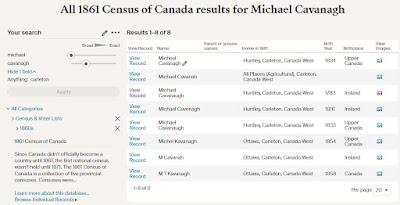
Screen capture of the results from searching the 1861 Census of Canada collection on Ancestry for Michael Cavanagh with the exact keyword of "carleton".

We find that there are several Michael Cavanaghs (with various spellings) in the Carleton district with their home in the Huntley sub-district. Only one stood out to me and that was the Michael Cavanaugh born in 1783 in Ireland since he matched the information provided my Lorraine. He was found in enumeration district number 7. However, to be on the safe side I checked the others:

  • Michael Cavenagh born 1816 in Ireland is recorded as single residing in enumeration district no. 5,
  • Michael Cavanagh born 1834 in Upper Canada is recorded as single residing in enumeration district no. 1 possibly in the household of John Cavanagh, and
  • Michael Cavanagh born in 1833 in Upper Canada is recorded as single residing in enumeration district no. 7 apparently in the household of the Michael Cavanaugh born 1873 in Ireland.

There is also that Michael Cavanah without a birth year and birth place with a home  of "All Places (Agricultural), Carleton, Canada West. Looking at the image we can see that it is for the agricultural schedule for enumeration district no. 7 in the Township of Huntley in Carleton County.

Census of 1861, Canada West, Carleton, Township of Huntley, Enumeration District No. 7, p 23 [stamped]; RG 31; digital images, Library and Archives Canada, Library and Archives Canada (www.bac-lac.gc.ca : accessed 16 Feb 2022); citing Library and Archives Canada microfilm C-1013.

Here we find a "Michael Cavanah" with property on lot 27 of the 11th concession in Huntley Township, Carleton County, Canada West. This looked very promising and Lorraine was able to confirm that was her "Michael Cavanagh".

That covers the easy work which most of us can do once we are familiar with using any of the major genealogy sites and searching the various censuses of Canada. Now we move away from the usual collections and on to Ontario land records and the challenges of looking at digitized microfilms.

Since we can now place Michael on the ground on lot 27 of the 11th concession in Huntley Township we can see if we can find him in the historical Abstract/Parcel Register Books within the Ontario Land Property Records Portal (AKA OnLand) or in the Abstract index books collections in the "Land and property" category for "Canada, Ontario, Carleton" on FamilySearch.

I personally like using the collections on FamilySearch since I don't have to worry about if OnLand is open for business when I'm searching Ontario land records late at night. Here is the start of the page for lot 27 on concession 11 in Huntley Township.

Abstract index books, ca. 1800-1959, of Carleton County, Huntley Township (v. A), Lot No. 27 Concession 11; Registrar's Office, Ottawa, Ontario; DGS 8,344,621, image 274, FamilySearch (https://www.familysearch.org/ark:/61903/3:1:3Q9M-CSTY-Z9FM-9 : accessed 16 Feb 2022).

It was fairly easy to find but it seems he received the land not from the Crown, like one might expect if it was from a grant, but from the Canada Company on 11 Apr 1835. He then sells the property to a Michael T Cavanagh on 23 Jul 1851...possibly his son?

Yet what got my attention was on the preceding page for the East 1/2 of lot 26 in the 11th concession of Huntley Township.

Abstract index books, ca. 1800-1959, of Carleton County, Huntley Township (v. A), East half Lot No. 26 Concession 11; Registrar's Office, Ottawa, Ontario; DGS 8,344,621, image 274, FamilySearch (https://www.familysearch.org/ark:/61903/3:1:3Q9M-CSTY-Z9FM-9 : accessed 16 Feb 2022).

Here a Michael Cavenagh received the land as a patent from the Crown on 13 Oct 1836 and then he sells it on 9 Mar 1937 to Andrew Whelan.

OK, time to pull in the sails and try another tack. Can I find information about that patent which was granted on 13 Oct 1836 on lot 26? Keep in mind that a patent isn't granted until all of the required duties to be performed on the land have been completed. So it may be a number of years from the time a petition is granted until a patent has been received.

This time it is over to the "Land Petitions of Upper Canada, 1763-1865" database at Library and Archives Canada. I've learned that for names which may have multiple interesting ways of being spelled to put in the minimum number of letters in the LAC database search system so I searched on the surname of "cav" and the given name "michael"

Screen capture of the results searching the Land Petitions of Upper Canada, 1763-1865 database on Library and Archives Canada for the surname "cav" and given name "michael".

Two results got my attention: the 1829 and the 1823 petitions. The 1848 petition is much too late for the patent granted in 1836.

Let's take a look at the 1823 petition found in the Upper Canada Sundries on microfilm C-4611 first since it is the earliest petition. The Upper Canada Sundries have been digitized on Héritage site of the Canadian Research Knowledge Network.

A search for microfilm C-4611 displays "Upper Canada Sundries : C-4611" at the top of the search results. Even better, almost all the pages have full-text search support. Searching for "cavanagh" gave me two matching pages: image 119 and image 781. Looking at image 119, in the top corner I could see "32254" stamped. This didn't match what was in the results from the Land Petitions of Upper Canada, 1763-1865 at LAC. However, image 781 has "32921" stamped in the corner and that is a number we want to see.

"Civil Secretary's Correspondence, Upper Canada Sundries, October-November 1823," page 1 of the petition of Michael Cavanagh, p. 32921 [stamped], image 781; digital images, Canadian Research Knowledge Network,  Héritage (https://heritage.canadiana.ca/ : accessed 16 Feb 2022); citing Library and Archives Canada, RG 5, A 1, vol. 62, pp 32850-33396, Reel C-4611.
"Civil Secretary's Correspondence, Upper Canada Sundries, October-November 1823," page 1 of the petition of Michael Cavanagh, p. 32921 [stamped], image 781; digital images, Canadian Research Knowledge Network,  Héritage (https://heritage.canadiana.ca/ : accessed 16 Feb 2022); citing Library and Archives Canada, RG 5, A 1, vol. 62, pp 32850-33396, Reel C-4611.

In this letter dated 13 Oct 1823 we learn some of the following details about Michael Cavanagh:

  • he was with the 57th Regiment of Foot
  • he was discharged in Vallencenes [Valenciennes] in France
  • he has been in Upper Canada for nearly three years
  • when he first went to apply for land he had four in his family left in Ireland
  • he initially applied in Lanark to get his "military locations" but was told the "land was of no use there was nether rations or utinsial alowed for me an to go an get my family before I trobled myself with land..."
  • it seems his family landed in St. John, New Brunswick and he has returned to Brockville, Upper Canada with his family

Alas, no details about if he was given land and where. Time to look at the next petition from 1829.

The microfilms for the RG 1 L3 reference are found in an archived microform collection on the LAC site. Most of the time I can't recall how I bookmarked it in my browser so I click on the "How to obtain copies" link found on the left side of the page where the results are displayed. There LAC has provided a link to "Upper Canada Land Petitions - Microform digitization". Microfilm C-1725 was easy to find and I clicked on that link.

After a bit of bouncing around the images I was able to relatively quickly find Upper Canada Land Petitions "C" Bundle 16, 1825-1831 (RG 1, L 3, vol. 109). That sort of information is supposed to be at the bottom of each microfilm image. The petition number is written at the top of the page in one of the corners. The first page of the bundle will just be a number and the subsequent pages will include a letter like "16a" followed by "16b", etc.

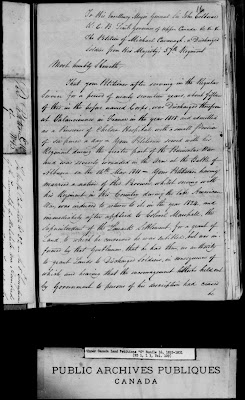
Here is the first of several pages from Michael Cavanagh's petition from 1829.

Upper Canada Land Petitions "C" Bundle 16, 1825-1831, Petition 16, page 1 of the petition of Michael Cavanagh; RG 1 L3, vol. 109, microfilm C-1725, images 758; Library and Archives Canada, Ottawa.

This petition has all kinds of wonderful details for this Michael Cavanagh such as:
  • he was a discharged soldier from his Majesty's 57th Regiment of Foot,
  • he was discharged at Valanciennes [Valenciennes] in France in 1818,
  • he served in the Peninsula War,
  • he was admitted as a pensioner of Chelsea Hospital with a small pension of 6 pence a day,
  • he was wounded in the arm at the Battle of Albuera on 16 May 1811, and
  • he now has five children to support.

It looks like he didn't get the reply he wanted from his 1823 petition and tried again but this time addressing it to the newly arrived Lieutenant Governor of Upper Canada His Excellency Major General Sir John Colborne KCB. It also seems that Michael served in the same brigade under Sir John.

Only one problem with this bundle...I didn't see any mention of what land was being granted to him only "In Council 6th Nov 1829 recommended as a discharged soldier for 100 acres". But at least we know that this petition was successful.

So it was off to the Ontario Crown Lands collection RG 1, C-I-3 which I had looked at in my post "Ontario Crown Land RG 1 C-I-1, C-I-2, C-I-3 Collections on FamilySearch". In that collection I had noticed a number of bundles for "Military warrants" on later pages.

Looking through the "RG 1, C-I-3, vol. 124, Register for Military Warrants" found in the digitized collection on FamilySearch under "Military warrants (v. 124-125) 1799-1869 (indexed) Locations to discharged soldiers and seamen (v. 126) 1815-1822 (indexed) Nominal return of troops entitled to land for service in the War of 1812-1814 (v. 127) Photostatic copy of v. 127, Prince Regent's land grant to Flank companies militia U.C. War of 1812-1814 (v. 127A)" in FHL 1376096 / DGS 8346076 I found a Michael Cavanagh listed in the hand written index at the start with a reference to folio 47. Based on my experience that meant I needed to look for page 47 in this register.

"Military warrants (v. 124-125) 1799-1869 (indexed) Locations to discharged soldiers and seamen (v. 126) 1815-1822 (indexed) Nominal return of troops entitled to land for service in the War of 1812-1814 (v. 127) Photostatic copy of v. 127, Prince Regent's land grant to Flank companies militia U.C. War of 1812-1814 (v. 127A),"  FamilySearch, Images (www.familysearch.org : accessed 16 Feb 2022), R.G. 1, C-I-3, vol. 124, Register for Military Warrants, folio 47, Michael Cavanagh; citing DGS 8346076, item 1, image 79 of 744.
"Military warrants (v. 124-125) 1799-1869 (indexed) Locations to discharged soldiers and seamen (v. 126) 1815-1822 (indexed) Nominal return of troops entitled to land for service in the War of 1812-1814 (v. 127) Photostatic copy of v. 127, Prince Regent's land grant to Flank companies militia U.C. War of 1812-1814 (v. 127A),"  FamilySearch, Images (www.familysearch.org : accessed 16 Feb 2022), R.G. 1, C-I-3, vol. 124, Register for Military Warrants, folio 47, Michael Cavanagh; citing DGS 8346076, item 1, image 79 of 744.

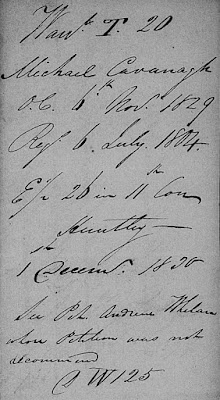
Above is the entry in this register for Michael Cavanagh. It is recorded that he is a "Soldier from the 57 Regiment of Foot As a discharged Soldier". What is even better is that it gives the location of the property as E 1/2 Lot 26 on the 11th Concession in Huntley. It was by the authority of OC 6 Nov 29 [Order in Council 6 Nov 1829] just like we saw in the bundle of his 1829 petition. This document ties the Michael Cavanagh found in the Land Petitions of Upper Canada to that property we found in the Abstract index books.

But we can't stop there since it gives a number for the warrant: T 20.

With a little bit of trial and error (how FamilySearch labels their collections can be a trial at times) I found the warrant in "Military warrants (v. 111-112) bundle A10-Z12, 1823-1829" (FHL 1376008 / DGS 8346063) under "R.G. 1, C-I-3, Vol. 112, Military Warrants, Bundle A19-Z21" starting at image 1294.

"Military warrants (v. 111-112) bundle A10-Z12, 1823-1829,"  FamilySearch, Images (www.familysearch.org : accessed 16 Feb 2022), R.G. 1, C-I-3, vol. 112, Military Warrants, bundle A19-Z21, Warrant T20, Michael Cavanagh; citing DGS 8346063, item 4, image 1294 of 1350.
"Military warrants (v. 111-112) bundle A10-Z12, 1823-1829,"  FamilySearch, Images (www.familysearch.org : accessed 16 Feb 2022), R.G. 1, C-I-3, vol. 112, Military Warrants, bundle A19-Z21, Warrant T20, Michael Cavanagh; citing DGS 8346063, item 4, image 1294 of 1350.

Looking within that bundle what do I see but a note from A Whelan...that same Andrew Whelan we saw in the Abstract index.

There is another place we can look for possible information about a property and that is in the Township Papers also found on FamilySearch within the Land and property category of "Canada, Ontario". There are actually two collection and both are labelled "Township papers, ca. 1783-1870's". One goes from A to H and the other goes from H to Z. What makes this a bit frustrating is that the index is not quite alphabetical by township name. So sometimes it takes a bit of effort to find the digitized microfilm for the township you are wanting. In the case of Huntley it wasn't too hard to find them and select "Huntley, North 1/2, Lot 1, 5th Con. to Lots17 & 18, 11th Con?" (FHL 1378112 / DGS 8346536). There I found the start of "Huntley Lots 26 & 27, Con. 11, Huntley". Within is a letter describing the issue concerning improvements made and confusion about who owned what part of the property. 

Of course, one might even look in the Deed books on FamilySearch for the instruments listed in the Abstract index books for the various transactions on the two properties on Concession 11 in Huntley Township which Michael owned for any additional insights into the property. 

Keep in mind that I'm just giving you the highlights of what I came across. Always read and then re-read all of the various documents, letters, and records for potential clues and hints as to where to look next.

The next step into learning more about Michael Cavanagh and his service to the Crown could be to look in the various registers concerning Chelsea Pensioners held by The National Archives (Kew, England). Some of these registers have been digitized and made available on sites such as Ancestry and Findmypast. There may be many Michael Cavanaghs listed but how many of them served in the 57th Regiment of Foot during the time of the Peninsular War? But I will leave that to you, gentle reader, to explore in your leisure.

As you can see, the process isn't always straight forward and we sometimes need to approach the research question from a different angle in order to connect the dots.


Thursday, May 7, 2020

Canadian War Diaries from the Second World War

With the 75th anniversary commemorating the end of the Second World War occurring this year more people are researching what happened to their ancestors and relatives that served during that war. Unlike the First World War, many of the personnel service records are not easily available to researchers due to privacy restrictions. For researching into those that served Canada during the Second World War I'll generally send people to the Second World War: 1939-1945 landing page on the Library and Archives Canada site as a starting point.

One often overlooked resource when researching the events that involved our men and women that served and fought in the Second World War are the War Diaries, Ships Logs, and Operations Record Books. Keep in mind that these are not the diaries of those that served but of the units and ships. You will often find mentions of officers but in these diaries and logs it is uncommon to find the enlisted personnel recorded in the pages. Unlike the First World War where the war diaries of the Canadian Expeditionary Force have been digitized, not all the Army war diaries from the Second World War have been digitized or even microfilmed. From the Library and Archives Canada page their guidance for searching states:
Second World War (1939-1945) and Korean Conflict (1950-1953)

References to War diaries (RG24-C-3) can be identified by using the Advanced Archives Search.
  • In the pull down menu, select Finding Aid Number, and enter: 24-60
  • Enter a keyword, for example, the unit name: "Royal Canadian Dragoons" or "Princess Patricia's"
  • Some volumes are available on microfilm.
  • Some of the microfilm reels have been digitized on our partner site Héritage.
Sounds almost simple doesn't it? It is, and yet, like most of our research, it often isn't. I'm going to walk you through a few examples.

First of all, you need to go to the Library and Archives Canada Enhanced Archives Search - Advanced page. Once there you need to instruct the search engine to search by Finding aid number 24-60 and also by the keyword of the regiment or unit you are interested in finding. In this case it is the unit of my grand-uncle Ronald McGregor Warrener who died on July 25, 1943 in Sicily, the 48th Highlanders.

Screen capture from Library and Archives Canada Enhanced Archives Search - Advanced with search terms of Finding aid number 24-60 and keyword 48th highlanders.

If everything works out, after you click the Submit button, you will get a list of results.

Screen capture with the results from the Library and Archives Canada Enhanced Archives Search - Advanced with search terms of Finding aid number 24-60 and keyword 48th highlanders.

In this case you see that there are several items with PDFs. The first for May 1944 to August 1945 and the second from August 1945 to October 1945. The PDFs contain the digitized regimental war diaries. However, the one that I'm interested in is #3, March 1942 to April 1944. There are no images or indications of PDF files so I will will need to click on that link to see what is available.

Screen capture from Library and Archives Canada record description for 48th Highlanders of Canada, Canadian Active Service Force, 1902/03-1944/04.

What you will find is a description of the item in the collection. For our purposes the "Conditions of access" is what we are interested in. In this case, there are no references to a microfilm and no links to a Online MIKAN item are found in the description. This means that we will need to visit Library and Archives Canada in Ottawa or have someone visit that place for us to view the actual regimental war diaries. Fortunately, back in 2015 I did just that.

Photo of the spine of the Regimental War Diary for the 48th Highlanders of Canada, May 43 to Apr 44

In addition to the weather report and the often boring daily accounts of unit business you some times find funny or interesting items in the diary, like what they thought of films "Saboteur", rated poor, and "Footlight Serenade", which was rated as good.

Regimental War Diary for the 48th Highlanders of Canada, 26-27 May 1943

Or, in the case of the entry for July 25, 1943, a very bad day with the death of Lt. R. F. Osler and 10 O.Rs. along with 2 missing and 38 wounded. It was through reading about that day in the book "Dileas: History of The 48th Highlanders of Canada 1929-1956" by Kim Beattie that I learned more about what happened to to "Pte. Red (R.M.) Warriner" and the rest of his brothers-in-arms of Dog Company.

Regimental War Diary for the 48th Highlanders of Canada, 25 Jul 1943

Sometimes, in the search for the war diaries, you will come across a description like this for the Headquarters of the 9th Canadian Infantry Brigade:

Screen capture from Library and Archives Canada record description for Headquarters, 9th Canadian Infantry Brigade, 1944/05-1944/06.

In the "Conditions of access" you will note that there are references to two microfilm reels, T-12331 and T-12332. Remember that one of the bullets in the guidance from Library and Archives Canada was that "Some of the microfilm reels have been digitized on our partner site Héritage." Let's open a new tab in our browser and head over to the Héritage site to search their catalogue. If you haven't used the Héritage site before, pop over to my post "Old School" Research With a Modern Twist" to learn about what that site has and how to search it. As you can see below, I've entered in the microfilm number T-12331 in quotes in the search box.

Screen capture from Héritage site looking for microfilm T-12331.

We see that there are two results returned when searching for T-12331.

Screen capture from Héritage site with search results when looking for microfilm T-12331.

Clicking on "War diaries : T-12331" will bring up the first image from that microfilm. You might have noticed that there are 1674 pages. There is no easy way to search the diary for mentions of any names since, unlike the T-1489 microfilm, it hasn't been indexed for a full-text search. You will need to flip through the various digitized pages to find the dates that you are interested in.

Since this is from the Headquarters of the 9th Canadian Infantry Brigade it has quite of bit of military information about the upcoming Operation Overlord, the landings on Normandy Beach. You will find various maps, unit boarding allocations for the landing crafts, and other details. There is also some interesting art work!

"Cover page for Signal Instructions, Appendix "D" 9 CDN INF BDE Operations Order No. 1, 18 May 1944.", War diaries : T-12331. Library and Archives Canada. Heritage microfilm T-12331, image 515.

As for the number of digitized microfilms that may pertain to the Second World War regimental war diaries hosted on the Héritage site, it has 1353 reels available in this collection. Unfortunately the metadata provided for the microfilms doesn't include the name of the units. So flipping through the microfilms will be time consuming. To learn what units may be on a specific microfilm go back to the Library and Archives Canada Enhanced Archives Search - Advanced page and enter in the Finding aid number 24-60 and for Any Keyword use the microfilm number. For example, on microfilm T-10561 the search results include:
  • 7th Canadian Division - war diaries [textual record]. 1942-1943. Series.
  • 7th Canadian Division - General Staff. 1942/06-1943/09
  • 6th Canadian Division - Assistant Adjutant and Quartermaster General. 1942/06-1943/10
  • 6th Canadian Division - Assistant Adjutant and Quartermaster General. 1944/01-1944/05
I have come across a few cases where this search doesn't return any results but it is better than nothing.

I hope that you have fun learning more about what happened in the Canadian units that your ancestor or relative served in during the Second World War.