Showing posts with label Ancestry. Show all posts

Monday, February 2, 2026

Bill C-3 (2025) and Searching for Birth Registrations in Ontario

Ever since Royal Assent was granted on 20 Nov 2025 to Bill C-3, An Act to amend the Citizenship Act (2025), there has been a steady increase in the number of posts seen in the various Ontario genealogy groups on Facebook I participate in, and also by the branches of Ontario Ancestors.

Screen capture of the start of An Act to amend the Citizenship Act (2025), Assented to 20 Nov 2025 as Bill C-3 in the First Session, Forty-fifth Parliament 3-4 Charles III, 2025.

This change to the Citizenship Act (R.S.C., 1985, c. C-29) for Canada removed the first generation born outside Canada limitation of Canadian citizenship in some situations.

I am not a lawyer, nor do I portray one on TV. So I don't pretend to understand the gotchas involved not only when it comes to applying for a citizenship certificate but also who can make use of this claim of Canadian citizenship through descent beyond the first generation. If you have any questions about doing this process, I'm definitely the wrong person to ask. Instead, I recommend contacting a law firm that deals in Canadian citizenship and immigration for guidance. The money and time spent talking with a competent legal expert many save you grief and disappointment later.

One of the key document that folks are often having challenges with locating is evidence of a great-grandparent's birth. With birth, marriage, and death registrations in Canada being a provincial concern, each province started civil registrations in different years. You will need to first brush up on when registrations started where your ancestor was born and then figure out where to find those documents.

Since I deal with Ontario genealogy the most, although I am familiar with other provinces, I'm going to focus on those who are seeking to use Canadian citizenship through descent where their ancestors were born in Ontario. Although similar challenges exist for all the provinces when it comes to civil birth registrations.

The key thing to know about Ontario civil birth registrations is that it didn't start until 1 Jul 1869. What is frustrating to many is even then it took many years before there was full compliance with the law. As an example of that lack of compliance with registering births, it is estimated that the birth returns for 1898 were only 80% complete. It's no wonder we sometimes have challenges looking for an Ontario birth registration prior to the 1900s. I've written about finding Ontario civil birth registrations in my blog back in 2022 and I updated it in 2024. Please take a few minutes to read the post to understand what is available and where.

Also, don't just rely on transcriptions and indexes to find your ancestor's birth registration in Ontario. If you can't find the civil birth registration by using the computer aided search feature on the various sites, then take the effort to browse the digitized birth registration index created by the government of Ontario that is found digitized on FamilySearch in their "Births, stillbirths, and delayed registration with indexes, 1869-1912" collection. That digitized material is generally grouped by the first letter of the last name, and then by year. Within the those groupings, the names are order alphabetically.

If you do find the birth registration in the digitized material and you are wanting a certified copy, then read the "Birth, marriage and death registrations" page on the Archives of Ontario site in the section under "Order a certified copy of a registration".

However, if a birth registration can't be located, that means folks will be looking for church records in the hopes that a baptism was performed around the time the person was born.

The challenge then really begins since many of the parish registers are not online and name indexed for searching. If we are lucky, the ancestor might have been baptized by a Wesleyan Methodist minister. Why lucky? Wayne Bower has generously digitized and made available those Wesleyan Methodist baptism registers now held by the United Church of Canada on his page "Wesleyan Methodist Baptismal Registers
1825-1910
". You might also come across some parish registers on FamilySearch and Ancestry. But those are more the exception than the rule.

Instead you will need to research the family to figure out the following from around the time of the birth:

  • What religion was the family following?
  • Did the denomination the family followed practice infant baptisms?
  • Where was the family was residing?
  • What churches may have been in existence in the area?
  • Where are those records now held? 
  • Have the records for that time period been made available online? 

You might have noticed I emphasized the word "research". That is because the answers to those questions require us to find other documents such as census and land records, read and understand what has been recorded in those other records, possibly use maps to find the family on the ground to identify nearby churches, reading local histories to figure out what churches were in existence at the time, and contacting existing churches or archives to find out where the records may have ended up. You might even have to research that religion to get some of those answers.

For example, the Methodist Church, Canada, the Congregational Union of Canada, and about 70% of The Presbyterian Church in Canada came together to form The United Church of Canada in 1925. There have been other congregations brought into that union over the subsequent years. That means, for those congregations you might need to contact The United Church of Canada Archives to find the records. But what about the 30% of the Presbyterian Church in Canada that didn't join in that union? Then you might need to contact The Presbyterian Church in Canada Archives

What if the family attended the Church of England? You will need to figure out the diocese that church was in and contact the appropriate diocesan archives in the hopes that they will be able to locate a baptism record. 

One thing to keep in mind when it comes to families who followed one of the various Protestant faiths that practiced infant baptism, you might actually find a baptism of a child performed by a clergyman of a different Protestant faith. In my own research I've come across families who stated they were Presbyterian in the censuses yet several of their children were baptized by Wesleyan Methodists circuit ministers. So keep an open mind as to where you might actually find a record of baptism.

If the family was Roman Catholic you might find the parish registers in the digitized material held by the Drouin Institute on their site Généalogie Québec. Ancestry also has many of those same registers in their copies of the Drouin collection in "Ontario, Canada, Catholic Church Records (Drouin Collection), 1802-1967", "Quebec, Canada, Vital and Church Records (Drouin Collection), 1621-1968", and "Acadia, Canada, Vital and Church Records (Drouin Collection), 1757-1946". Ancestry also has a "Ontario, Canada, Roman Catholic Baptisms, Marriages, and Burials, 1760-1923" collection that includes Ontario parishes not found in the Drouin collection. Don't forget that FamilySearch also has digitized copies of various Roman Catholic parish registers on their site. 

Even Library and Archives Canada has a number of parish registers either on microfilm or made available in an online digitized format courtesy of their partner CRKN's Héritage in their "Parish and related birth, marriage and death records" collection.

There is also the "Church records collection (F 978)" available at the Archives of Ontario. A list of the churches and associated microfilms in that fond is found on the Archives of Ontario page "Church records collection data table: 1749-1981". Some of those microfilms have been digitized and made available for viewing on FamilySearch. When looking at the microfilm numbers in that table, the ones that start with "MS" or "GS" are from the Archives of Ontario. If the microfilm starts with just a "C" or "M" followed by numbers, those from Library and Archives Canada's collections.

Just a word of caution — I have found that when dealing with any handwritten parish registers, transcriptions or indexes can be a bit iffy. So you quite often have to dive into the weeds and actually browse the images for the parish in the hopes of finding the baptism of your ancestor.


Please note that this blog post may be updated periodically as more information comes to light. I do stress that, in my opinion, before embarking on doing the paperwork to claim your Citizenship Certificate you consult with an immigration and citizenship lawyer who is well versed in the Canadian Citizenship Act and the changes the bill made.

I wish you best of luck in your efforts to find those sometimes hard to locate birth and baptism records. And, if it applies, I also wish you luck in your endeavours to establish your lost Canadian citizenship.


  • [Update 3 Feb 2026: Added paragraph on baptisms by other Protestant clergymen]
  • [Update 7 Feb 2026: Added link to "Guide for Paper Applications for a Citizenship Certificate for Adults and Minors (Proof of Citizenship) under Section 3 (CIT 0001)" that may clarify the 1,095 days requirement for parents residing in Canada.
  • [Update 10 May 2026: Removed the Section 3 (CIT 0001) paragraph and commentary]
  • [Update 12 May 2026: Added link to the Archives of Ontario Church records collection F 978] 


Tuesday, January 14, 2025

1921 Censuses of England, Wales, Channel Islands, Isle of Man on Ancestry

Up until January 6, 2025, the only place you could view the 1921 censuses of England, Wales, Channel Islands, and the Isle of Man from home was Findmypast. This census had been released on the Findmypast site in January 2022. However, to access that census from home, one either had to have what Findmypast currently calls their "Everything" subscription or pay either for the transcription or to see the images associated with a household on a per household view. That all changed earlier this year when Ancestry added that 1921 census to their catalogue since Findmypast no longer had the exclusive rights to host the images online.

Before we look at this census on Ancestry, it might be a good idea for folks to first read the Findmypast blog page "The 1921 Census is now online for the very first time" and also follow the links on Findmypast's help page "The 1921 Census of England & Wales" as a refresher to understand what was captured and how it was taken. I'll let you read it yourself. When that census was released online in 2022 there was also a flurry of blog posts writing about it such as John Reid's "1921 Census Experience" on Anglo Celtic Connections.

However, before jumping into the images on Ancestry, I want to highlight a few things:

The first issue with this census is that it wasn't taken on Sunday, April 24, 1921 like what it written on all the forms. Due to the "industrial crisis" (mass strikes!) happening at the time, the census had been postponed until June 19, 1921. Of course this can throw a wrench into finding your kin since they may have already started their holidays a bit early. That happened to me with one of my distant cousins.

The next is that this census, unlike the 1950 census of the USA and 1931 Census of Canada which were transcribed using AI enhanced handwriting recognition technology, was transcribed by humans. That is why it took about six months for it to be published with a searchable index on Findmypast instead of the days we are now seeing on Ancestry for newly released censuses.

Finally, when you viewed the image of the census page with the folks listed at an address on Findmypast, you also had the option to view the "Extra" images associated with that page:

  • "Cover" of the enumerator's book
  • "Address", which was written on the other side of the page that had all the details about who resided at that location. The "address" included details to help one to create a "good" citation.
  • "Map" showing the big picture of the area to be enumerated
  • "Plans of Division" that describes that enumerator district

Findmypast made it easy for us to access all those extra images. If you retrieved the image of the page with the people at a place from Findmypast, hopefully you also downloaded the extra images to your computer for safekeeping and later review.

But what it you didn't spend the money from your genealogy budget (yes, I have a budget for my research) on either the "Everything"subscription on Findmypast or buying access to the individual images? Maybe you only purchased the right to view the transcription on Findmypast and didn't pay to view the image.

Well, if you have a subscription with Ancestry that includes the censuses of England, you now have access to the transcriptions and images without paying extra.

Yet like most of our genealogy and family history research, there are a few gotchas with using the census on Ancestry:

The first is there currently isn't a single search page on Ancestry for the 1921 census for England, Wales, Channel Islands, and Isle of Man like we found on Findmypast. But we can use the existing "UK Census Collection" search page like I show here to search for Harry Warrener. I used the "Residence Date" search box at the bottom of the form to limit the search to exactly 1921 (highlighted in a red oval).

Screen capture of Ancestry's "UK Census Collection" search page looking for Harry Warrener with a Residence Date of exactly 1921.
Screen capture of Ancestry's "UK Census Collection" search page looking for Harry Warrener with a Residence Date of exactly 1921, taken 14 Jan 2025.

By doing this, you can easily search the individual Ancestry 1921 census collections of

  • 1921 Channel Islands Census
  • 1921 England Census
  • 1921 Isle of Man Census
  • 1921 Wales Census

all in one go.

The next thing to understand is the source of the transcription used to create the searchable index.

Here I've recreated the search I used to find the page with the enumeration of Annie Leontine Chipman. I know we should treat each person in our tree equally but Annie has become a favourite of mine just due to the interesting life she led, challenges she presented me in finding her in the records, and what some of those records have taught me in terms of how they were created (Annie Leontine Chipman and a Census Mystery).

Screen capture of Findmypast's 1921 Census of England & Wales search results for Leontine Chipman, taken 14 Jan 2025.

Here are the results of the same query on Ancestry:

Screen capture of Ancestry's UK Census Collection search results for Leontine Chipman with a residence date of exactly 1921, taken 14 Jan 2025.

Everything seems to be same. My guess is that Findmypast, as part of their agreement with The National Archives (TNA) in England, has given TNA the transcriptions and Ancestry is using those transcriptions instead of creating their own.

Why do I think that?

1921 census of England, Devonshire, Coombe House, St. George's Road, Torquay, extract; digital images, Findmypast, Findmypast (www.findmypast.com : accessed 30 Jul 2024); citing RG 15/10483 Sch 53, registration district 272, sub district 6, enumeration district 31.
1921 census of England, Devonshire, Coombe House, St. George's Road, Torquay, extract; digital images, Findmypast, Findmypast (www.findmypast.com : accessed 30 Jul 2024); citing RG 15/10483 Sch 53, registration district 272, sub district 6, enumeration district 31.

In looking at the entry for Leontine Chipman on the image of the occupants of "Coombe House" on St. George's Road in Torquay, Devon we can clearly see that the birthplace for Leontine is "Cornwallis Nova Scotia". I'm suspecting the transcriber tried to fit a square peg in a round hole and selected "Cornwall, England" from a drop down box. 

In a chat with John Reid, he asked Gemini what was written in that box in the image and Gemini came back with:

"The image appears to say:
Cornwallis
Nova Scotia
Let me know if you have any other images you need transcribed!
"

This transcription error made it a bit of a challenge to find her initially since she should have been in Northumberland County, England instead of holidaying in Devonshire. I had initially discounted that index entry since it stated Cornwall and not Nova Scotia or Canada as her birth place. If it hadn't been for the kindness of a stranger who had a full subscription with 1921 census access on Findmypast to quickly check the image from the record for me I would never have found her. But this quirk also seems to indicate that the transcriptions on Ancestry originally came from the work done by Findmypast.

When it comes to viewing the images on Ancestry, if we want to see almost all the same images that are pointed to on Findmypast, we need to do a bit of work ourselves.

Screen capture of the top part of Ancestry's page from the 1921 England Census for Leontine Chipman, taken 14 Jan 2025.

When we look at the details page for Leontine Chipman and click on the image shown, we are brought to the page in the census with the details recorded for everyone at the location as of midnight 19 Jun 1921.

To view the other side of that page with the street address, registration district number, registration sub-district number, and enumeration district number we need to go to the next image. On Findmypast, this is the image they labelled as "Address". 

If you are like me and save any of the images you find about your kin to your computer, make sure you also save this one too.

You will also probably want to go to the first image of the image filmstrip for that Enumeration district to get the other details about the enumeration district and also the "series piece number" for your source citation. The series piece number is the number after the RG15 that was written on the page when it was archived at The National Archives.

Cover page for Registration District 272, Registration Sub-district 6, Enumeration District 30 & 31 with the RG and Series Piece Number written on the page.

What about the "Plan of Division" pages that were linked to on Findmypast? They are from RG114 at The National Archives. That takes a bit more effort to locate on Ancestry since they are stored a bit differently. On Ancestry we need to browse the images, pick the county we are interested, select the appropriate name of the registration district, and then select "Not Stated" as the Sub-registration district.

In the case of where Leontine was residing when the census took place, on that "Cover" page from the enumerator's book, we can faintly read "Newton Abbot" beside the number 272 as the registration district. Next we need to walk through the images to find the "Plan of Division" page for 272 number 6. On Ancestry's filmstrip, that was found on image 203 of 278. Finally we want to location the page for Enumeration District 30 and 31 which is located on images 255 and 256 where we learn the boundary descriptions of those two enumeration districts.

As for the maps of the registration districts provided by Findmypast as one of the "extra" images, those appear to be from The National Archives RG 18 (https://discovery.nationalarchives.gov.uk/browse/r/h/C16337741) but they don't seem to have been added to the Ancestry collection for the 1921 census. Using The National Archives site I as able to quickly browse through the descriptions to location registration district 272 to find that RG 18/1103 is a "Collage of Ordnance Survey map sheets cut, mounted and annotated to show the following registration districts as used for the 1921 census...District 272, sub-district 6: Torquay" (https://discovery.nationalarchives.gov.uk/details/r/C990371). Alas, I've also not been able to find these maps on sites other than Findmypast. So if you know of a site with the TNA RG 18/830-1465 collage of maps, please let me know!

Hopefully with the information I've provided, you will be able to better document in your tree on Ancestry all your kin who were in England, Wales, Channel Islands, or Isle of Man when that 1921 census was taken.

Have fun in your noble quest to learn more about your family lines!

Thursday, January 9, 2025

Census of the Prairie Provinces, 1926 now on Ancestry...sort of

Up until now, we could only search for folks who lived in Manitoba, Saskatchewan, and Alberta in the Census of the Prairie Provinces that started on June 1st, 1926 on FamilySearch in their "Canada, Prairie Provinces Census, 1926" collection via the "Canada, Prairie Provinces, Census, 1926" collection specific search page or using the Library and Archives Canada's "Census search" system. FamilySearch and Library and Archives Canada (LAC) both provide access to this census for free. The FamilySearch site even has a pretty good search system that also searches for variations of names, something that the LAC search can't do for us.

So why would we care that Ancestry now includes this census, labelled as "1926 Prairie Census of Canada", as part of their catalogue?

Many folks have their online tree, whether it be public or private, on Ancestry and many like to have one central place to search for information and record details about their ancestors. Of course, Ancestry isn't the only genealogy focused research site but it is probably the one used by the most people. In my case, along with Ancestry, I use almost all the major genealogy related sites in my research (budget permitting!), plus many others sites hosted by organizations such universities, libraries, archives, museums, and private individuals. So I've been using this census for some time now to help me document my Prairie kin.

But back to Ancestry and their "1926 Prairie Census of Canada" collection.

Screen capture of the top part of the "1926 Prairie Census of Canada" search page on Ancestry taken 9 Jan 2025.

On the Ancestry search page for the "1926 Prairie Census of Canada" we can search by the usual personal information such as their first, middle, and last names, along with when and where they were born. We can also search on additional details such gender, marital status, relation to the head of the household, whether they could speak English or French, could they read or write, ethnicity, citizenship, and immigration date. We can also search on the census details such as district and sub-district numbers.

However, you might notice something missing on the right side of the search page. Unlike with the other Canadian censuses that Ancestry has made available on their site, there is no way to browse the images of the pages.

That's because this collection is just an index and the images of the census pages aren't available on Ancestry (at least at this time).

This creates a little bit of a problem since I always stress that we should always look at the images of the source material. 

Why? To see what has been excluded from the index transcription or to confirm that it is the right person we are looking at due to transcription challenges.

So how do we do that with this census?

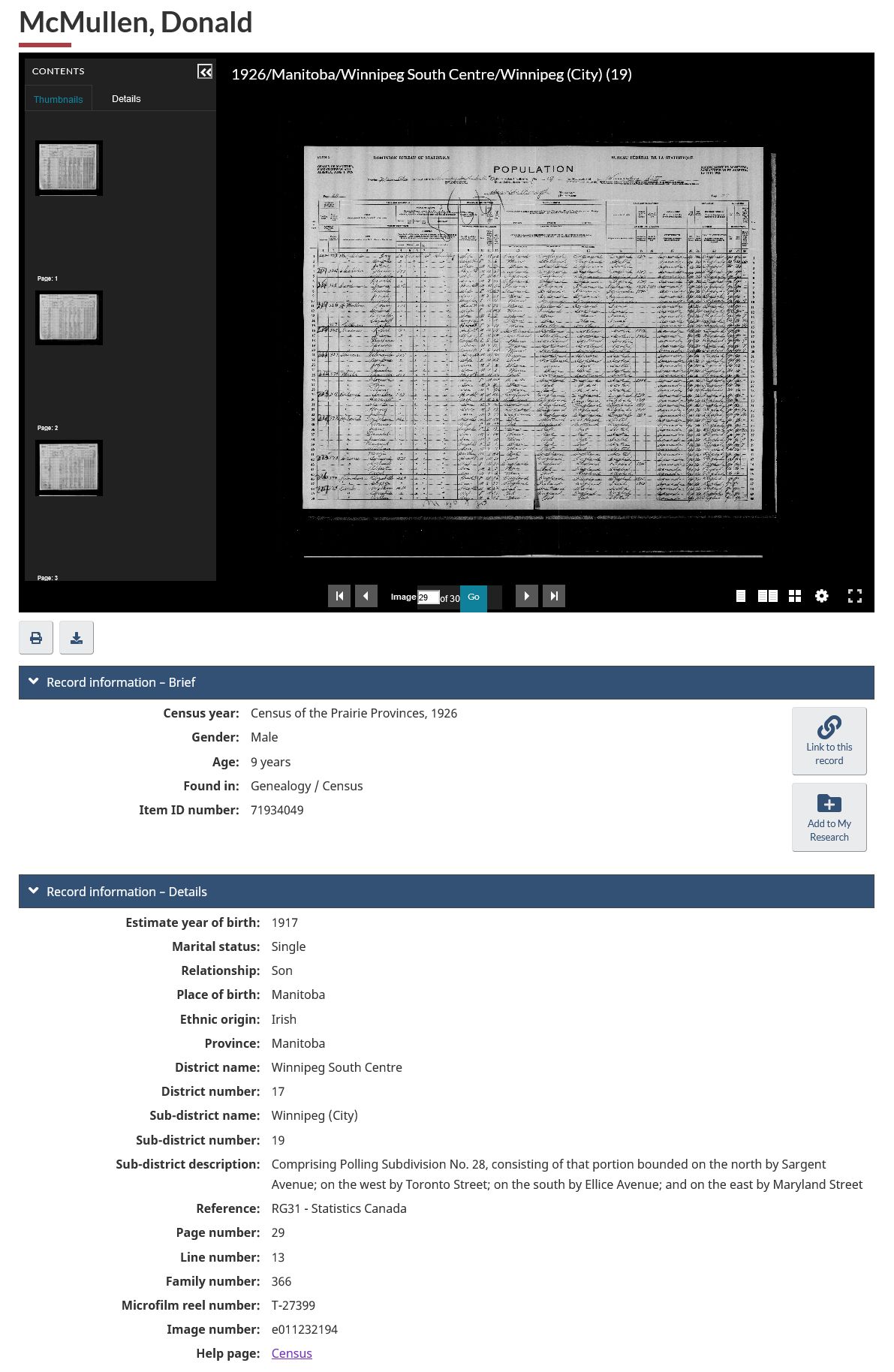
To start with, you may have searched for the person in this census on Ancestry or it could have popped up as a hint. Here is a screen capture of the page on Ancestry with the details for Donald McMullen, my grandfather.

Screen capture of the Ancestry "1926 Prairie Census of Canada" collection details page for Donald McMullen, age 9 years, in Manitoba, Canada.

As you can see, there is no image on the left side of the index transcription information for us to click on and look at.

We are going to have to do a little bit of work to get to the image since we are going to visit the Library and Archives Canada "Census search" page. Why use the Library and Archives Canada "Census search" since FamilySearch has the same information? FamilySearch doesn't let us search using the enumeration district and sub-district information. The district information is useful for filtering down to just a single page or two when there are multiple people with the same name. Plus with LAC we don't even need an account to view the images.

So we need to write down a few details from that Ancestry details screen:

  • Name
  • Age
  • Residence Place
  • Enumeration District
  • Sub-District

All these details came from the index on the Library and Archives Canada site. By the way, the index for this census on the LAC site originally came from the folks at FamilySearch.

Popping over the Library and Archives Canada "Census search" page I've filled in the key fields with the information from the Ancestry details screen for my grandfather, Donald McMullen:

Screen capture of the Library and Archives Canada Census search page with "1926 (Prairies)" selected, First name of "Donald", Last name of "McMullen", Age 9, in Manitoba with District number 17 and Sub-district number 19 specified in the "Where" "more" section.

Here I've selected to search only the "1926 (Prairies)" census in the "When" section.

In the "Who" section, I've typed in the name exactly how it was found spelled in the Ancestry details along with the age.

When I only selected the "1926 (Prairies)", the "Where" section greyed out all the provinces not covered in this census. This made it easy to only select Manitoba since that is the residence place listed in the details.

The next step is a little more advanced, I need to click on the "More" button under "Place" to display the district and sub-district search boxes. There I filled in the District number, 17 in this case, and Sub-district number of 19.

With all those details, only one result was returned.

Screen capture of the Library and Archives Canada Census search results page of the "1926 (Prairies)" for Donald McMullen, age 9 years, in Manitoba.

A few tips concerning the results page:

  • If you need to change your search don't use your browser's back button. Instead, click on that "Modify search" link at the top to bring up the search screen again. Using the back button will often bring you to a empty search screen and you have to type all the information again.
  • As tempting as it is, don't click on the "digital object(s)" image to view the page. You are going to want to click on the name of the person.

Clicking on the name brings us to the details page. If I had just clicked on the image, I wouldn't be able to see the details about the record on the LAC site that I will want to use in a citation (we all use citations, right?).

Screen capture of the Library and Archives Canada Census search details page of the "1926 (Prairies)" for Donald McMullen, age 9 years, in Manitoba, item ID number 7193049.

You can now view the image on your screen, print it on your printer, or download it to your computer.

If you choose to download the image to your computer you can either save just the page you at looking at as a JPG or save all the pages in that sub-district as a PDF. 

Census of the Prairie Provinces, 1926, Manitoba, enumeration district 17 Winnipeg South Centre, sub-district 19 Winnipeg (City), page 29; imaged, "Census search", Library and Archives Canada (http://central.bac-lac.gc.ca/.redirect?app=census&id=71934049&lang=eng : accessed 9 Jan 2025); citing ecopy number e011232194.

No matter what you choose to do, you can now review all the details recorded about the person for yourself. One detail that we don't find in the transcription is the address where the person was residing. This could be a street address for a town or city, or the section, township, range, and meridian that we can use to learn more about the property.

Have fun searching this census for your kin who resided in Manitoba, Saskatchewan, or Alberta in 1926!

Thursday, November 14, 2024

Finding a Will of an English Earl or What's in a Name?

In our genealogy and family history research we've all probably come across challenges with finding someone in the records when searching for them by their name. The issue could be a problem with the transcription used to create the index such as what I found for the household of Thomas S. Pattillo inthe 1911 Census of Canada where the surname was originally transcribed as "Pattires" by the folks at Ancestry.

Extract from the 1911 Census of Canada, Nova Scotia, Colchester, Truro, p 13 of the Thomas S. Pattires [Pattillo] household
1911 Census of Canada, population schedule, Nova Scotia, Colchester district (41), Truro sub-district (25), p. 13, dwelling 113, family 125, household of Thomas S. Pattires [Thomas S. Pattillo], digital image, Ancestry (www.ancestry.com: accessed 13 Nov 2024); citing Library and Archives Canada microfilm T-20358.

Maybe the civil or church authority who recorded the name in an official document spelled the name as they heard it. I came across that challenge for the household of John Haughton in the 1881 Census of Canada where the enumerator recorded the name as "Hutton".

Extract of the 1881 Census of Canada, Ontario, Simcoe North, Tiny, division 2, p 61 of the household of John Hutton.
1881 Census of Canada, population schedule, Ontario, Simcoe North district (139), Tiny sub-district (H), division 2, p. 61, dwelling 250, family 254, household of John Hutton, digital image, Ancestry (www.ancestry.com: accessed 13 Nov 2024); citing Library and Archives Canada microfilm C-13251.

We might even come across cases where a nickname or diminutive of the name is recorded. Possibly someone was named after their great-aunt Agnes but they go by the name Nancy since they think that Agnes sounds old-fashioned.

Then there is the interesting case a patron at a recent joint Ottawa Public Library - Ottawa Branch of Ontario Ancestors Genealogy Drop-In brought to the group. She was looking for help in locating the will of the 12th or 13th Earl of Derby as part of her efforts to confirm a family story of a possible undocumented child of one of those two Earls.

It should be easy to find the will I thought.

The first thing I did was to look up the details about the 12th and 13th Earls of Derby using Wikipedia to find out their birth names and when they died. I could also have looked up the entries in Burke's A Genealogical and Heraldic History of the Peerage and Baronetage, the Privy Council, Knightage and Companionage

I learned the following details:

  • 12th Earl of Derby: born Edward Smith-Stanley and died 21 Oct 1834
  • 13th Earl of Derby: born Edward Smith-Stanley and died 30 Jun 1851

Since both of the Earls died before 1857, I can't use the "Search probate records for documents and wills (England and Wales)" site. At the drop-in, John Reid, one of our subject matter experts, suggested that we need to look in the Prerogative Court of Canterbury (PCC) records since they cover the years 1384 to 1858. Since Ancestry has indexed and made available the images from the PCC wills in their "England & Wales, Prerogative Court of Canterbury Wills, 1384-1858" collection that's where I started.

And got absolutely nowhere!

I searched for any "Edward Smith-Stanley" who died around 1834 or 1851. I even searched for Edward Smith Stanley". I searched for all kinds of variations on the name and expanded the year range but there was no one who matched what I was looking for.

Since we only have an hour to help those dropping in, I put the searching aside and the group continued with the next question. But this was an itch that I just couldn't scratch. So at around 11 p.m. that night (it was one of those "I can't sleep" research itches) I dived back in this problem.

Might the will had been proved in another court such as the Prerogative Court of York or at a local court in England?

But first there was one other place I wanted to check for the Prerogative Court of Canterbury wills. That is The National Archives (England) "Wills 1384-1858" research guide since it has a search box. Instead of searching by name I searched for the keyword "Earl of Derby" (without quotes). I got back 18 results and two results got my immediate attention:

Reference:     PROB 11/1853/415
Description:     Will of The Right Honorable Edward Earl of Derby of Chester , Cheshire
Date:     25 November 1835
Held by:     The National Archives, Kew

and

Reference:     PROB 11/2140/271
Description:     Will of The Right Honorable Edward Earl of Derby of Angel Inn, John Street, Minories , City of London
Date:     22 October 1851
Held by:     The National Archives, Kew

So it seems that the wills for both the 12th and 13th Earls of Derby were proven in the Prerogative Court of Canterbury. I could even download a digitized copy of both of those wills for free from The National Archives if I sign in with my free account.

Yet why couldn't I find these wills on Ancestry?

I puzzled over that for a few minutes and then noticed that nowhere in the description is his birth surname "Smith-Stanley" recorded. Could Ancestry have taken his title and used it as his last name?

In searching for any "Edward" with the last name of "Earl" who died around 1834 only one entry was returned in the results:

Screen capture of the entry from Ancestry of the "England & Wales, Prerogative Court of Canterbury Wills, 1384-1858" collection index page found by searching for the first name "Edward", last name "Earl", who died around 1834.

Same with searching for any "Edward" with the last name of "Earl" who died around 1851:

Screen capture of the entry from Ancestry of the "England & Wales, Prerogative Court of Canterbury Wills, 1384-1858" collection index page found by searching for the first name "Edward", last name "Earl", who died around 1851.

After reviewing the images, I was certain that was them. It only took me less than two hours of effort to find the will and to understand why I couldn't find the information during our drop-in.


Now that we know how those copies of the wills of the peerage of the United Kingdom have been possibly recorded in the index of the "England & Wales, Prerogative Court of Canterbury Wills, 1384-1858" database on Ancestry we can try our hand at finding other wills of nobility proven in that court.

We can find other interesting wills of the English and Welsh peerage in this Ancestry collection by searching on the rank of nobility such as Earl/Countess, Viscount/Viscountess, Marquess/Marchioness, or Duke/Duchess, as their last name. But Duke and Earl are also possible actual last names. How do we filter out the non-peerage? By adding an exact Keyword match of "Honorable" or "Noble". You can even leave off the rank of nobility and just search use the exact match Keyword of "Highness" to find wills of some princes and princesses. I even came across the copy of the will of Her Most Excellent Majesty Charlotte, Queen of the United Kingdoms of Great Britain and Ireland by just using the exact Keyword search of "Majesty" and leaving out all the other details.

Start of the will of Charlotte, Queen of the United Kingdoms of Great Britain and Ireland, probated 26 Jan 1819
Start of the will of Charlotte, Queen of the United Kingdoms of Great Britain and Ireland, probated 26 Jan 1819; "England & Wales, Prerogative Court of Canterbury Wills, 1384-1858," Ancestry (www.ancestry.com : accessed 13 Nov 2024); citing The National Archives (Kew), PROB 11/1612.

So be creative when you are doing your searches by name, especially when it comes to those of who are Peers of the United Kingdom!


Monday, September 30, 2024

Canadian Pacific Steamship Company Records

Recently John Reid, of the Anglo-Celtic Connections blog fame, and I paid an in-person visit to the Library and Archives at the Ingenium Centre located beside the Canada Science and Technology Museum in Ottawa. Please note, this is not the same as Library and Archives Canada, so don't drop by the LAC building on Wellington if you are wanting to look at these actual records. 

Canadian Pacific Steamships crest
"Canada, Canadian Pacific Steamship Company Records, 1897-1981," database and images, Ancestry (https://www.ancestry.ca/search/collections/62578/ : accessed 30 Sep 2024), Miscelanious Records > 1950-1955 > Ships-Memorabilia > image 2 of 9, Canadian Pacific Steamships crest; citing Canada Science and Technology Museum; Ottawa, Ontario, Canada; Records of the Canadian Pacific Steamship Company, "Ships - Memorabilia, 1950-1955", reference CPS-04-0509 folder.

We were there to learn about their collaboration with Ancestry to digitize and make available the records of the Canadian Pacific Steamship Company (CPS). John Reid wrote about our visit there in his post "Resources of Ingenium Library and Archives". The digitized records were released online in June 2024 in Ancestry's "Canada, Canadian Pacific Steamship Company Records, 1897-1981" collection. It is important to note that not all the items in the collection have been digitized. Some of the large foldout ship diagrams and other large documents weren't digitized.

What makes this collection exciting for genealogy and family history researchers is the time period it covers. For Canada, we generally only have incoming passenger lists up to 1935. But what about after that time? This is where you might get lucky and find your kin mentioned in the records if they sailed on one of the Canada Pacific Steamship ships between 1897 to 1981.

However, before you dive into the records make sure you read the descriptions of the Canadian Pacific Steamship Limited fonds and their sub-series hosted on Archeion. These description gives you the history of the CPS along with details about the various series to help you understand what you might find.

Here is the search screen on Ancestry:

https://www.ancestry.ca/search/collections/62578/
Screen capture of Ancestry's "Canada, Canadian Pacific Steamship Company Records, 1897-1981" collection (https://www.ancestry.ca/search/collections/62578/ : accessed 24 Sep 2024).

If you are like me, you may have recorded the names of the ships and when your ancestors sailed on them in your genealogy software. Yet how do we know which ships were operated by the Canadian Pacific Steamship Company? Fortunately we have a list of the ships operated by the CPS found on Wikipedia in their "List of ships of CP Ships" article. 

Using that list of ships I searched my database and found about 35 people who sailed on the various Empress and Duchess ships of the CPS. Out of that list I actually came across passenger indexes for only two of them. Yet that is still two more lists of passengers than what I started with. Here is a page from the index for tourist class on board the Empress of Britain from Liverpool to Quebec with my 2nd cousin twice removed, Cora McTavish, listed.

Passenger index for the Empress of Britain, arrived 24 Sep 1959 at Quebec, P.Q. with Cora E. McTavish listed
"Canada, Canadian Pacific Steamship Company Records, 1897-1981," database and images, Ancestry (https://www.ancestry.ca/search/collections/62578/ : accessed 27 Sep 2024), Cora E. McTavish, age 46, arrived 24 Sep 1959 at Quebec, P.Q. onboard the Empress of Britain; citing Canada Science and Technology Museum; Ottawa, Ontario, Canada; Records of the Canadian Pacific Steamship Company, Reference Number: X0450.

You might be wondering how I knew that Cora was on this ship? I used the BT27 series of records held by The National Archives in England and made available on various genealogy site in searchable databases such as Ancestry's "UK and Ireland, Outward Passenger Lists, 1890-1960" collection and Findmypast's "Passenger Lists Leaving UK 1890-1960" collection.

Going to the first page of that passenger index on Ancestry I found that the Empress of Britain arrived in Quebec City on 24 Sep 1959. Along the way, the ship also stopped at Greenock, Scotland.

Cover page for the Passenger Index of the Empress of Britain arriving 24 Sep 1959 with details of departure and arrival ports.
"Canada, Canadian Pacific Steamship Company Records, 1897-1981," database and images, Ancestry (https://www.ancestry.ca/search/collections/62578/ : accessed 27 Sep 2024), Passenger Index cover page for the Empress of Britain, arrived 24 Sep 1959 at Quebec, P.Q.; citing Canada Science and Technology Museum; Ottawa, Ontario, Canada; Records of the Canadian Pacific Steamship Company.

Yet what else can one find in this collection?

I also came across her name in the list of Tourist Passengers when she went from Montreal to Liverpool on board the Empress of England. She is listed with her cabin numbers along with an indicator that she was in the first seating for dinner.

Tourist Class passengers with room numbers and dining seating for the Empress of England voyage on 21 Jul 1959 from Montreal to Liverpool via Greenock.
"Canada, Canadian Pacific Steamship Company Records, 1897-1981," database and images, Ancestry (https://www.ancestry.ca/search/collections/62578/ : accessed 27 Sep 2024), Cora E. McTavish, Tourist Passengers, Empress of England, 21 Jul 1959, from Montreal to Liverpool via Greenock; citing Canada Science and Technology Museum; Ottawa, Ontario, Canada; Records of the Canadian Pacific Steamship Company, Reference Number: CPS-01-0030.

Maybe I'm interested in what may have happened on the voyage of the Empress of Britain that Cora was on when she came back to Canada. Using the "Browse this collection" on the right side of the search screen we can also browse the collections for other tidbits of information for record groups such as:

  • Crew of Passenger Lists
  • Immigration Regulations and Policy
  • Journals, Logs, and Ship Movement Books
  • Miscelanious Records [yes, that is a typo on Ancestry's part!]
  • Named Ships
  • Programmes, Menues, and Events
  • Promotional Artwork
  • Schedules and Fares
  • Ships Officers, or Company Officials
  • Voyage Reports

Along with the date of arrival or departure, often the key to finding these other documents that can shed some light on the voyages of our ancestors is the voyage number. 

If I didn't know voyage number from that manifest, I might have then looked for the Empress of Britain departing on September 18, 1959 in the Movement Book found in "Journals, Logs, and Ship Movement Books" record group.

Movement Book No. 40, 1959, p 10, Empress of Britain, Voyage No. 55
"Canada, Canadian Pacific Steamship Company Records, 1897-1981," database and images, Ancestry (https://www.ancestry.ca/search/collections/62578/ : accessed 27 Sep 2024), Journals, Logs, and Ship Movements Books > 1959 > Movement Book No. 40 > image 29  of 226, p 10, Empress of Britain, Voyage 55; citing Canada Science and Technology Museum; Ottawa, Ontario, Canada; Records of the Canadian Pacific Steamship Company, Movement Book No. 40.

There are also the voyage reports. With just a few clicks of the mouse I found out the details about Voyage No. 55, both from England to Canada and the return back to England.

Captain's General Voyage Report-Empress of Britain-Voyage No. 55
"Canada, Canadian Pacific Steamship Company Records, 1897-1981," database and images, Ancestry (https://www.ancestry.ca/search/collections/62578/ : accessed 27 Sep 2024), Voyage Reports > 1959 > Captain's General Voyage Report-Empress of Britain-Voyage No. 55 > image 2 of 29; citing Canada Science and Technology Museum; Ottawa, Ontario, Canada; Records of the Canadian Pacific Steamship Company.

In this sort of report we find the ports visited, times of arrivals and departures at the various ports, number of passengers embarking and debarking at the various ports, possibly how any cargo was stored, the names and positions of the officers, if a stowaway was found (yes, on the return to England), reports by the doctor (two deaths during the return to England), and a daily summary of the happenings on board the ship.

I had mentioned that the larger fold out pages haven't been digitized by Ancestry from this collection. In some cases you will need to visit the Library and Archives at the Ingenium Centre in Ottawa to view these large scale documents and pages for yourself. However, sometimes other organizations have digitized the material they have on hand. Such was the case for the deck plans of the Empress of Britain from 1955-1959 when I found them in a digitized on The University of British Columbia library site within The Chung Collection.

The "Canada, Canadian Pacific Steamship Company Records, 1897-1981" collection on Ancestry is one of those collections where name searching only uncovers part of the story of your ancestor's trip. Be curious and explore the browsable series within this collection to learn more about their voyage.


Monday, April 22, 2024

Beginner's Guide: Finding Ontario Civil Death Registrations [Update]

Back in February 2023 I wrote "Beginner's Guide: Finding Ontario Civil Death Registrations". Since then, Ancestry has made available the digitized images for deaths registered in Ontario in 1949 and 1950 in their "Ontario, Canada, Deaths and Deaths Overseas, 1869-1949" (as I write this post it still states "1949" in the title) collection as a partner of the Archives of Ontario.

[Update: as of 7 Feb 2026 Ancestry has the Ontario civil death registrations up to 1953 on their site.]

Ancestry.com, "Ontario, Canada, Deaths, 1869-1938 and Deaths Overseas, 1939-1949," database on-line, Ancestry.com (www.ancestry.com : accessed 22 Apr 2024), Harry Dempsey, died 27 Dec 1948; citing Archives of Ontario; Toronto, Ontario, Canada; Collection: Registrations of Deaths; Series: Registrations of Deaths (43-500); Reel: RG 80-8; Certificate Number 043124.
Ancestry.com, "Ontario, Canada, Deaths, 1869-1938 and Deaths Overseas, 1939-1949," database with images, Ancestry.com (www.ancestry.com : accessed 22 Apr 2024), Harry Dempsey, died 27 Dec 1948, Registration of Death form; citing Archives of Ontario; Toronto, Ontario, Canada; Collection: Registrations of Deaths; Series: Registrations of Deaths (43-500); Reel: RG 80-8; Certificate Number 043124.

As we can see in the above image of the Ontario Registration of Death, Form 6, for Harry Dempsey, all the information about him and his death is found recorded on a single form. The top half of the form has all the genealogical information we crave such as the name, place of death, residence, possible name of the spouse, names of the parents, the name and address of the informant, and possibly where the person was buried. The bottom half of the form has the "Medical Certificate of Death" including when the person died along with the cause(s) of death.

This changed in 1949 when the single form was split into two forms: Form 15, now titled "Statement of Death" and Form 16, "Medical Certificate of Death".

Ancestry.com, "Ontario, Canada, Deaths, 1869-1938 and Deaths Overseas, 1939-1949," database on-line, Ancestry.com (www.ancestry.com : accessed 22 Apr 2024), Catharine Aileen Gibson, died 27 Mar 1950, Statement of Death; citing Archives of Ontario; Toronto, Ontario, Canada; Registrations of Deaths, 1950; Series: 80-08-0-2918, Certificate Number 012230.Ancestry.com, "Ontario, Canada, Deaths, 1869-1938 and Deaths Overseas, 1939-1949," database on-line, Ancestry.com (www.ancestry.com : accessed 22 Apr 2024), Catharine Aileen Gibson, died 27 Mar 1950, Medical Certificate of Death; citing Archives of Ontario; Toronto, Ontario, Canada; Registrations of Deaths, 1950; Series: 80-08-0-2918, Certificate Number 012230.
Ancestry.com, "Ontario, Canada, Deaths, 1869-1938 and Deaths Overseas, 1939-1949," database with images, Ancestry.com (www.ancestry.com : accessed 22 Apr 2024), Catharine Aileen Gibson, died 27 Mar 1950, Statement of Death and Medical Certificate of Death forms; citing Archives of Ontario; Toronto, Ontario, Canada; Registrations of Deaths, 1950; Series: 80-08-0-2918, Certificate Number 012230. 

Since the name is written on both forms you may come across a difference in the spelling like we see for Catherine above.

In my looking at the various forms I also came across a few tidbits and gotchas:

  • On Ancestry, the image of the Medical Certificate of Death seems to come after the Statement of Death image on their virtual filmstrip. So, for 1949 onward, make sure you review and even download both of those forms when you are documenting a death of someone who died in Ontario. 
  • For those of the First Nations in Ontario you may come across their registration of death recorded on a different set of forms for 1949. Note that these titles are the titles used on the forms from that time period. Form 33 is "Statement of Death of an Indian" and Form 34 is "Medical Certificate of Death of an Indian". The differences seem to be primarily in the details describing where a person died where it asks the name of the "Indian Agency to Which Deceased Belonged." 
  • The counties for the 1950 death registrations are a real mess if you are attempting to browse the collection. For example, if you select Lanark County, you don't find any deaths for 1950. There is a "Lanark, Middlesex, and Ontario" grouping for 1950 but they are a hodgepodge of various counties with the first one being for Peel county. I did a search for "Lanark" as an exact place of death for 1950 and found deaths recorded in county groupings such as "Essex, Peterborough, Simcoe, Wentworth, and York" and "York". Until someone at Ancestry can sort out this mess, browsing by counties is a bit of a mess to say the least!

As an aside, those with a sharp eye might also notice that on both the death registrations I use in my examples we find in the "Cause of Death" section a set of numbers added in. For Harry it is "180-0" and for Catherine it is "776X". Those are the codes from the "International List of Causes of Death" and "International Classification of Diseases" which can be found at http://www.wolfbane.com/icd/. Harry's code is a tricky one since in 1948 a new revision came out, ICD Revision 6. If we use that revision it states he died of "Malignant neoplasm of kidney". That doesn't make sense since it is clearly written on the form "Asphyxia due to fire in which he was burned to death." However, if we look at ILCD, Revision 5 we see that code 180 is "Conflagration". That makes much more sense. So be careful when looking up those codes for those years a new revision came out.

[Updated 7 Feb 2026: Added note that we are up to 1953 for the death registrations.]

Wednesday, February 28, 2024

February 30? - Always Find the Source of the Source!

With this being a leap year I thought I'd share one of the more interesting calendar related errors I've come across in my travels. It is for the burial of Michael Stafford, who according to the transcription of the record was buried on 30 Feb 1900.

Screen capture taken 28 Jan 2024 from Ancestry for the "Ontario, Canada, Roman Catholic Baptisms, Marriages, and Burials, 1760-1923" register page with the entry for Michael Stafford buried 30 Feb 1900 in St. Augustine, Ontario, Canada.

As we all know, we can't trust transcriptions so our first thought is that the transcriber of the register made a mistake and no one caught it.

St. Augustine (St. Augustine, Ontario, Canada), Ontario, Canada, Roman Catholic Baptisms, Marriages, and Burials, 1760-1923, "Baptism, Marriage, Burial, Confirmation; Goderich, St Augustine; 1861-1910," Michael Stafford, buried 30 Feb 1900, Interment p 2; digital images, Ancestry.com, Ancestry (www.ancestry.com : accessed 28 Jan 2024).
St. Augustine (St. Augustine, Ontario, Canada), Ontario, Canada, Roman Catholic Baptisms, Marriages, and Burials, 1760-1923, "Baptism, Marriage, Burial, Confirmation; Goderich, St Augustine; 1861-1910," Michael Stafford, buried 30 Feb 1900, Interment p 2; digital images, Ancestry.com, Ancestry (www.ancestry.com : accessed 28 Jan 2024).

I thought that too. But when I looked at the column formatted register page, on the second to last line in the register the date is clearly written "1900 Feb 30".

Yet this is a column formatted register and it isn't in the usual format we often see in Roman Catholic church registers.Might there be an entry in the parish register itself?

Fortunately for us, that set of books have been digitized and also made available to us on both Ancestry and FamilySearch.

St. Augustine (St. Augustine, Ontario, Canada), "Baptisms 1895-1917, Deaths 1895-199, Marriages 1895-1911, Confirmations 1895-1927," p 14, burial of Michael Stafford, 3 Feb 1900; DGS 5,107,225, item 3, image 148 of 684.

We can clearly read (at least those who have learned to read cursive) that:

"On the third of February nineteen hundred, I the undersigned parish priest buried in the Catholic cemetery of St. Augustine, the body of Michael Stafford aged sixty seven years."

At least the original entry in the church books makes sense. I just wonder what the poor clerk was thinking when they created the entry in that column formatted register. Their brain might just have been tired from copying the information.

Since his death was in the time when civil registrations of deaths in Ontario should have been filed with the authorities we can check the date of his death.

Ancestry.com, "Ontario, Canada, Deaths, 1869-1938 and Deaths Overseas, 1939-1949," database on-line, Ancestry (www.ancestry.com : accessed 21 Jan 2019), entry for Michael Stafford, died 1 Feb 1900; citing Archives of Ontario; Toronto, Ontario, Canada; Collection: MS935; Reel: 97.

And we can see that on line 4 of the death register that it is recorded that he passed away on "Feby 1 1900" with the date of registration on "Feby 2 1900".

So remember, when things just don't seem to add up, start digging deeper!

This is just another lesson of why we always need to try to follow the records back to the original source document. Sometimes, such as in this case, we can make use of the digitized image. Other times we may need to consult a microfilm or original paper document.