Showing posts with label census. Show all posts

Tuesday, January 14, 2025

1921 Censuses of England, Wales, Channel Islands, Isle of Man on Ancestry

Up until January 6, 2025, the only place you could view the 1921 censuses of England, Wales, Channel Islands, and the Isle of Man from home was Findmypast. This census had been released on the Findmypast site in January 2022. However, to access that census from home, one either had to have what Findmypast currently calls their "Everything" subscription or pay either for the transcription or to see the images associated with a household on a per household view. That all changed earlier this year when Ancestry added that 1921 census to their catalogue since Findmypast no longer had the exclusive rights to host the images online.

Before we look at this census on Ancestry, it might be a good idea for folks to first read the Findmypast blog page "The 1921 Census is now online for the very first time" and also follow the links on Findmypast's help page "The 1921 Census of England & Wales" as a refresher to understand what was captured and how it was taken. I'll let you read it yourself. When that census was released online in 2022 there was also a flurry of blog posts writing about it such as John Reid's "1921 Census Experience" on Anglo Celtic Connections.

However, before jumping into the images on Ancestry, I want to highlight a few things:

The first issue with this census is that it wasn't taken on Sunday, April 24, 1921 like what it written on all the forms. Due to the "industrial crisis" (mass strikes!) happening at the time, the census had been postponed until June 19, 1921. Of course this can throw a wrench into finding your kin since they may have already started their holidays a bit early. That happened to me with one of my distant cousins.

The next is that this census, unlike the 1950 census of the USA and 1931 Census of Canada which were transcribed using AI enhanced handwriting recognition technology, was transcribed by humans. That is why it took about six months for it to be published with a searchable index on Findmypast instead of the days we are now seeing on Ancestry for newly released censuses.

Finally, when you viewed the image of the census page with the folks listed at an address on Findmypast, you also had the option to view the "Extra" images associated with that page:

  • "Cover" of the enumerator's book
  • "Address", which was written on the other side of the page that had all the details about who resided at that location. The "address" included details to help one to create a "good" citation.
  • "Map" showing the big picture of the area to be enumerated
  • "Plans of Division" that describes that enumerator district

Findmypast made it easy for us to access all those extra images. If you retrieved the image of the page with the people at a place from Findmypast, hopefully you also downloaded the extra images to your computer for safekeeping and later review.

But what it you didn't spend the money from your genealogy budget (yes, I have a budget for my research) on either the "Everything"subscription on Findmypast or buying access to the individual images? Maybe you only purchased the right to view the transcription on Findmypast and didn't pay to view the image.

Well, if you have a subscription with Ancestry that includes the censuses of England, you now have access to the transcriptions and images without paying extra.

Yet like most of our genealogy and family history research, there are a few gotchas with using the census on Ancestry:

The first is there currently isn't a single search page on Ancestry for the 1921 census for England, Wales, Channel Islands, and Isle of Man like we found on Findmypast. But we can use the existing "UK Census Collection" search page like I show here to search for Harry Warrener. I used the "Residence Date" search box at the bottom of the form to limit the search to exactly 1921 (highlighted in a red oval).

Screen capture of Ancestry's "UK Census Collection" search page looking for Harry Warrener with a Residence Date of exactly 1921.
Screen capture of Ancestry's "UK Census Collection" search page looking for Harry Warrener with a Residence Date of exactly 1921, taken 14 Jan 2025.

By doing this, you can easily search the individual Ancestry 1921 census collections of

  • 1921 Channel Islands Census
  • 1921 England Census
  • 1921 Isle of Man Census
  • 1921 Wales Census

all in one go.

The next thing to understand is the source of the transcription used to create the searchable index.

Here I've recreated the search I used to find the page with the enumeration of Annie Leontine Chipman. I know we should treat each person in our tree equally but Annie has become a favourite of mine just due to the interesting life she led, challenges she presented me in finding her in the records, and what some of those records have taught me in terms of how they were created (Annie Leontine Chipman and a Census Mystery).

Screen capture of Findmypast's 1921 Census of England & Wales search results for Leontine Chipman, taken 14 Jan 2025.

Here are the results of the same query on Ancestry:

Screen capture of Ancestry's UK Census Collection search results for Leontine Chipman with a residence date of exactly 1921, taken 14 Jan 2025.

Everything seems to be same. My guess is that Findmypast, as part of their agreement with The National Archives (TNA) in England, has given TNA the transcriptions and Ancestry is using those transcriptions instead of creating their own.

Why do I think that?

1921 census of England, Devonshire, Coombe House, St. George's Road, Torquay, extract; digital images, Findmypast, Findmypast (www.findmypast.com : accessed 30 Jul 2024); citing RG 15/10483 Sch 53, registration district 272, sub district 6, enumeration district 31.
1921 census of England, Devonshire, Coombe House, St. George's Road, Torquay, extract; digital images, Findmypast, Findmypast (www.findmypast.com : accessed 30 Jul 2024); citing RG 15/10483 Sch 53, registration district 272, sub district 6, enumeration district 31.

In looking at the entry for Leontine Chipman on the image of the occupants of "Coombe House" on St. George's Road in Torquay, Devon we can clearly see that the birthplace for Leontine is "Cornwallis Nova Scotia". I'm suspecting the transcriber tried to fit a square peg in a round hole and selected "Cornwall, England" from a drop down box. 

In a chat with John Reid, he asked Gemini what was written in that box in the image and Gemini came back with:

"The image appears to say:
Cornwallis
Nova Scotia
Let me know if you have any other images you need transcribed!
"

This transcription error made it a bit of a challenge to find her initially since she should have been in Northumberland County, England instead of holidaying in Devonshire. I had initially discounted that index entry since it stated Cornwall and not Nova Scotia or Canada as her birth place. If it hadn't been for the kindness of a stranger who had a full subscription with 1921 census access on Findmypast to quickly check the image from the record for me I would never have found her. But this quirk also seems to indicate that the transcriptions on Ancestry originally came from the work done by Findmypast.

When it comes to viewing the images on Ancestry, if we want to see almost all the same images that are pointed to on Findmypast, we need to do a bit of work ourselves.

Screen capture of the top part of Ancestry's page from the 1921 England Census for Leontine Chipman, taken 14 Jan 2025.

When we look at the details page for Leontine Chipman and click on the image shown, we are brought to the page in the census with the details recorded for everyone at the location as of midnight 19 Jun 1921.

To view the other side of that page with the street address, registration district number, registration sub-district number, and enumeration district number we need to go to the next image. On Findmypast, this is the image they labelled as "Address". 

If you are like me and save any of the images you find about your kin to your computer, make sure you also save this one too.

You will also probably want to go to the first image of the image filmstrip for that Enumeration district to get the other details about the enumeration district and also the "series piece number" for your source citation. The series piece number is the number after the RG15 that was written on the page when it was archived at The National Archives.

Cover page for Registration District 272, Registration Sub-district 6, Enumeration District 30 & 31 with the RG and Series Piece Number written on the page.

What about the "Plan of Division" pages that were linked to on Findmypast? They are from RG114 at The National Archives. That takes a bit more effort to locate on Ancestry since they are stored a bit differently. On Ancestry we need to browse the images, pick the county we are interested, select the appropriate name of the registration district, and then select "Not Stated" as the Sub-registration district.

In the case of where Leontine was residing when the census took place, on that "Cover" page from the enumerator's book, we can faintly read "Newton Abbot" beside the number 272 as the registration district. Next we need to walk through the images to find the "Plan of Division" page for 272 number 6. On Ancestry's filmstrip, that was found on image 203 of 278. Finally we want to location the page for Enumeration District 30 and 31 which is located on images 255 and 256 where we learn the boundary descriptions of those two enumeration districts.

As for the maps of the registration districts provided by Findmypast as one of the "extra" images, those appear to be from The National Archives RG 18 (https://discovery.nationalarchives.gov.uk/browse/r/h/C16337741) but they don't seem to have been added to the Ancestry collection for the 1921 census. Using The National Archives site I as able to quickly browse through the descriptions to location registration district 272 to find that RG 18/1103 is a "Collage of Ordnance Survey map sheets cut, mounted and annotated to show the following registration districts as used for the 1921 census...District 272, sub-district 6: Torquay" (https://discovery.nationalarchives.gov.uk/details/r/C990371). Alas, I've also not been able to find these maps on sites other than Findmypast. So if you know of a site with the TNA RG 18/830-1465 collage of maps, please let me know!

Hopefully with the information I've provided, you will be able to better document in your tree on Ancestry all your kin who were in England, Wales, Channel Islands, or Isle of Man when that 1921 census was taken.

Have fun in your noble quest to learn more about your family lines!

Thursday, January 9, 2025

Census of the Prairie Provinces, 1926 now on Ancestry...sort of

Up until now, we could only search for folks who lived in Manitoba, Saskatchewan, and Alberta in the Census of the Prairie Provinces that started on June 1st, 1926 on FamilySearch in their "Canada, Prairie Provinces Census, 1926" collection via the "Canada, Prairie Provinces, Census, 1926" collection specific search page or using the Library and Archives Canada's "Census search" system. FamilySearch and Library and Archives Canada (LAC) both provide access to this census for free. The FamilySearch site even has a pretty good search system that also searches for variations of names, something that the LAC search can't do for us.

So why would we care that Ancestry now includes this census, labelled as "1926 Prairie Census of Canada", as part of their catalogue?

Many folks have their online tree, whether it be public or private, on Ancestry and many like to have one central place to search for information and record details about their ancestors. Of course, Ancestry isn't the only genealogy focused research site but it is probably the one used by the most people. In my case, along with Ancestry, I use almost all the major genealogy related sites in my research (budget permitting!), plus many others sites hosted by organizations such universities, libraries, archives, museums, and private individuals. So I've been using this census for some time now to help me document my Prairie kin.

But back to Ancestry and their "1926 Prairie Census of Canada" collection.

Screen capture of the top part of the "1926 Prairie Census of Canada" search page on Ancestry taken 9 Jan 2025.

On the Ancestry search page for the "1926 Prairie Census of Canada" we can search by the usual personal information such as their first, middle, and last names, along with when and where they were born. We can also search on additional details such gender, marital status, relation to the head of the household, whether they could speak English or French, could they read or write, ethnicity, citizenship, and immigration date. We can also search on the census details such as district and sub-district numbers.

However, you might notice something missing on the right side of the search page. Unlike with the other Canadian censuses that Ancestry has made available on their site, there is no way to browse the images of the pages.

That's because this collection is just an index and the images of the census pages aren't available on Ancestry (at least at this time).

This creates a little bit of a problem since I always stress that we should always look at the images of the source material. 

Why? To see what has been excluded from the index transcription or to confirm that it is the right person we are looking at due to transcription challenges.

So how do we do that with this census?

To start with, you may have searched for the person in this census on Ancestry or it could have popped up as a hint. Here is a screen capture of the page on Ancestry with the details for Donald McMullen, my grandfather.

Screen capture of the Ancestry "1926 Prairie Census of Canada" collection details page for Donald McMullen, age 9 years, in Manitoba, Canada.

As you can see, there is no image on the left side of the index transcription information for us to click on and look at.

We are going to have to do a little bit of work to get to the image since we are going to visit the Library and Archives Canada "Census search" page. Why use the Library and Archives Canada "Census search" since FamilySearch has the same information? FamilySearch doesn't let us search using the enumeration district and sub-district information. The district information is useful for filtering down to just a single page or two when there are multiple people with the same name. Plus with LAC we don't even need an account to view the images.

So we need to write down a few details from that Ancestry details screen:

  • Name
  • Age
  • Residence Place
  • Enumeration District
  • Sub-District

All these details came from the index on the Library and Archives Canada site. By the way, the index for this census on the LAC site originally came from the folks at FamilySearch.

Popping over the Library and Archives Canada "Census search" page I've filled in the key fields with the information from the Ancestry details screen for my grandfather, Donald McMullen:

Screen capture of the Library and Archives Canada Census search page with "1926 (Prairies)" selected, First name of "Donald", Last name of "McMullen", Age 9, in Manitoba with District number 17 and Sub-district number 19 specified in the "Where" "more" section.

Here I've selected to search only the "1926 (Prairies)" census in the "When" section.

In the "Who" section, I've typed in the name exactly how it was found spelled in the Ancestry details along with the age.

When I only selected the "1926 (Prairies)", the "Where" section greyed out all the provinces not covered in this census. This made it easy to only select Manitoba since that is the residence place listed in the details.

The next step is a little more advanced, I need to click on the "More" button under "Place" to display the district and sub-district search boxes. There I filled in the District number, 17 in this case, and Sub-district number of 19.

With all those details, only one result was returned.

Screen capture of the Library and Archives Canada Census search results page of the "1926 (Prairies)" for Donald McMullen, age 9 years, in Manitoba.

A few tips concerning the results page:

  • If you need to change your search don't use your browser's back button. Instead, click on that "Modify search" link at the top to bring up the search screen again. Using the back button will often bring you to a empty search screen and you have to type all the information again.
  • As tempting as it is, don't click on the "digital object(s)" image to view the page. You are going to want to click on the name of the person.

Clicking on the name brings us to the details page. If I had just clicked on the image, I wouldn't be able to see the details about the record on the LAC site that I will want to use in a citation (we all use citations, right?).

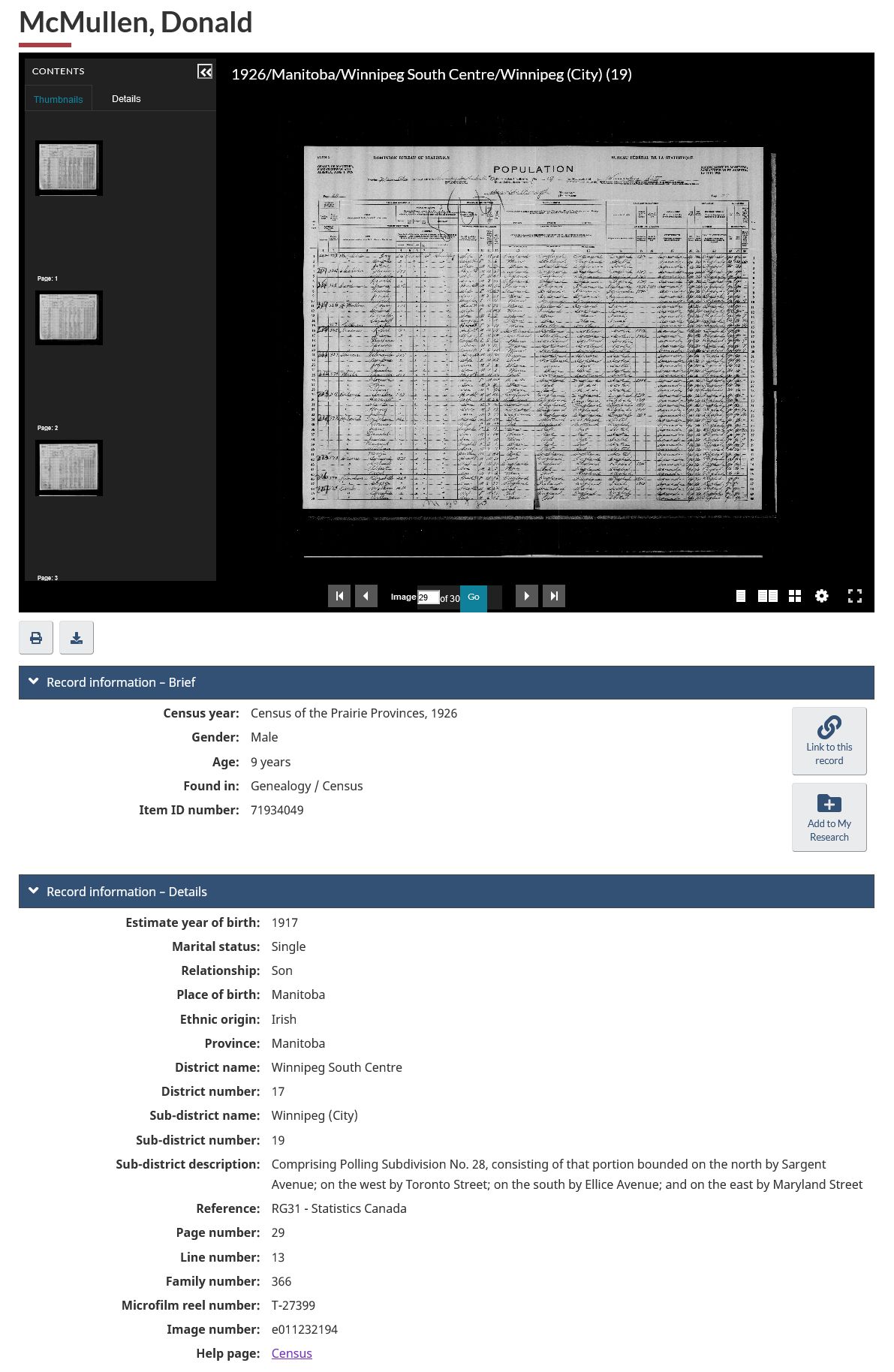
Screen capture of the Library and Archives Canada Census search details page of the "1926 (Prairies)" for Donald McMullen, age 9 years, in Manitoba, item ID number 7193049.

You can now view the image on your screen, print it on your printer, or download it to your computer.

If you choose to download the image to your computer you can either save just the page you at looking at as a JPG or save all the pages in that sub-district as a PDF. 

Census of the Prairie Provinces, 1926, Manitoba, enumeration district 17 Winnipeg South Centre, sub-district 19 Winnipeg (City), page 29; imaged, "Census search", Library and Archives Canada (http://central.bac-lac.gc.ca/.redirect?app=census&id=71934049&lang=eng : accessed 9 Jan 2025); citing ecopy number e011232194.

No matter what you choose to do, you can now review all the details recorded about the person for yourself. One detail that we don't find in the transcription is the address where the person was residing. This could be a street address for a town or city, or the section, township, range, and meridian that we can use to learn more about the property.

Have fun searching this census for your kin who resided in Manitoba, Saskatchewan, or Alberta in 1926!

Wednesday, March 6, 2024

Canadian Census Enumerator Instructions - Updated

Back in 2015 I wrote an article titled "Canadian Census Enumerator Instructions" which pointed folks to the instructions that the enumerators were supposed to follow (operative word here is "supposed"). Over the past 9 years we've had two more Canadian censuses released to the public, Library and Archives Canada has undergone a change to their site, and links to some of the instructions have broken. So here is an update to that article.

Seventh census of Canada 1931, instructions to commissioners and enumerators (Ottawa: F.A. Acland, Printer to the King's Most Excellent Majesty, 1931), cover page.

First of all, before pointing you to the enumerator instructions, I want to remind everyone to make sure you read all the way across the census page and look at each column. There can be important clues held within that we may be ignoring in our haste to move to the next record to locate. Details such as:

  • Were the children going to school? 
  • Did someone in the household have an infirmity? 
  • Was another language spoken in the household? 
  • Is there a note indicating the date and household where the enumerator stopped their work for the day?

In our review of the various columns we will come across abbreviations that might have us wondering things like what religion is "E.M.C." and what is that "U.C." recorded for the place of birth. My initial starting place to help me decipher those abbreviations is the "General census guide" page on Library and Archives Canada web site found under their "Census records" topic page. If you haven't done so lately, take the time to check out the various census related pages found under that topic page. There have been many changes and updates in the past few years.

As for the instructions to the enumerators, the "Pre-Confederation, 1825 to 1867", "Dominion of Canada, 1871 to 1931", and "Prairie Provinces Census, 1870-1926" pages on the Library and Archives Canada site all have columns with links pointing to where we can find the instruction. Some of these links will take you to the Act permitting the government to take the census.

In addition to the links provided by Library and Archives Canada, here the links to the same sorts of instruction manuals for the post Confederation enumerations of Canada mostly found on the Internet Archive:

There are also the surviving special nominal censuses of Manitoba, Saskatchewan, and Alberta that were taken between the censuses of the rest of the dominion:

Before Confederation in 1867 there were censuses taken of New Brunswick, Nova Scotia, Canada East, and Canada West. These censuses can vary greatly in terms of what was asked. For example, the Nova Scotia censuses prior to Confederation only include the name of the head of household

1851: 

1852 (Canada East/Canada West)

1861

You might have noticed that I also included the instructions for censuses that have not yet been released to the public. The images for those census won't be transferred from Statistics Canada to Library and Archives Canada until 92 years after the census date. However, now we at least know what questions were asked.

As always, make sure you save any of the PDFs to your computer for safe keeping. One never knows when a page or document will disappear from the Internet.

Monday, July 3, 2023

1931 Census of Canada - Do you have a radio?

In column 10 of Form 1A and Form 1B, the population schedules excluding the North West Territories, of the Seventh Census of Canada, 1931, we find an interesting question being asked:

"Has this family a radio?"

1931 Census of Canada, Ontario, district 127, sub-district 77, London, p. 5, extract of columns 3-10;digital images, Ancestry.com Operations, Inc., Ancestry (www.ancestry.com : accessed 26 Jun 2023); citing Library and Archives Canada folder T-27278.

This was the first and only time this question was asked in a census of Canada. Interestingly, this question was also asked in the Fifteenth Census of the United States, 1930 where in the "Home Data" section they asked "Radio set" in column 9.

So why did both Canada and the United States ask that question about having a radio?

Canadians are that time were wondering the same thing.

So on May 28, 1931 in The Lloydminster Times we find a write up titled "RADIO CENSUS".

"Radio Census," The Lloydminster Times, 28 May 1931, p. 8, col. 4; digital images, Newspapers.com https://www.newspapers.com/ : accessed 26 Jun 2023).

The column starts off explaining that it wasn't to locate people who have not paid for a radio receiving equipment license. The answers to this question, like all questions on Canadian censuses, are confidential until 92 years after the census was taken. All that the various government departments get are the compiled statistical results. The newspaper column went on to explain that the question was asked because the government was wanting to understand who had a radio. Nothing sinister at all.

Just a moment...you had to have a license to operate radio receiving equipment1 (AKA a radio) in Canada?

"License to Operator a Radio Receiving Equipment - Victoria, British Columbia - Canada 1924," digital image,Scripophily.com (https://scripophily.net/license-to-operate-a-radio-receiving-equipment-victoria-british-columbia-canada-1924/ : accessed 26 Jun 2023).

That was actually the case until 1953 when the Government of Canada finally dropped that requirement for folks to have a license to own a radio, and it was a license per radio at that, to listen to broadcasts of "The Happy Gang".

So if the government already knew who had a license, why ask this question on the census?

The license only told the government that a household had a radio and where. The neat thing about the census is that it asks all kinds of information. That other information can then be correlated and processed to create possibly interesting bits of information for future planning.

There is even a short report created in 1932 by the Dominion Bureau of Statistics using the information from the Seventh Census of Canada, 1931 titled "Radio Sets in Canada 1931" available for your reading enjoyment (or as an insomnia remedy aid). Note that this was a preliminary count of radios and differs from the final reports published in 1936. This 1932 report even breaks down where the radios are located based on the census districts and cities and the number of radios per 1,000 population. In Volume 1 of the Seventh Census of Canada, 1931 reports published in 1936 there are a few other tables included such as the one found on page 1404. Volume 5 of the reports also has a few tables breaking down radio ownership by household types.

Hopefully this answers the question of why folks in Canada were asked in the 1931 Census if the household owned a radio.


1. See the various articles on the RadioAlumni.ca site starting with "Remember When We Has Private Receiving Station Licenses ?" by W. J. Wilson for an interesting history on these licenses.


Sunday, June 11, 2023

1931 Census of Canada - Major City Street Indexes

As I keep digging deep into the Seventh Census of Canada, the one started on June 1, 1931, additional resources are starting to appear to make it just a little bit easier for us to find our kin.

On Friday, June 9, 2023, Ancestry published the first public version of their name searchable index for the 1931 Census of Canada. This index was created by Ancestry's Handwriting Recognition software. Of course, as with any transcription, there are challenge with reading the handwriting. So what if you can't find your ancestor using the name index, what else can you do?

I was creating a short presentation on the 1931 Census of Canada and was reviewing my material and all the pages I have stumbled upon over the past month on this topic. That is when I noticed the Library and Archives Canada Collections catalogue page "Census returns for the 1931 census [textual record (microfilm)]" had been updated with all kinds of potentially useful links.

One of them was a reference to Library and Archives Canada Finding aid 31-80 where there are the street indexes which may cover censuses from 1911 to 1941. If a person lived in one of the following cities, then we are in luck: 

For my great-grandfather, George Kaye Warrener, who ended up with the mangled transcription of "George Heryekaner", it took me about 40 minutes of manual searching for the street address of 28 Collahie in Toronto where he lived to find him on an image. I used Google Maps and the technique I talk about in my post "1931 Census of Canada - Success Stories". I've found that to be not too bad for a place like Toronto.

Ah, but what about using that street index finding aid?

Extract from Library and Archives Canada Finding aid 31-80 for Collahie in Toronto.

In the extract above we see that Collahie in Toronto has four entries:

  • 11-128-104
  • 21-113-52
  • 31-138-53
  • 41-163-6

The first set of digits is the census year. So I would want to look at the entry "31-138-53" for the 1931 Census of Canada.

The next set of digits is the district number, 138, followed by the sub-district number, 53.

But the districts listed on the Library and Archives Canada 1931 Census search page and in Ancestry's "1931 Census of Canada" collection only list the district by name. How does one map a district number to a name?

That information is also found in Finding aid 31-80. Those pages have been extracted and are available in PDF form so that we can even download and save the files to our computer:

In looking in the PDF for Ontario I find that district number 138 is the Parkdale district.

Now I can quickly browse the images on Ancestry or LAC for the Province of Ontario, Parkdale district, and select sub-district 53 from the list. Then just skip through the pages until I find Collahie listed as the street address.

Total time using the street address to find George Kaye Warrener using the street index this time? Less than 5 minutes!

Keep in mind that some streets may be found spanning multiple sub-districts or even districts. College street is one such place in Toronto. So you will need to look at multiple locations to find the right range of street numbers. Yet this street index really does make it much easier to find the possible district and sub-district for a street address.

Best of luck in your searches!


Friday, June 9, 2023

1931 Census of Canada - Initial Searchable Index

On June 1st, 1931 the enumerators of the the seventh census of Canada began their work throughout most parts of Canada. 

Jump ahead to June 1st, 2023 and the surviving information that was gathered, the population schedule on Form 1, was now available to all who wanted to take the time to wade through the images to find their ancestors. The release of those images didn't go as smoothly as hoped since there were a number of issues with the Library and Archives Canada web site during those first two days. By the morning of June 2nd, Ancestry had finished processing and loading those same images into their system so that we could view them, thus taking the pressure off LAC.

In just over a week from the time that Ancestry had first started receiving the images of the 1931 Census of Canada from Library and Archives Canada just after midnight on June 1st, Ancestry has the first public version of their searchable index ready for our use. Ancestry, along with FamilySearch, will be working hard in the coming weeks and months to improve the accuracy of the information extracted and to add more information to those indexes just like what we see for the indexes in the 1921 Census of Canada.

You can find the "1931 Census of Canada" collection and the associated searchable index on Ancestry at https://www.ancestry.ca/search/collections/62640/.

Partial screen capture of the "1931 Census of Canada" search page from Ancestry (https://www.ancestry.ca/search/collections/62640/ : accessed 9 Jun 2023).

In looking at the updated search page for the 1931 Census of Canada we find that we can search by name, birth year, where the person is living, associated family members, "relation to head", marital status, sub-district number, enumeration district, and gender. This index was effectively created by computer algorithms (AI in the marketing world) using Ancestry's Handwriting Recognition software to attempt to read what the enumerators had written down.

If you want to learn more about Ancestry's Handwriting Recognition technology and it's use in transcribing the census, you can watch their approach to the 1950 Federal Census of the United States of America, which was done last year, in their view "Teaching a Computer to Read the 1950 U.S. Census | Ancestry®".

Here is a screen capture from the 1931 Census of Canada on Ancestry with all the details open for a specific person. Yes, it is a busy screen but I'm used to it.

Screen capture of the web page from Ancestry Canada showing the 1931 Census of Canada page for Ontario, Parkdale district, sub-district 53, page 10 with "George Heryekaner" selected.

I chose this screen capture of "George Heryekaner" as my example of what we can see for a very specific reason. I'd already found him through manually looking through the censuses. He is my great-grandfather. But his name isn't "George Heryekaner" but "George Kaye Warrener". And his son isn't "Nancy" but is written as "Ronald Macgregor". OK, even I had a challenge reading the "Macgregor" part. The computer did do a good job on reading "Henriette" and "Lilian"...so kudos to our future AI Overlords.

1931 Census of Canada, Winnipeg, district 138 (Parkdale), sub-district 53 (Toronto City Ward 6), p. 10, dwelling 87, family 126, household of George Heryekaner; RG 31; digital images, Ancestry Operations, Inc., Ancestry.ca (https://www.ancestry.ca/search/collections/62640/ : accessed 3 Jun 2023).
1931 Census of Canada, Winnipeg, district 138 (Parkdale), sub-district 53 (Toronto City Ward 6), p. 10, dwelling 87, family 126, extract of household of George Heryekaner; RG 31; digital images, Ancestry Operations, Inc., Ancestry.ca (https://www.ancestry.ca/search/collections/62640/ : accessed 3 Jun 2023).

When I first saw George's name recorded in the census I knew that the computer would have a fit trying to transcribe his name. And I was right! Now I thought it might guess the last name as "Kaye Warrener" or "Haye Warrener" or just "Kaye" or "Haye". However, I was wrong as to what the attempt at reading the handwriting came up with.

If I hadn't known where George and the family was living I probably would never have found him in the index. The handwriting by the enumerator is, to put it kindly, challenging. Fortunately, just like many of the other transcriptions made of records by Ancestry, we can submit our own corrections to the name and select fields. I have now added my own suggested corrections to the transcription of the 1931 Census of Canada for this family.

Contrast the handwriting above with the penmanship by the enumerator in sub-district 29 (London City Ward 4), London district, Ontario:

1931 Census of Canada, district 127 (London), sub-district 29 (London City Ward 4), p. 1, dwelling 12, family 14, extract of household of Nathaniel McKinlay; RG 31; digital images, Ancestry Operations, Inc., Ancestry.ca (https://www.ancestry.ca/search/collections/62640/ : accessed 8 Jun 2023).

Here the computer had no problems reading the handwriting. 

1931 Census of Canada, district 127 (London), sub-district 29 (London City Ward 4), p. 1, dwelling 12, family 14, transcription for the entry of Nathaniel McKinlay; RG 31; digital images, Ancestry Operations, Inc., Ancestry.ca (https://www.ancestry.ca/search/collections/62640/ : accessed 8 Jun 2023).

As you can well imagine, this first public release of the index from Ancestry will have it's challenges. That is why it is still important to know how to actually find an address in the census and not just rely on a computer to do the work for you. I look at using our research skills to look for someone by address in my post "1931 Census of Canada - Success Stories".

So set your expectations appropriately. The computer can't perform miracles when the handwriting is not great. Yet having the ability to search by name for folks in the 1931 Census of Canada will allow us to deal with the low hanging fruit so that we can focus our research skills on those we can't easily find.

Have fun searching!


Saturday, June 3, 2023

1931 Census of Canada - Success Stories

It has been an interesting and challenging time for all involved with the public release of the 1931 Census of Canada by Library and Archives Canada on June 1, 2023. What started with joy and happiness quickly turned to sadness and frustration for the genealogy and family history community as issues on the Library and Archives Canada site prevented many from even trying to view the images. Yet I'm not going to harp on those issues since I've already done so in my post "1931 Census of Canada - A Release Fiasco?" Instead I'm going to share my own success stories and some tips on how I found the kin I was looking for.

Screen capture of the Library and Archives Canada 1931 Census Collection Search page on 3 Jun 2023 at 12:23 p.m. ET.

My goal was to to find all four of my grandparents in this census. I knew that they were all alive and residing in Canada by the end of 1930. So, in theory, this goal should be achievable. Having a goal or task being achievable is one of the elements I mentioned in being Genealogy SMART, a post from July 2019:

  • Specific: I want to find my four grandparents in the 1931 Census of Canada.
  • Measurable: By the end of the process I should be able to count how many of the grandparents I have found. Hopefully all four of them.
  • Achievable: Since the images of the 1931 Census of Canada have been released, I believe it should be possible to find my grandparents.
  • Relevant: Finding them in the census will help me understand where they lived and how they were doing, economically, in 1931.
  • Timely: The census was just released and is available for our use.

First of all, since the images of the 1931 Census of Canada aren't yet searchable by personal details such as names or street address I had to do some work ahead of time to learn exactly where they were living. I just can't plunk their names in a search engine and have the computer spit out the answers. It's going to take a bit of work on our part. The more work we do before even looking at the images should save us time in the long run.

All of my grandparents decided that they would be living in moderate to large cities in 1931 to make it a bit more challenging for me. I know that others who have also had success stories have been able to very quickly find their kin since those folks were living in rural areas or small towns and villages.

Here are family groupings for my grandparents, along with what I discovered in this step. Note that some of this information was gathered while actually in the searching for the census records. I really should have done all this work ahead of time!

  • Nathanial and Winnifred (nee Warrener) McKinlay
    • They were married in 1930 in Toronto
    • In the 1932 city directory of London, Ontario they reside at 579 Colborne Street1
  • Donald McMullen
    • He had not yet married Frances Howe
    • In the 1926 Census of the Prairie Provinces of Canada in the Winnipeg South Centre district he was living with his parents Louis Norman and Gertrude Anne (nee Martin) McMullen at 521 Toronto Street, Winnipeg2
    • In the 1932 city directory of Winnipeg, Manitoba no Donald McMullen was found listed but his father is recorded as "McMullen L N  druggist Wpg Drug h 9, 796 Wolseley"3
  • Frances Howe
    • She had not yet married Donald McMullen
    • In the 1926 Census of the Prairie Provinces of Canada in the Winnipeg South Centre district she was living with her parents Joseph and Annie (nee Chipman) Howe at  what appears to be 72 Walnut Street, Winnipeg4. However, the 1927 city directory gives their address as 72 Chestnut Street5.
    • In the 1932 city directory of Winnipeg, Manitoba no Frances Howe was found but her father is recorded as "Howe Joseph E asst prof Univ Man h 72 Chestnut"6

You might notice that I reference the 1932 city directories. Most directories weren't published the same year the information was collected so I will often use the following year's directory.

Also I recorded the district (in some cases when I was getting frustrated that I couldn't find them in the 1931 Census) they we found in for the prior census closest to the 1931 Census. This might help me figure out where I should start my looking in the 1931 Census, especially when it comes to large cities.

Since I'm dealing with moderate to large cities I also used Google Maps to place each street address on a map. This became important as I worked my way through the images.

I thought I was ready to begin my search on June 1st, 2023...but the Library and Archives Canada site had another opinion. But I did have a workaround. It was a bit more work but doable.

I started with Nathaniel and Winnifred McKinlay. Based on where I found them on the map I started with the assumption that they were in the London district and not Middlesex East or Middlesex West. Via another site I had a possible lead that the address, 579 Colborne Street, might be in sub-district 17 so I started there. After scanning the eighteen pages I didn't find them.

This is where using Google Maps became useful. With 579 Colborne Street pinned on the map I had Google Maps give me directions to the first address in sub-district 17, 290 Cheapside.

Screen capture from Google Maps for directions from 290 Cheapside Street to 579 Colborne Street in London, Ontario.

Why map the directions? As I came across the next sub-district I could put in an address from one of the pages to see if I was getting any closer to my target address. I might even jump ahead a few sub-districts and see about getting directions. By doing this I could also figure out how the sub-districts were roughly laid out.

Since I was using a workaround method which was a bit slower than just clicking the next image it did take me a bit of time. But after about 178 images I found my Dad's parents, Nathaniel and Winnifred (nee Warrener) McKinlay on page 1 in sub-district 29!

1931 census of Canada, Ontario, district 127 (London), sub-district 29 (London City Ward 4), p. 1, dwelling 12, family 14, household of Nathaniel McKinley; RG 31; digital images, Library and Archives Canada (https://recherche-collection-search.bac-lac.gc.ca/eng/census2/index1931 : accessed 1 Jun 2023).

Since I'm a persistent (some may call it stubborn) researcher, I tried my luck finding my grandmother Frances Howe. This was a bit harder since I hadn't written down in my pre-search notes the district name from the 1926 Census of the Prairie Provinces of Canada yet. 

This bit me big time!

I spent way too much time looking in the wrong districts because of an assumption. I first looked in Winnipeg North and Winnipeg North Centre since I assumed that the Assiniboine River would be the district boundary. But when I plotted the various address I was seeing in the sub-districts for those districts they were all too far away from 72 Chestnut Street and getting further away. That's when I clued in to look at the 1926 Census of the Prairie Provinces of Canada all thanks to a suggestion by Dave Obee in his CanGenealogy 1931 census research tips page.

They were in the Winnipeg South Centre district in 1926! Once I started getting directions from 72 Chestnut Street to addresses for the sub-districts in that district plotted on the map everything started to work out much, much better. Relatively quickly I was able to find Frances and her parents.

1931 census of Canada, Winnipeg, district 189 (Winnipeg South Centre), sub-district 51 (Winnipeg Ward 1), p. 7, dwelling 58, family 59, household of Joseph Howe; RG 31; digital images, Library and Archives Canada (https://recherche-collection-search.bac-lac.gc.ca/eng/census2/index1931 : accessed 2 Jun 2023).

It was getting late, I was tired, and I'd already had enough challenges on the launch day while also providing guidance and tips to others via several Facebook groups. So I decided to leave looking for my other grandparent, Donald McMullen, until the daylight hours of June 2nd.

At around 11 am on June 2, 2023 Ancestry released their copies received from Library and Archives Canada and posted the images in their "1931 Census of Canada" browse only collection and the game suddenly changed for me. 

Screen capture from Ancestry's "1931 Census of Canada" collection search page found at https://www.ancestry.ca/search/collections/62640/.

I didn't have to deal with a slow or non-functioning LAC site. Since Ancestry had already gone through the experience of hosting the images of the 1950 Federal Census of the United States of America I figured they could deal with any amount of traffic created by Canadian researchers.

Using all the tricks I'd learned I knew I should be able to find Donald and his parents in short order.

I decided I'd first plot both where Frances Howe, his future wife, and Donald McMullen lived since I could possibly use her address as starting point.

Screen capture from Google Maps for directions from 72 Chestnut Street to 796 Wolseley Avenue in Winnipeg, Manitoba.

They are practically neighbours! According to the map, they were about a minute walk apart.

In just a few minutes I found the household of Donald's parents, Louis and Gertrude (nee Martin) in the next sub-district, number 52, from Frances Howe and her parents.

1931 Census of Canada, Winnipeg, district 189 (Winnipeg South Centre), sub-district 52 (Winnipeg Ward 1), p. 12, dwelling 110, family 140, household of Louis McMullen; RG 31; digital images, Ancestry Operations, Inc., Ancestry.ca (https://www.ancestry.ca/search/collections/62640/ : accessed 2 Jun 2023).

I had actually completed my goal of finding my grandparents in the 1931 Census of Canada.

I won't bore you with the challenges I had finding Elizabeth (nee Murdoch) McKinlay, my great-grandmother, in London, Ontario. But I can tell you that it is really, really important to be not distracted when looking at the images. I missed her at least two times!

The one I dreaded finding was the household of George Kaye and Henrietta (nee McGregor) Warrener, my great-grandparents, in Toronto. With Toronto being so large I thought it would be a near impossible task. Yet I found them in about 40 minutes (again a wrong assumption got me for about 10 minutes of that time).

I still have a few great-grandparents to find but now that I have a working method it shouldn't be to much of a challenge (I know, Murphy's Law is just waiting in the wings).

My tips to you:

  • Do your searches when you won't get distracted!
  • Have a plan.
  • Gather as much information about where the person was living around 1931 
    • Use city directories for 1931 and 1932
    • The 1935 Voters' Lists might help if you believe they stay in the same home since 1931
    • Use the prior census to see what district and even sub-district that street or place was listed in. The person might not even be in Canada at that time but knowing the district and sub-district may help reduce the number of pages to look at in a large city.
  • For a large city, make use of Google Maps to help figure out if you are getting closer to the street address you want to find
  • Use the images from Ancestry. Their images load so much faster than the copies on the LAC site. Plus their filmstrip found at the bottom of their image screen makes it a breeze to move to the next sub-district
  • Don't get stressed out trying to find your kin. Genealogy and family history research is supposed to be fun. You might even think about waiting until a searchable name index is available.

Good luck in your searches!


1. Vernon Directories Limited, Vernon's City of London (Ontario) Directory for the Year 1932 (Hamilton, Ontario: Vernon Directories Limited, 1932),  370, entry for McKinlay Nathnl (Winnifred). 

2. 1926 Census of the Prairie Provinces of Canada, Manitoba, district 17, sub-district 19, Winnipeg, p. 29, dwelling 219, family 366, Donald McMullen; RG 31; digital images, Library and Archives Canada, Library and Archives Canada (www.bac-lac.gc.ca : accessed 30 Apr 2020); citing Library and Archives Canada microfilm T-27399.

3. Henderson Directories Limited, Henderson's Winnipeg Directory 1932 (Winnipeg, Manitoba: Henderson Directories Limited, 1932), 935, entry for McMullen L N.

4. 1926 Census of the Prairie Provinces of Canada, Manitoba, district 17, sub-district 21, Winnipeg, p. 7, dwelling 71, family 75, Frances Howe; RG 31; digital images, Library and Archives Canada, Library and Archives Canada (www.bac-lac.gc.ca : accessed 5 Jan 2021); citing Library and Archives Canada.

5.  Henderson Directories Limited, Henderson's Winnipeg Directory 1927 (Winnipeg, Manitoba: Henderson Directories Limited, 1927), 943, entry for Howe Joseph E.

6.  Henderson Directories Limited, Henderson's Winnipeg Directory 1932 (Winnipeg, Manitoba: Henderson Directories Limited, 1932), 817, entry for Howe Joseph E.