Showing posts with label Internet Archive. Show all posts

Wednesday, January 21, 2026

Using the OLRI in Ontario Land Research

This past weekend, the Toronto Branch of the Ontario Genealogical Society presented "A Celebration for the OLRI". The recordings of that event are now available to watch on their page "A Celebration for the OLRI: Recordings" and, if you have tried to do any land research in Ontario, I strongly recommend that you watch the videos to pick up some really good tips and tricks. In my own 25 minute talk, "OLRI to the Rescue", I gave two examples where I used the Ontario Land Records Index to find in a specific collection that is found digitized on FamilySearch.

However, I know that some folks prefer reading how to do something instead of watching and re-watching a presentation multiple times, so here is another example of how we can connect the various Ontario land records together that are available online for free.

This is part of what came to me via an email and it was just enough of a challenge for me that I thought it deserved a blog post. Please keep in mind that I will often just point you to the collections and my "Finding on the Ground" series of blog posts. So, please don't inundate me with requests for assistance or else I will have to start charging for the help I've freely given over the years.

"I want to find the original patent documents. I have looked in the Land Petitions of Upper Canada, 1763-1865 on LAC for him but have not found his entry. I used variations of his names, and also searched everyone who patented land in Sullivan, but he is still not coming up. 

Do you have any advice on where to find his patent info? This is my first foray into this record set.
"

They also provided the image from the Abstract Register found on FamilySearch. I really liked that since the image provided key details I could use to confirm what I was seeing in the other records.

Registrar of Deeds for Grey County (Ontario), Abstract register for Sullivan Township, vol. 1, p. 2, Division 2, Lot No. 3, Concession 1, patent entry for Edward Elliott dated 10 Jul 1849, "Abstract index books, ca. 1832-1958", FamilySearch, (https://www.familysearch.org/ark:/61903/3:1:3Q9M-CSVG-GSNL-8 : accessed 21 Jan 2026), image group number (IGN) 8129790 > image 8 of 550.
Registrar of Deeds for Grey County (Ontario), Abstract register for Sullivan Township, vol. 1, p. 2, Division 2, Lot No. 3, Concession 1, patent entry for Edward Elliott dated 10 Jul 1849, "Abstract index books, ca. 1832-1958," imaged, FamilySearch, (https://www.familysearch.org/ark:/61903/3:1:3Q9M-CSVG-GSNL-8 : accessed 21 Jan 2026), image group number (IGN) 8129790 > image 8 of 550.

My first assumption, and we all know that assumptions are not a good thing, is that they are not looking for the land patent records but the petition records since they mention searching the Land Petitions of Upper Canada found on the Library and Archives Canada site. If they are looking for the patent paperwork, they would have to visit the Archives of Ontario in Toronto to go through the microfilms since they aren't digitized.

What do we know from the abstract register entry?

We see that Edward Elliott was granted letters patent on 10 Jul 1849 for Lot 3 located in the 2nd Division on Concession 1 in the Township of Sullivan.

Using the Ontario Land Records Index, OLRI, found digitized on the Internet Archive we can browse digitized fiche either by the township index or nominal index. If I have a location I will generally start with that since the person who received the letters patent might not have been the person who was originally allotted the lot.

Once I get into either the Nominal Index or Township Index collection, I will always re-sort the fiche sheets by the "Title" since the default is by weekly views and I don't really care which fiche were looked the most. By re-sorting the list of fiche I can quickly find that "OLRI Township Index: Fiche 60 Stephen-Sydenham" should have Sullivan Township.

Then it's just looking through the digitized images of the fiche to find the image with Sullivan Township, Concession 1, Lot 3, Division 2.

Ontario Land Records Index, Township Index, Sullivan Township, p. 2221, Internet Archive, (https://archive.org/details/olri_township-index_060_stephen-sydenham/page/n185/mode/2up : accessed 21 Jan 2026), Township Index > Fiche 60 Stephen-Sydenham > image 186 of 270; citing the Archives of Ontario, Toronto, Ontario.
Ontario Land Records Index, Township Index, Sullivan Township, p. 2221, imaged, Internet Archive, (https://archive.org/details/olri_township-index_060_stephen-sydenham/page/n185/mode/2up : accessed 21 Jan 2026), Township Index > Fiche 60 Stephen-Sydenham > image 186 of 270; citing the Archives of Ontario, Toronto, Ontario.

We can see that the fourth entry from the bottom has the following details:

  • Township/Town/City: Sullivan
  • Lot: 3 in 2 Div
  • Concession: 1
  • Date ID: 8
  • Issue Date: 18490413 [13 Apr 1849]
  • Trans Type: FG
  • Type FG: AA
  • Name of Locatee: Elliot Edward [last name followed by the first name]
  • Archival Reference: RG 1 CI3 Series Vol. 149, page 14

To decipher some of those codes we need to take a look at the OLRI Fields and Codes finding aid (the French version is here).

The "Date ID" of 8 means that it was issued via an Order-in-Council. That means we should probably be able to find the petition in the Upper Canada Land Petitions on the Library and Archives Canada site. The "Trans Type" of "FG" tells us that it was a "Free Grant" but administrative fees may have been charged. And the "Type FG" of "AA" means that it was "Gratuitous—free grants to individuals who were (a) judged destitute by a government board and/or (b) had all their administrative fees waived."

We also get the old Archives of Ontario reference details. Many, but not all, of those files have been digitized and placed online on FamilySearch in their "Land records, ca. 1792-1876" collection. In the past, I used to dread having to use this collection since, before the digitization of the OLRI and also the Full Text Search feature on FamilySearch, I had to first find the name indexes for the various sets of volumes, then the register pages, and hopefully finally the images of the fiats or warrants. It sometimes took hours of browsing the images to find that one nugget.

To find out if the reference is on FamilySearch, have to go to the Archives of Ontario in Toronto, or request an interlibrary loan of a microfilm we can look in the OLRI Archival References document (French version) to see if there is an entry in the "FamilySearch DGS" column for that series and volume.

Just a heads up, that "CI3" is not "See One Three" but "See Eye Three".

In that OLRI Archival References document for RG 1 C-I-3 Volume 149, we learn that it is:

  • found on the Archives of Ontario microfilm MS 693 Reel 153,
  • the new reference in the archive is RG 1-155-2-1,
  • found on FamilySearch microfilm number 1376110;
  • found on FamilySearch DGS (Image Group Number) 8126225.

Awesome, we can view it from home! 

In the FamilySearch "Land records, ca. 1792-1876" collection created by the Crown Lands Department of Ontario we see that Image Group Number (DGS) 8126225 is described as "Fiats - A.A. (v. 148-149) bundle 401-646, 1851-1869, ca. 1846-ca. 1870 (includes index to 367-646)". In this case, we have to scroll through the images a fair bit before we get to the start of the volume described as "R.G. 1, C-I-3, VOL. 149 REGISTER FIATS - A.A., FIATS 367-646". For this register, they included a name index so we have to scroll past them to get to the register pages to locate page 14 of the register.

Crown Lands Department (Ontario), RG 1, C-I-3, Vol. 149, Register for Fiats - AA, p. 14, “Land records, ca. 1792-1876”, FamilySearch, (https://www.familysearch.org/ark:/61903/3:1:3Q9M-CSVK-TCBV-L : accessed 21 Jan 2026), image group number (IGN) 8126225 > image 676 of 938; citing Archives of Ontario, Toronto, Ontario.
Crown Lands Department (Ontario), RG 1, C-I-3, Vol. 149, Register for Fiats - AA, p. 14, “Land records, ca. 1792-1876,” imaged, FamilySearch, (https://www.familysearch.org/ark:/61903/3:1:3Q9M-CSVK-TCBV-L : accessed 21 Jan 2026), image group number (IGN) 8126225 > image 676 of 938; citing Archives of Ontario, Toronto, Ontario.

Edward Elliot is the first name for the entries in Sullivan Township and all the location details match what was found in the Abstract Register and in the OLRI. In the column before the number 1211 for the Description number is the date of the Order-in-Council which is 13 Apr 1849. That's the "Issue Date" in the OLRI. However, what is interesting (at least to me) is that there are a number of names associated with number 384 in the first column, the Fiat Number. So it would appear that maybe one petition was made on behalf of a number of folks. So that might explain why we couldn't find a petition under Edward Elliot's name.

When it comes to the fiat and warrant books held by the Archives of Ontario and found digitized on FamilySearch, we need to realize that the indexes and registers come after the volumes they reference.

For those "A.A." fiats that are mentioned in volume 149 we will need to look in volumes before and the correct digitized microfilm that has fiat in question. In this case, it is the microfilm described as "Warrants, etc., (v. 147-148) bundle 101-400, 1820-1851" on FamilySearch which is on Image Group Number (DGS) 8346087.

It didn't take me too long to find the start of Fiat 384 A.A. on image 1100 of 1160:

Crown Lands Department (Ontario), RG 1, C-I-3, Vol. 148, Warrants, Fiats Bundle 301-400, Fiat 384 A.A., “Land records, ca. 1792-1876”, FamilySearch, (https://www.familysearch.org/ark:/61903/3:1:3Q9M-CSTB-2S81-Q : accessed 21 Jan 2026), image group number (IGN) 8346087 > image 1100 of 1160; citing Archives of Ontario, Toronto, Ontario.
Crown Lands Department (Ontario), RG 1, C-I-3, Vol. 148, Warrants, Fiats Bundle 301-400, Fiat 384 A.A., “Land records, ca. 1792-1876,” imaged, FamilySearch, (https://www.familysearch.org/ark:/61903/3:1:3Q9M-CSTB-2S81-Q : accessed 21 Jan 2026), image group number (IGN) 8346087 > image 1100 of 1160; citing Archives of Ontario, Toronto, Ontario.

There we see that it was approved by an Order-in-Council on 13 Apr 1849 and it was for "Alexander McLaren & others". When I did a search for any Alexander McLarens in the Library and Archives Canada "Land Petitions of Upper Canada, 1763-1865" database, I didn't find any from 1849.

Yet it was the next image that had the clue I was looking for.

Crown Lands Department (Ontario), RG 1, C-I-3, Vol. 148, Warrants, Fiats Bundle 301-400, Fiat 384 A.A., “Land records, ca. 1792-1876”, FamilySearch, (https://www.familysearch.org/ark:/61903/3:1:3Q9M-CSTB-2S81-Q : accessed 21 Jan 2026), image group number (IGN) 8346087 > image 1101 of 1160; citing Archives of Ontario, Toronto, Ontario.
Crown Lands Department (Ontario), RG 1, C-I-3, Vol. 148, Warrants, Fiats Bundle 301-400, Fiat 384 A.A., “Land records, ca. 1792-1876,” imaged, FamilySearch, (https://www.familysearch.org/ark:/61903/3:1:3Q9M-CSTB-2S81-Q : accessed 21 Jan 2026), image group number (IGN) 8346087 > image 1101 of 1160; citing Archives of Ontario, Toronto, Ontario.

There it stated, "Confirming Locations Owen Sound Settlement Garrafraxa Rd".

The rest of the pages from that fiat included all the names for this settlement.

When I went back to LAC "Land Petitions of Upper Canada, 1763-1865" database and searched for "Owen Sound" as an exact phrase and the date 1849 I got one entry:

  • Year: 1849
  • Place of registration: Owen Sound
  • Reference: RG 1 L3, Volume 396A
  • Bundle: O 5
  • Petition: 13
  • Microfilm: C-2487
  • Hierarchical level: File
  • Type of material: Textual material
  • Found in: Genealogy / Land / Land Petitions of Upper Canada, 1763 to 1865
  • Item ID number: 51910

I could use the "Upper Canada Land Petitions - Microform digitization" on the LAC site, but I also know that FamilySearch has a number of these microfilms digitized in their "Petitions for land grants and leases, 1791-1867" collection and, honestly, I prefer the navigation tools on FamilySearch over that archived microform system on the Library and Archives Canada site if I can access the digitized microfilm from home. Fortunately for me, microfilm C-2487 is available on FamilySearch in Image Group Number (DGS) 8630347 and is accessible without braving the cold to visit my closest FamilySearch Affiliate or using the LAC site.

To say it was underwhelming when it came to details was an understatement since all we got were two pages with little detail except that yes, it was approved in council on 13 Apr 1849.

Upper Canada Land Petitions, “O”, Bundle 5, 1848-1850, RG 1 L3, vol. 396(a), petition 13, FamilySearch (https://www.familysearch.org/ark:/61903/3:1:3Q9M-C3H4-MSPG-K : accessed 21 Jan 2026), image group number (IGN) 8630347 > image 670 of 1282; citing Library and Archives Canada, microfilm C-2487.
Upper Canada Land Petitions, “O”, Bundle 5, 1848-1850, RG 1 L3, vol. 396(a), petition 13, imaged, FamilySearch (https://www.familysearch.org/ark:/61903/3:1:3Q9M-C3H4-MSPG-K : accessed 21 Jan 2026), image group number (IGN) 8630347 > image 670 of 1282; citing Library and Archives Canada, microfilm C-2487.
Upper Canada Land Petitions, “O”, Bundle 5, 1848-1850, RG 1 L3, vol. 396(a), petition 13a, FamilySearch (https://www.familysearch.org/ark:/61903/3:1:3Q9M-C3H4-MSP8-9 : accessed 21 Jan 2026), image group number (IGN) 8630347 > image 671 of 1282; citing Library and Archives Canada, microfilm C-2487.
Upper Canada Land Petitions, “O”, Bundle 5, 1848-1850, RG 1 L3, vol. 396(a), petition 13a, imaged, FamilySearch (https://www.familysearch.org/ark:/61903/3:1:3Q9M-C3H4-MSP8-9 : accessed 21 Jan 2026), image group number (IGN) 8630347 > image 671 of 1282; citing Library and Archives Canada, microfilm C-2487.

I even checked the Upper Canada Land Books for the minutes of the meeting on 13 Apr 1849 but they didn't have much more.

Upper Canada Land Books, Book E, p 697, Minutes of 13 Apr 1849 meeting, CRKN Héritage, (https://heritage.canadiana.ca/view/oocihm.lac_reel_c108/697 : accessed 21 Jan 2026), microfilm C-108 > image 697 of 1056; citing Library and Archives Canada.
Upper Canada Land Books, Book E, p 697, Minutes of 13 Apr 1849 meeting, imaged, CRKN Héritage, (https://heritage.canadiana.ca/view/oocihm.lac_reel_c108/697 : accessed 21 Jan 2026), microfilm C-108 > image 697 of 1056; citing Library and Archives Canada.

We can't forget to check the Township Papers collection from the Archives of Ontario that can be found on FamilySearch in two separate collections with the same name:

To find the correct digitized film on FamilySearch, I always visit Jane MacNamara's "Where the story takes me..." and check her "Ontario Township Papers: How to find them" post to save me a bunch of frustration. In short order I found that I probably should be able to find any documents for that lot in Sullivan Township on Image Group Number (DGS) 8347285.

With a little bit of effort I found the file for Lot 3 on Concession 1. Within the file starting at image 386 of 1019 on the digitized microfilm I came across a copy of the grant document issued to Edward Elliot.

Crown Lands Department (Ontario), RG 1 Township Papers, Sullivan, Lot 2, Con. 1 to Lot 30, Con. 6, Sullivan Township, Concession 1, Lot 3, Grant issued to Edward Elliott, imaged, “Township papers, ca. 1783-1870's”, FamilySearch, (https://www.familysearch.org/ark:/61903/3:1:3Q9M-CSY9-GCR4 : accessed 16 Jan 2026), image group number (IGN) 8347285 > image 387 of 1019; citing Archives of Ontario
Crown Lands Department (Ontario), RG 1 Township Papers, Sullivan, Lot 2, Con. 1 to Lot 30, Con. 6, Sullivan Township, Concession 1, Lot 3, Grant issued to Edward Elliott, imaged, “Township papers, ca. 1783-1870's”, FamilySearch, (https://www.familysearch.org/ark:/61903/3:1:3Q9M-CSY9-GCR4 : accessed 16 Jan 2026), image group number (IGN) 8347285 > image 387 of 1019; citing Archives of Ontario.

That's actually a pretty neat find and does sort of answer the original question, even if by accident! 

Except for the entry in the Abstract Register, all of these discoveries came about due to using the Ontario Land Records Index that we know find in digitized format on the Internet Archive. In total, it probably took me about an hour to locate all of these digitized documents — all without leaving the comfort of my home and braving the cold winter weather in Ottawa.

So, when looking for the documents concerning settlement of land in Ontario, especially when it comes to the folks who received the letters patent from the government, don't forget to check the digitized fiche of the Ontario Land Records Index to help you locate the warrants and fiats.


Tuesday, October 7, 2025

OLRI Now Digitized

In the Saturday, October 4, 2025 edition of the Ontario Ancestors eWeekly Update, it was announce that the Ontario Land Records Index had been digitized and can be found on the Internet Archive in their Ontario Land Records Index collection. Jane E. MacNamara wrote a guest post for the Internet Archive Canada making the announce of this important release at Now Online! Ontario Land Records Index.

These sorts of digitization projects take a number of folks to make it happen. To put the OLRI into a digital format and place it online took a number of partners:

Additionally there were key folks that Jane mentions in her announcement that performed that valuable task of fixing up the file names so we could actually use the digitized fiche in a manageable way.

What did we get from this project?

First of all, this isn't a plug in a name and the computer will magically bring us to the page with the name on it. This is the digitized representation of the pages of the fiche from the Archives of Ontario. We need to treat it as such but without the annoyance of finding a place with the OLRI and a working microfiche reader. We will be looking through the sheets and pages to find the information.

The digitized nominal index came from 53 sheets of fiche and the township order index from 75 sheets of fiche. You might think that that's not too many sheets to image. However, unlike microfilm which is one continuous roll of images, each fiche sheet can contain up to 270 very tiny pages. That can make it a bit more complicated to scan for digitization as can be seen in this 2-hour YouTube video of the Internet Archive doing microfiche scanning. For the OLRI, that's about 34,000 images to process!

Just what is this index and why is it so valuable for those researching their Ontario roots?

As Jane wrote in her guest post, this "is an index to those settlers who were allocated Crown land in Upper Canada/Canada West/Ontario." It was compiled in the 1970s by the Archives of Ontario and published in 1979. For many of us who have used the OLRI in the past, we quickly became familiar with the fiche found in the various archives and libraries that was so often scratched up from use over the years. Just as importantly, we knew which institutions had working microfiche readers.

When using the Ontario Land Records Index on the Internet Archive, at this time I recommend that when you get to the "Ontario Land Records Index" page, to select either the "Township Index" if you know where your person resided or the "Nominal Index" if you don't.

Next, click on "Title" in the "Sort by" menu bar. This will organize the sheets in an alphabetical order so that Fiche 04 comes after Fiche 03. Otherwise, the default sort is by the number of weekly views and that will really annoy you when trying to find that one sheet for "Bennet Rich J - Boulton Dary Edward" that is Fiche 04.

We also need to keep in mind that the OLRI is exactly what its name implies. It is an index.  

Image of a page from the Ontario Land Records Index Township Index, pages 4049-4070
Archives of Ontario, "Ontario Land Records Index," Alphabetical Listing by Township/Town/City, Fiche 19 Douro-Dungannon, p. 4069-4070, Drummond; digital images, Internet Archive (https://archive.org/details/olri_township-index_019_douro-dungannon/page/n169/mode/2up : accessed 7 Oct 2025).

Here we can see the page from the alphabetical listing by township/town/city, AKA Township Index, for Drummond Township in Lanark County that has my 4th great-grandfather, Alexander Fraser, listed on it. How do I know that this is my Alexander Fraser and not the Alexander Fraser who lived about a dozen lots away on the same concession?

A bunch of research plus I had found him in the Abstract register book where he was listed as the first settler to be recognized the owner of that property by the Crown.

Page from the Lanark County (South), Ontario, Abstract index books, ca. 1800-1959, Drummond Township Abstract Volume A, p. 78, for the Township of Drummond, North East Half Lot No. 16 in 2nd Concession
Lanark County (South), Ontario, Abstract index books, ca. 1800-1959, Drummond Township Abstract Volume A, p. 78, Township of Drummond, North East Half Lot No. 16 in 2nd Concession; digital images, FamilySearch (https://www.familysearch.org/ark:/61903/3:1:3Q9M-CSGS-WQFH-H : accessed 7 Oct 2025); DGS 8200306, image 96 of 601.

I can also find him listed in the Alphabetical Listed by Name of Locatee, AKA Nominal Index. Of course, Alexander Fraser isn't exactly an uncommon name. So, I would need to know where he resided to make sure I was looking to the right person.

Image of a page from the Ontario Land Records Index Nominal Index, pages 4264-4265
Archives of Ontario, "Ontario Land Records Index," Alphabetical Listing by Name of Locatee, Fiche 16 Fisher Andrew Jr - Fraser Joseph, p. 4264-4265; digital images, Internet Archive (https://archive.org/details/olri_nominal_index_nl_016_fisherandrewjr_fraserjoseph/page/n243/mode/2up : accessed 7 Oct 2025).

Here is the abstract for his lot from the Township Index:

Township/Town/City: Drummond
Lot: NE 1/2 16
Concession: 2
Date ID: 8
Issue Date: 05 Nov 1812
Transaction Type: FG
Type FG: M
Type of Lease/Sale:
Name of Locatee: Alexander Fraser
Archival Reference
RG: 01
Series: CI3
Volume: 123
Page: 69

There is a bit to understand here. Fortunately for us, the Archives of Ontario has their "How to use the Ontario Land Record Index" PDF document to help us decipher some of what we see in the index entry.

  • Hopefully by now if you have done any land record research in Ontario, you know that the "NE 1/2 16" for the lot means the North East Half of Lot 16.
  • The Date ID code of "8" means that this was granted by an Order-In-Council.
  • The Transaction Type of "FG" indicates that Alexander received this as a  Free Grant — a transfer of land ownership by the Crown that wasn't done by a sale.
  • Since it was a Free Grant, we learn that the "M" means it was a grant for his military or militia service.

As for the Archival Reference, that is actually the really useful part of this index for it points us to the record that was used to create this index entry.

To figure what that is , we need to consult the "Understanding the Archival Reference Code in the Ontario Land Record Index" page also from the Archives of Ontario. There we find that RG 01, Series CI3 is from the Fiats and Warrants. Clicking on the link that is provided in that document we find that volume 123 is on microfilm MS 693 Reel 138.

That would be sort of annoying, but acceptable if there wasn't another option, if we had to order that microfilm. Fortunately for me, I happen to know that many of the microfilms from the Archives of Ontario that hold the CI3 series have been digitized and placed online on FamilySearch. They can be found in the "Land records, ca. 1792-1876" collection. That collection does include the Ontario Land Records Index but not in the digitized format — that's why the release of the OLRI in a digitized format is so important.

However, if you didn't know that little fact, you might have discovered it by reading the "Finding Aid to Archival References in the Ontario Land Records Index (OLRI)" also found on the OLRI Internet Archive page.

Since I hadn't yet looked at that document, after looking through the list of volumes for the warrants and fiats I found volume 123 in the digitized microfilm titled "Military warrants (v. 121-122) bundle A127-Z140, 1831-1867 Military fiats (v. 123) 1817-1836 (indexed)" in Image Group Number (DGS) 8312358 with volume 123 starting at image 1027 of 1148. Within a few minutes I had found his entry in the register book.

Image from FamilySearch of the Archives of Ontario, RG 1 C-I-3, vol. 123, p. 69 that has Alexander Fraser listed on the page.
Archives of Ontario, "Land records, ca. 1792-1876", Military fiats (v. 123) 1817-1836, RG 1 C-I-3, vol. 123, p. 69; digital images, FamilySearch (https://www.familysearch.org/ark:/61903/3:1:3Q9M-CSRG-BWDZ-S : accessed 7 Oct 2025); DGS 8312358, item 7, image 1122 of 1148.

I remember when I didn't have easy access to the OLRI and it would take me easily an hour to find the source document in this collection on FamilySearch. It took me five minutes to find it this time. That is why this index is so valuable to those using land records in Ontario for their genealogy and family history research. The Ontario Land Records Index is a huge time saver.

Of course, not all the land records have been digitized and made available online as can be seen in that "Finding Aid to Archival References in the Ontario Land Records Index (OLRI)". It would be so nice to have the Canada Company land transaction records and others used as the source material for the OLRI also online but I will happily use whatever resource I can find.

Tuesday, January 21, 2025

Legislative Acts and Ontario Genealogy

Over the past few years I've been looking at the acts that have been passed by the Government of Canada and also the Legislature of Ontario to help be better understand notations made on records, why some of the documents we use in our research are the way they are, and when the various laws came into effect or changed what we use.

For example, often folks state that the civil registration of birth, marriages, and deaths in Ontario didn't start until 1 Jul 1869. But where did that date come from? It came from "An Act to provide for the Registration of Births, Marriages and Deaths" found as Cap. XXX (AKA Chapter 30) "Passed in the Session Held in the Thirty-second Year of the Reign of Her Majesty Queen Victoria Being the Second Session of the First Parliament of Ontario".

Clipping of the act title for the Second Session of the First Parliament of Ontario (1868-1869), Chapter 30, "An Act to provide for the Registration of Births, Marriages and Deaths.
However, what many folks don't realize is that the civil registration of marriages actually started much earlier than that. Hopefully in a future blog post I will touch upon the requirement to register marriages in Canada West and Upper Canada before this act took effect such as "20 Vic Cap. LXVI - An Act to amend the Laws relating to the solemnization of Matrimony in Upper Canada" from 1857.

Why would we want to look at the acts. They are just boring and filled with "lawyer-talk".

Just a disclaimer, I am not a lawyer or a parliamentarian.

Let's dispel the notion that the acts are filled "lawyer-talk" at the start. 

I've read a number of the acts passed by the Parliament of Canada and Legislature of Ontario, and I've actually found them to be fairly readable.

They can be dry reading but the information contained within can help us understand why something might not be found on a form. Such as "In registering a birth of an illegitimate child, is shall not be lawful for the name of any person to be entered as the father, unless at the joint request of the mother and of the person acknowledging himself to be the father..."

Boring, yes. But readable.

Over time, we might even find the act being updated with additional clarifications that the lawmakers never dreamed of when the act was first passed.

So where can we find these acts?

For Ontario it all depend on the time period.

If we are looking for legislative acts passed prior to Confederation on 1 Jul 1867, then I will turn to
"British North American Legislative Database, 1758-1867" hosted by the University of New Brunswick. You can search on key words, filter by the province, and sort on the year the act was passed.

For example, maybe you are interested in reading about "An Act to provide more effectually for taking the Periodical Census of the Province. 30th August, 1851." found in 14 & 15 Victoria, Chapter 49:

Screen capture from the British North American Legislative Database, 1758-1867 showing the page for "An Act to provide more effectually for taking the Periodical Census of the Province. 30th August, 1851", 14 & 15 Victoria, chapter 49.

I can read the transcribed act and even download the images of the original act to my computer. 

For acts passed by the the Legislature of Ontario after Confederation, I will often turn to the Osgoode Hall Law School's Osgoode Digital Commons' Statutes collections. This is where I've found the annually published statutes and revised statutes as passed by the Ontario Legislature.

Screen capture of the Osgoode Digital Commons Ontario: Revised Statutes advanced search for "vital statistics" in the Title.

In the screen capture above, I've done an advanced search for "vital statistics" in the title of the Ontario Revised Statutes. It returned back 8 results. I can then download the specific act or acts to my computer as a PDF for reading for free.

What about the acts passed by Parliament in Ottawa?

Why would I want to look at those acts?

The biggest reason is that until 1930, divorces in Ontario could only be granted by an Act of Parliament. That changed with the passing of 20-21 George V, Chap. 14, "An Act to provide in the province of Ontario for the dissolution and annulment of Marriage", assented to on 30 May 1930.

We can search for these federal Acts of Divorces using the database on the Library and Archives Canada site: "Acts of Divorce, 1841-1968". Keep in mind that this is still hosted under the old LAC site so the URL will be changing sometime in the future. However, all that database will return are the names of the petitioner and spouse, a reference, a year, and a citation. That's good start but we probably want to read the act itself.

Let's take a look at the divorce of Clarice Sheppard from James Henry Smith found in the "Acts of Divorce" database. The reference is the "Statutes of Canada" in 1916 with a citation of 88. I picked this one since it was the first one that appeared when I searched for a spouse with the surname of Smith.

We are fortunate that the "Acts of the Parliament of the Dominion of Canada" AKA "Statutes of Canada" have been digitized and made available on the Internet Archive. Filtering on just the year 1916, two volumes are returned: "Acts of the Parliament of Canada (12th Parliament, 6th Session, Chapter 1-29), 1916" and "Acts of the Parliament of Canada (12th Parliament, 6th Session, Chapter 30-94), 1916". Since the citation from the database stated "88", I would look in the volume containing chapters 30 to 94. Very quickly I was able to find "An Act for the relief of Clarice Smith" recorded in 6-7 George V, Chap. 88. Not only do we find when the divorce was granted but also where they were residing (Toronto, Ontario), when and where they were married (25 Oct 1913 in Chicago, Illinois), and the reason for the divorce.

I will also sometime look in the "Canadian Parliamentary Historical Resources" hosted by the Canadian Research Knowledge Network.

For more modern acts from about 2000 onwards, I will usually head over to CanLII to search their Legislation databases or the Law Society of Ontario "Great Library" and their library guide "On the Web: Where to Find Canadian Legislation" to point me to where I can find the current legislation.


As an aside, you might have noticed acts include something like "6-7 George V" or "20 Vic". Instead of writing the year of when the session of the legislature or parliament was held, earlier acts included the year of the reigning monarch. To help me figure out the year I will turn to the "Convert Regnal Years to Calendar Years" page hosted on Barry Sharples' Bosbury History Resource. Looking up the 20th year of Victoria's reign it tells us that the year is 1857.


Often when I have a question about why something was included or changed on a form, or I find a semi-cryptic ink stamp on a record, I've found that reading the legislation can help me understand what I've found. 

Hopefully this will also help you out in your family history research endeavors.


Wednesday, March 6, 2024

Canadian Census Enumerator Instructions - Updated

Back in 2015 I wrote an article titled "Canadian Census Enumerator Instructions" which pointed folks to the instructions that the enumerators were supposed to follow (operative word here is "supposed"). Over the past 9 years we've had two more Canadian censuses released to the public, Library and Archives Canada has undergone a change to their site, and links to some of the instructions have broken. So here is an update to that article.

Seventh census of Canada 1931, instructions to commissioners and enumerators (Ottawa: F.A. Acland, Printer to the King's Most Excellent Majesty, 1931), cover page.

First of all, before pointing you to the enumerator instructions, I want to remind everyone to make sure you read all the way across the census page and look at each column. There can be important clues held within that we may be ignoring in our haste to move to the next record to locate. Details such as:

  • Were the children going to school? 
  • Did someone in the household have an infirmity? 
  • Was another language spoken in the household? 
  • Is there a note indicating the date and household where the enumerator stopped their work for the day?

In our review of the various columns we will come across abbreviations that might have us wondering things like what religion is "E.M.C." and what is that "U.C." recorded for the place of birth. My initial starting place to help me decipher those abbreviations is the "General census guide" page on Library and Archives Canada web site found under their "Census records" topic page. If you haven't done so lately, take the time to check out the various census related pages found under that topic page. There have been many changes and updates in the past few years.

As for the instructions to the enumerators, the "Pre-Confederation, 1825 to 1867", "Dominion of Canada, 1871 to 1931", and "Prairie Provinces Census, 1870-1926" pages on the Library and Archives Canada site all have columns with links pointing to where we can find the instruction. Some of these links will take you to the Act permitting the government to take the census.

In addition to the links provided by Library and Archives Canada, here the links to the same sorts of instruction manuals for the post Confederation enumerations of Canada mostly found on the Internet Archive:

There are also the surviving special nominal censuses of Manitoba, Saskatchewan, and Alberta that were taken between the censuses of the rest of the dominion:

Before Confederation in 1867 there were censuses taken of New Brunswick, Nova Scotia, Canada East, and Canada West. These censuses can vary greatly in terms of what was asked. For example, the Nova Scotia censuses prior to Confederation only include the name of the head of household

1851: 

1852 (Canada East/Canada West)

1861

You might have noticed that I also included the instructions for censuses that have not yet been released to the public. The images for those census won't be transferred from Statistics Canada to Library and Archives Canada until 92 years after the census date. However, now we at least know what questions were asked.

As always, make sure you save any of the PDFs to your computer for safe keeping. One never knows when a page or document will disappear from the Internet.

Friday, November 25, 2022

Old LAC Site via the Wayback Machine

For those of us who make use of the Library and Archives Canada web site in our daily genealogy and family history research the change to the new look and feel has been a constant challenge. Key pages which we are very familiar with have undergone drastic changes with potentially useful material omitted or they have just vanished into the aether. So what can we do?

This is when we can turn to the Internet Archive's Wayback Machine.

Before we head into the Wayback Machine's copy of the Library and Archives Canada web site there are a few things to note:

  • What the Wayback Machine has available is a snapshot taken on various days. For the LAC site I am generally wanting to be looking at the archived copies of the pages made before the end of August 2022 when LAC flipped to the new look and feel of the site.
  • The Wayback Machine is not speedy (neither is the LAC site at times!). Remember, this is an archive and is not meant to be used like you are browsing the Internet.
  • Searching databases won't work. The Wayback Machine can't copy the database back-end systems.
  • Links found on the Wayback Machine's archive that point to other sites will attempt to go Wayback Machine's copy of that other site. We probably don't want that. I'll address that later in this post.
  • We won't see any new material added to the LAC site.

When I'm using the Wayback Machine's copy of the Library and Archives Canada site I start with the 15 Jul 2022 copy of the LAC home page: https://web.archive.org/web/20220715023037/https://www.bac-lac.gc.ca/eng/Pages/home.aspx. Why that date? I just have it bookmarked and it works for my purposes.

Screen Capture from 25 Nov 2022 of the Internet Archive's Wayback Machine capture of the Library and Archives Canada home page which was made on 15 Jul 2022.

I can now navigate on that page. Usually I will use the "Discover the Collection" or possibly the "Search the Collection" drop down menus to select what I want to see. Just remember that any page where you can do a search will appear but the searching part won't work.


What if you have a URL in your bookmarks that is no longer working on the new LAC site?

My first place to check is the "A to Z tools and guides" page on the new Library and Archives Canada site and filter by the keywords. If the page appears in the list then check it out. It might have all that you are looking for.

But what if the page has been gutted of all the really useful information or it is not found?

Then go back to the Internet Archive home page and at the top where it has the Wayback Machine search box copy and paste your URL you had bookmarked. By the way, this works for many of the "lost" pages and web sites on the Internet, not just for the Library and Archives Canada site.

Screen capture taken 25 Nov 2022 of the Internet Archive home page.

For example, I've not been able to find Merchant Marine page on the new Library and Archives Canada site. For those researching anyone who served in the Merchant Marine (peacetime) or Merchant Navy (wartime), this page was a great place to find out where many of the records are held (hint, it isn't LAC) and also what collections LAC has that may help you out in your research. The page used to be at "https://www.bac-lac.gc.ca/eng/discover/genealogy/topics/employment/Pages/merchant-marine.aspx" but if I go to that URL it just brings me to the new Library and Archives Canada site. However, if I copy and paste that address into the Wayback Machine it displays:

Screen capture taken 25 Nov 2022 of the Internet Archive's Wayback Machine's archive dates of the Library and Archives Canada Merchant Marine page.

A total of 61 snapshots of that page have been archived by the Wayback machine. If I hover my mouse pointer over the highlighted dates in the calendars I can then select the time of the capture of the page in question. For the LAC site I will generally want to see pages from before 30 Aug 2022. There are no updates to the page in August so I might pick 15 Jul 2022 at 10:32:18 or 7 Jul 2022 taken at 18:49:22.

And here is the page from the snapshot taken by the Wayback Machine:

Screen capture taken 25 Nov 2022 of the Internet Archive's Wayback Machine snapshot at https://web.archive.org/web/20220707184922/https://www.bac-lac.gc.ca/eng/discover/genealogy/topics/employment/Pages/merchant-marine.aspx of the old Library and Archives Canada Merchant Marine page (https://www.bac-lac.gc.ca/eng/discover/genealogy/topics/employment/Pages/merchant-marine.aspx).

One of the links on that page points to how to submit an ATIP request to Veterans Affairs Canada in order to request wartime records of those who served in the Merchant Navy. The problem is that the link doesn't actually take you to Veterans Affairs Canada but to the Wayback Machine copy. We don't want that.

Screen capture taken 25 Nov 2022 of the Internet Archive's Wayback Machine snapshot of the old Library and Archives Canada Merchant Marine page concerning how to request Wartime records.

This is where we have to do some work. If we hover the mouse pointer on the URL and right click (on a Windows system...a Mac or mobile device will be done differently) you can copy the link which appears to be:

https://web.archive.org/web/20220707184922/https://www.veterans.gc.ca/eng/veterans-rights/access-to-information-privacy/how-to-submit-atip-request

Notice that the URL is made up of two parts:

1. The Wayback Machine details that include the date and time stamp: https://web.archive.org/web/20220707184922

2. The URL of the web page we are looking at: https://www.veterans.gc.ca/eng/veterans-rights/access-to-information-privacy/how-to-submit-atip-request

We just want to take that second part of the address, https://www.veterans.gc.ca/eng/veterans-rights/access-to-information-privacy/how-to-submit-atip-request, and copy that into our web browser. With any luck we will be able to get to the right page on that site.


The new Library and Archives Canada web site is still undergoing updates through a phased approach. You will get frustrated, annoyed, a really ticked off when you can't find what you know used to be there. Hopefully this post will ease some of the frustrations you are feeling.

Also, if it is an important page that really should be there, voice your concerns by going to the "Ask reference a question" page, select "Reference" as the "Request Type", and let them know (politely of course) how useful the page was and ask if it will be made available on the site sometime in the near future. 


Remember, the Wayback Machine works for a number of other web pages found in the Internet that may have disappeared into the aether. If you do find the Wayback Machine, or the Internet Archive in general, to be a useful tool, please consider making a small donation to help them pay for their back-end resources.


Sunday, January 3, 2021

Just When Did Caleb Howe Die? June or July 1755?

Over the Christmas-New Year week I decided to update the various profiles for my ancestors recorded in the FamilySearch "one-world" or common family tree. One reason for doing this was to see if others had posted any additional events, documents, or even family members that I might not have known about. It turns out I was able to uncover several distant cousins that were born and died between census enumerations plus find where a few branches of the family disappeared to.

But that's not what this post is about. Instead I'm going to write about the challenges of verifying a date of death from the mid 1700s.

My 6th great-grandfather, Caleb How(e), the second husband of Jemima Sawtell and the father of my 5th great-grandfather, Lt. Caleb Howe of the Queens Rangers, was killed in a raid by Native Americans as probably part of the actions stemming from what became known as the French and Indian War of 1754–1763. I've come across several different dates but most either have him killed on 27 Jun 1755 or 27 Jul 1755. However, which month is it? June or July?

I've written about Jemima in my post "The Fair Captive" when I attempted to trace through the various footnotes and endnotes to locate details about her captivity and subsequent release. In the tale "Narrative of the Captivity of Mrs. Jemima Howe, taken by the Indians at Hinsdale, New-Hampshire, July 27, 1755." in The American Preceptor published in 1801, a story told by Jemima Howe, Caleb's wife, a number of years after the events she says that the attack happened on 27 Jul 1755.

Caleb Bingham. American Preceptor; Being a New Selection of Lessons for Reading and Speaking. Designed for the Use of Schools (Boston, Massachusetts: Manning and Loring, 1801), p 176; digital images, Internet Archive (https://archive.org/details/americanprecept09binggoog/page/n1/mode/2up : accessed 3 Jan 2021).
Caleb Bingham. American Preceptor; Being a New Selection of Lessons for Reading and Speaking. Designed for the Use of Schools (Boston, Massachusetts: Manning and Loring, 1801), p 176; digital images, Internet Archive (https://archive.org/details/americanprecept09binggoog/page/n1/mode/2up : accessed 3 Jan 2021).

However, if the attack took place on July 27, 1755 and Caleb was found alive the next morning before passing away after he was brought to Fort Hinsdale, then he would have died on July 28, 1755. Also, in the Gazetteer of Cheshire County, N.H., 1736-1885 published in 1885 it states: "...and July 27 they ambushed Caleb How, Hilkiah Grout and Benjamin Gaffield as they were returning from their labor in the field."

Even a few years later in 1758 a letter concerning Mrs. Jemima How states that she was taken in July 1755.

[John Farmer, Nathaniel Bouton, Isaac Hill]. Collections of the New-Hampshire Historical Society, Vol. V (Concord, New Hampshire: New Hampshire Historical Society, 1837), pp.254-256, Letter of Col. Ebenezer Hindsdale to Gov. Benning Wentwork-1755; digital images, Internet Archive (https://archive.org/details/collectionsnewh06socigoog/page/n7/mode/2up : accessed 18 May 2020).
[John Farmer, Nathaniel Bouton, Isaac Hill]. Collections of the New-Hampshire Historical Society, Vol. V (Concord, New Hampshire: New Hampshire Historical Society, 1837), pp.254-256, Letter of Col. Ebenezer Hindsdale to Gov. Benning Wentwork-1755; digital images, Internet Archive (https://archive.org/details/collectionsnewh06socigoog/page/n7/mode/2up : accessed 18 May 2020).

However, in the "New Hampshire Death Records, 1654-1947" database found on FamilySearch we come across this image of a card created on 29 Aug 1905:

"New Hampshire Death Records, 1654-1947," database, FamilySearch (familysearch.org : accessed 20 Feb 2012), entry for Caleb How, died 27 Jun 1755; citing Death Records, FHL film 1,001,086; New Hampshire Bureau of Vital Records and Health Statistics, Concord, New Hampshire.

Here we see that it is recorded that he died on June 27, 1755 at Hinsdale, New Hampshire "Killed by the Indians". But we don't know the source of that information in that "modern" record. Could it be from the grave marker?

The marker found on Find A Grave appears to confirm that detail:

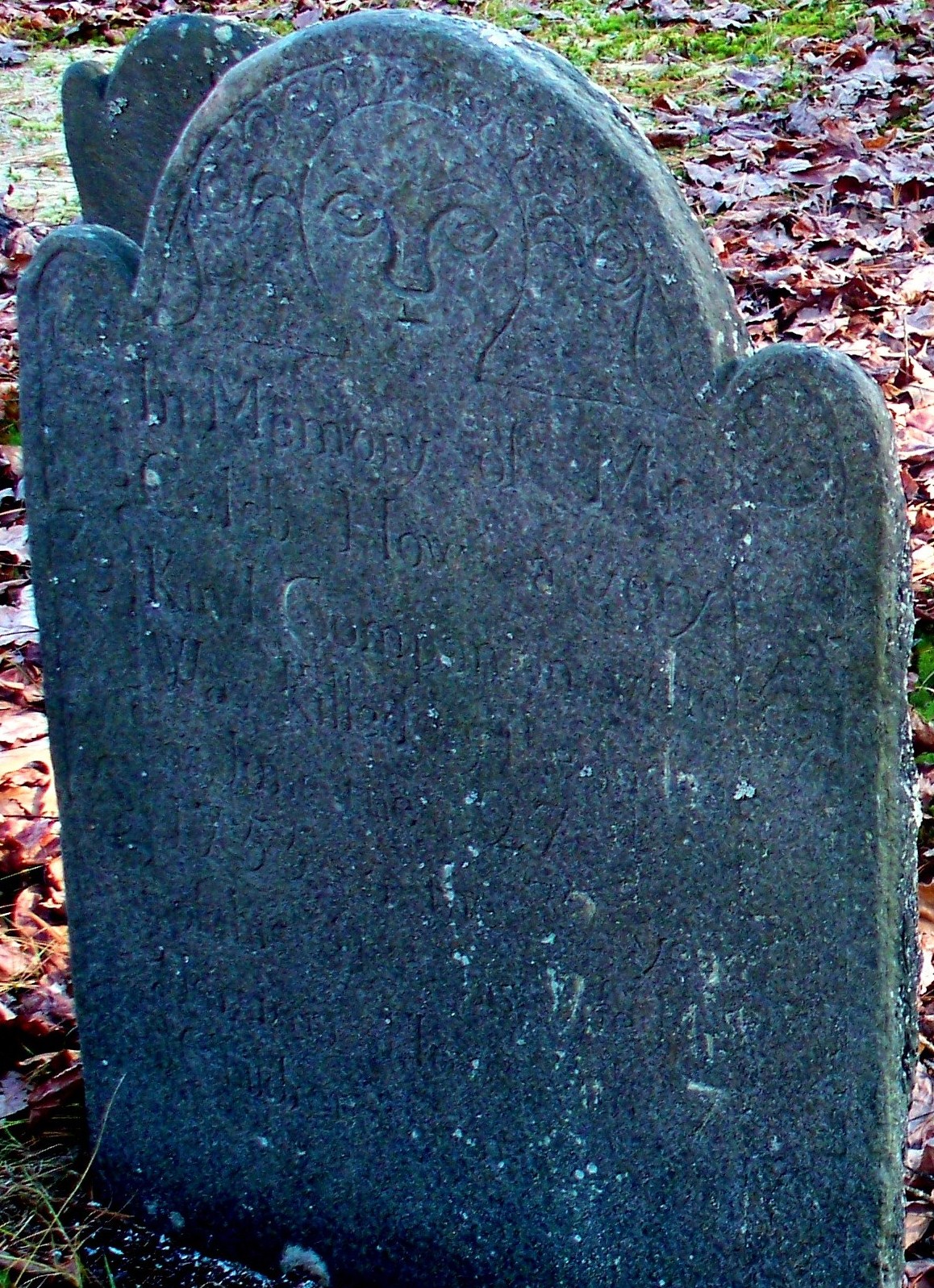
Find a Grave, database and images (https://www.findagrave.com : accessed 03 January 2021), memorial page for Caleb Howe (3 Dec 1723–28 Jun 1755), Find a Grave Memorial no. 69042959, citing Hooker Cemetery, Hinsdale, Cheshire County, New Hampshire, USA ; Maintained by John Clay Harris (contributor 47322896).

In memory of Mr. Caleb How a very Kind Companion who Was killed by the Indians June the 27th 1755 in the 32nd year of his age, his wife Mrs.Jemima How With 7 Children taken Captive at the Same time.

A bit more searching led me to a letter from Colonel Ebenezer Hinsdale to Governor Benning Wentworth date 22 Jul 1755 in the Provincial Paper: Documents and Record relating to the Province of New-Hampshire, from 1749 to 1763, Volume VI with a copy found at the Internet Archive. There on page 412 at the tail end of a letter from Col. Hinsdale is mentioned within a postscript by Abigail Hinsdale the following:

"Mr. Hinsdale wrote to his excellency the 28 of June of the mischief that was done upon the other side of the River, one man kill'd, three women, eleven children captivated, the Indians burnt two buildings."

A copy of that letter has been digitally preserved by the New Hampshire Historical Society and can be viewed at their site at "Letter from Colonel Ebenezer Hindsdale to Govenor Benning Wentworth, 1755 July 22".

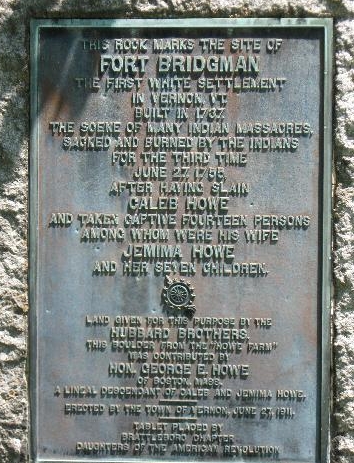
On 27 Jun 1911 at Vernon, Vermont there was a dedication of a marker on the site of Fort Bridgman where the attack took place:

Find a Grave, database and images (https://www.findagrave.com : accessed 03 January 2021), memorial page for Caleb Howe (3 Dec 1723–28 Jun 1755), Find a Grave Memorial no. 69042959, citing Hooker Cemetery, Hinsdale, Cheshire County, New Hampshire, USA ; Maintained by John Clay Harris (contributor 47322896).

With the information from the dedication and the letter from Colonel Hinsdale/Hindsdale that included the postscript by his wife Abigail it would seem that the date of the attack was 27 Jun 1755. Yet if Caleb passed away at Fort Hinsdale the morning following the attack then the date of his death is actually 28 Jun 1755. So that's the date I'm going with at this time.


Friday, September 25, 2020

New CEF Collection on Fold3 - An Overview

Just over a month ago Fold3 added a new collection to their site, the "Canadian Expeditionary Force, 1915-1919" collection. When this collection was first released I found that there was a bit of confusion in several Facebook groups I frequent and in some blogs as to what it held.

Like any collection that is new to me on the various genealogy sites I try to find a collection overview or description. On Fold3 they make it easy:

Screen capture from Fold3 for the Canadian Expeditionary Force, 1915-1919 collection.

Note that it doesn't say personnel records or service files. For those records you can search the "Canada, World War I CEF Personnel Files, 1914-1918" collection on Ancestry or the Personnel Records of the First World War database on Library and Archives Canada (LAC). I will often use the Ancestry collection as my initial starting place just because the Ancestry search engine is more flexible when it comes to name searches than the system on Library and Archives Canada. However, once I have the regiment number I will go the LAC database to download the available service file as a PDF instead of the individual images of the pages as found on Ancestry.

You might also see that the overview page on Fold3 provides a starting template for your source citation (always a nice thing to do), and the "Content Source". It was the content source that got my attention. The documents came from the Internet Archive, one of the favourite places on the Internet for free, generally out of copyright or public domain, material. A search on "Subject:(Canadian Expeditionary Force)" on the Internet Archive returns 151 results.

Yet if all this stuff is free on the Internet Archive why should I use a pay site like Fold3 to look at the same material?

For me, it is a trade off between time and money.

Let's look at an example. In this case, I'm interested in learning more about my McKinlay relatives that served in the First World War for Canada. I know of the following, all sons of Samuel McKinlay and Elizabeth Murdoch residing in Peterborough, Ontario, Canada, that joined the CEF:

  • Samuel McKinlay, 7656
  • William Hamilton McKinlay, 111575
  • Francis Murdoch McKinlay, 195145

I had already retrieved their service files from Library and Archives Canada so I knew when and where they enlisted, their service details, and in the case of Samuel, when and where he died. However, I'm always interested to see what else I can learn about their service.

When I searched the Fold3 "Canadian Expeditionary Force, 1915-1919" collection I used "McKinl?y" as the name since I know that it is often written as "McKinley".

I found "Samuel McKinley" recorded in the "1st Canadian Contingent of British Expeditionary Force" unit as being in the 2nd Battalion, 1st Infantry Brigade, "A" Company. Using the virtual filmstrip icon at the bottom of the image I quickly moved to the start of the book where I found that the title is "List of Officers and Men Serving in the First Canadian Contingent of the British Expeditionary Force, 1914". Yes, that book is on the Internet Archive, but to find Samuel McKinlay on the Internet Archive I would have had to have known to look in that one book and to read possibly the 364 page (includes the cover) to locate his entry. Fold3 took a few seconds to bring up the page.

For Francis, AKA Frank, his entry was found in the "Canadian Expeditionary Force 93rd Battalion Nominal Roll of Officers, Non-Commissioned Officers and Men". Unlike Samuel's entry which only had his regimental number, if I didn't have Franks details I would have learned that he was formerly with the 57th Regiment, his next of kind was Mrs. Catherine Wallace McKinlay and her address was 310 Margaret Ave., Peterboro', Ont. He was born in Scotland and taken on strength with the 93rd on 31 Aug 1915. Oh, and his all important regimental number was 195145.

Could I have found Francis in that book on the Internet Archives? Sure. But his name is 11 pages in (at least it is alphabetical) and I would have to know that he was in the 93th Battalion.

You might also come across some war diaries. I stumbled up on the transcriptions of the war diaries of the 7th Canadian Infantry Brigade. Yes, there are digitized originals available from Library and Archives Canada with search instructions on their "War Diaries of the First World War" page but you have to manually find the applicable diary via the Collection Search and then read each page i nthe hopes of finding a name of interest to you. Having some of the transcribed war diaries available and searchable might help you learn if a relative was mentioned.

Sometimes, if you are really lucky, the regimental books and histories might have a picture of your ancestor like that of the Photographic Record and Souvenir of the Canadian Grenadier Guards Overseas Battalion "Eighty Seventh" from 1916.

Fold3, Canadian Expeditionary Force, 1915-1919 (/title/1094/canadian-expeditionary-force-1915-1919 :accessed September 23, 2020), database and images, https://www.fold3.com/title/1094/canadian-expeditionary-force-1915-1919; Photographic Record and Souvenir of the Canadian Grenadier Guards Overseas Battalion "Eighty Seventh", p 35

Fold3, Canadian Expeditionary Force, 1915-1919 (/title/1094/canadian-expeditionary-force-1915-1919 :accessed September 23, 2020), database and images,

This collection of Fold3 doesn't give the sort of details found in the service file but you may uncover additional information about your relative that served in the First World War for Canada. It is one more collection in your Canadian genealogy research toolkit.