Showing posts with label Military. Show all posts

Monday, June 16, 2025

Revisit - Library and Archives Canada RG 8, C Series How-To

More than a decade ago, I wrote a blog post titled "Library and Archives Canada RG 8, C Series How-To." Since then, the Library and Archives Canada site (LAC) has been revised, updated, and refreshed. After a colleague mentioned that they were having challenges accessing the finding aids associated with the RG 8, C Series collections1, I decided to check out what has changed in accessing this collection of important Canadian colonial military records.

The first big change is that the topic page, "British military and naval records," is now in the new format. That's both good and bad — and the bad definitely outweighs the good in this case. The bad is that a lot of the good stuff on how to access the digitized material has been left off the new page. Fortunately for us, the old page is archived on the Internet Archive's Wayback Machine at "British military and naval records (RG 8, C series) - Introduction and index."

Normally, I'd recommend using that archived page as one's guide to accessing the digitized images and use some of the links found on the new topic page to get to the images.

However, I wanted to see if I could find the material in this collection using the current Library and Archives site only and not go to the Wayback Machine copy.

In exploring this collection, I'm going to be looking for Alexander Fraser, late corporal with the 49th Regiment of Foot, who settled in Drummond Township in what is now known as Lanark County, Ontario, Canada. He is also my 4th great-grandfather.

The first place to start on the LAC site is going to be visiting the "British Military Records."C" Series [multiple media]" collection description page.

There is a lot of stuff there. Yet for us, the important link is found at the end of the Finding aid section on that page. There we find a link to a PDF file associated with "Multiple media (Electronic) Name Index - British Military Records. C Series (90: Open)" found at https://data2.archives.ca/pdf/pdf002/p000003718.pdf. In that PDF we learn how the name index maps to the microfilms with the digitized images of the old card index.

For Alexander Fraser, it seems that I need to look at microform C-11814 since his last name should be found somewhere between "Foy, Lewis - Freer, Noah."

That microform is part of the archived "British Military and Naval Records (RG 8, C Series) - INDEX ONLY" set of microfilms found buried on the current Library and Archives Canada web site. According to the current "British military and naval records" topic page they state: "Note: these links will be only be available until the images are fully available in Collection Search." How long that will take is anyone's guess.

Of course, since Alexander Fraser is a bit of a common name, it took me a few minutes to find my Alexander Fraser.

"British Military and Naval Records (RG 8, C Series) - INDEX ONLY," index card for Alex. Fraser, Corporal of the 49th Regt, image 711 of 6381; microfilm C-11814, Library and Archives Canada, Ottawa.

That "C.4." found at the bottom left corner of the digitized card isn't a microfilm number. Instead, it is a volume number and we need to drop the "C" part in the next step in order to figure out the microfilm that holds the images of the actual documents. I also need to write down that I'm going to be wanting to look for page 15 in that volume 4.

On the old LAC site there used to be a table that converted the volume numbers to microfilm reel numbers. However, that has disappear from the current "British military and naval records" topic page but it still exists on the Wayback Machine at https://webarchiveweb.wayback.bac-lac.canada.ca/web/20220707190537/https://www.bac-lac.gc.ca/eng/discover/military-heritage/loyalists/Pages/rg8-num.aspx. But using that archived page would defeat my purpose of only using the current system.

So, I'm going to the sometimes frustrating2 Collection search system on the Library and Archives Canada site and I want to use the Advanced search feature found at https://recherche-collection-search.bac-lac.gc.ca/eng/Home/SearchAdvanced.

I'm not going to do any name searching though. Instead I'm going to use a few of the advanced search features.

  1. For the "Collection", I selected "Collections and Fonds" from their pop-up list. It's near the top of the list.
  2. Next I'm going to look for "Specific terms". The first one I want to select is "Archival reference" from their pop-up list. In the box beside it I will type in "RG8-I". That's an "eye" not a "one", and there are no spaces.
  3. I also need a second Specific term so I want to click on the "+" next to the box where I filled in that RG8-I.
  4. In that newly added line for Specific terms, I'm going to leave the Boolean operator as "AND", and select "Volume/Box" from the pop-up list just like I did for "Archival reference". I'm going to type in that volume number I found in the index card in the text box beside it but without the "C." stuff in front. In this case it is "4".
  5. I'm leaving all the other search boxes empty or at their defaults. 

Screen capture of Library and Archives Canada Collection Search advance search screen with Collection = "Collections and fonds" selected, and Specific terms of Archival reference = "RG8-I" and Volume/Box = "4".
Screen capture of Library and Archives Canada Collection Search advance search screen with Collection = "Collections and fonds", and Specific terms of Archival reference = "RG8-I" and Volume/Box = "4".

Finally, I clicked the Search button.

If everything works out you too will hopefully see something like this in the search results.

Screen capture of Library and Archives Canada Collection Search advance search results looking for Collection = "Collections and fonds", and Specific terms of Archival reference = "RG8-I" and Volume/Box = "4".

By the way, if you are wanting to make changes to the search, don't use the back button in your browser. Instead, click on the "Modify search" button above the search results.

The first entry looks to be what I'm looking for since the reference states:

RG8-I, Volume number: 4, Microfilm reel number: C-2608

The other item that was returned in the results list actually states that the volume number is "92/1--92/4" and the search probably picked it because it has "4" in the volume number after a slash.

I recommend that you don't click on the image that is displayed as part of the search results. Instead, click on the title of the item to be viewed, in my case it is the one referencing microfilm reel C-2608. Clicking on the image will only display the digital object viewer. However, if I click on the title I get the viewer plus descriptive stuff I might want to use to create my source citation. In this specific example, the new(ish) digital object viewer will load the PDF holding the images from RG8-I, volume 4. Be patient, this can take a few minutes for the PDF to be displayed.

Screen capture of Library and Archives Canada Digital Object Viewer for RG 8, Volume 4 with page 15 displayed.

I was able to quickly browse through the images to find the page 15 mentioned on the index card.

I can now download the PDF to my computer, it is about 51 MB is size in this case. I can then use the PDF viewer on my computer to clip the pages I want to save as JPG images for safe keeping in the folder I have for Alexander Fraser on my computer3.

One question you might be asking is, "Why didn't I use the Collection search to find that microfilm reel of the index cards?" The answer is actually fairly simple. They haven't added those microfilms in a digitized format to the new collection database. So I had to use the archived microforms page for the "British Military and Naval Records (RG 8, C Series) - INDEX ONLY".


1. At the time I'm writing this, a number of users from non-Canadian locations are reporting getting "403 - Forbidden: Access is denied" error messages when trying to access some of the Library and Archives Canada pages. From conversations I've had with others, this might be a side effect of some security settings that LAC has put in place to prevent AI bots from scraping the content in various LAC collections. I've asked for feedback from LAC to confirm that this is the reason.

2. The Collection search is often frustrating since, if we just use the basic search, we get way too many results back and we are just overwhelmed with the hundreds or even thousands of items to look at. Yet it is a powerful search system once we figure out how to beat it into submission and use the various search filters found in the advanced search options. By the way, I'm still figuring it out.

3. Yes, I back up my genealogy files on a periodic basis to the cloud and also to USB memory sticks. I also backup my whole computer every month to an external drive that I keep disconnected except for when I'm doing my backups. Hopefully you also backup your important genealogy files.

Friday, November 8, 2024

The Harry Creagen Fonds of Canadian RFC and RNAS Airmen

During my visit to the Library and Archives at the Ingenium Centre in Ottawa to look at the Canadian Pacific Steamship Company Records, the archivist, Adele Torrance, mentioned that part of a collection held by the Library and Archives at the Canada Aviation and Space Museum (CASM) in Ottawa had been digitized by Ancestry. Just a note, this is not the Library and Archives Canada (LAC) that we often use in our Canadian research.

The Harry Creagen Fonds were pulled together by Mr. Creagen between 1938 and the 1990s. Mr. Creagen had a life long interest in aviation and he created a collection mainly concerning Canadians who served during the First World War in the Royal Flying Corps (RFC), Royal Naval Air Service (RNAS), and also the Royal Air Force which was created by merging the RFC and RNAS in 1918.

McKinlay, Ken, Stack one of three of banker boxes of the Harry Creagen Collection, Photograph, 10 Oct 2024, Canada Aviation and Space Museum Library and Archives.

What the Canada Aviation and Space Museum Library and Archives received were a number of files organized by subjects and placed in bankers boxes. The files are still in those boxes at the archives and haven't been added into their catalogue...yet. It's a long process and there is limited staff to do all that work. 

I had the fun and pleasure of actually looking through those boxes when I visited the Library and Archives at the CASM when I was looking for information about the Royal Naval Air Service Wing No. 3 and one of their pilots, Gordon Stuart Harrower, a Canadian from the Montreal area. 

Honestly, it really was fun!

It's not often that one gets to explore a collection with no idea of what may be found. With the aid of the archivist, Adele, we spent about an hour looking in the boxes and file folders to understand how the material was filed and finding material of specific interest to my research task for the day. Remember, this material hasn't been entered into the CASM catalogue and all we had to go on were the labels on the boxes and a subject matter list of the material that is organized by Mr. Creagen's filing cabinet drawers. 

File folders found in one box from the Harry Creagen Collection
McKinlay, Ken, File folders found in one box from the Harry Creagen Collection, Photograph, 10 Oct 2024, Canada Aviation and Space Museum Library and Archives.

One sort of offbeat file I came across was what I'm guessing is an English transcription or abstract of the Jagdgeschwader Nr. 1 Victory Log. You might be asking why this might be of interest. This is the German squadron sometimes referred to as "The Flying Circus" that was led by Manfred von Richthofen, AKA the Red Baron. These pages list the date, pilot, the type of allied aircraft shot down, where it happened and the kill number for that pilot. It also records when a German pilot of JG 1 was wounded or killed. As with any collection, until you start to dive into the records, you just never know what you will come across.

Then there are the boxes of the index cards created by Mr. Creagen.

Boxes of index cards from the Harry Creagen Collection
McKinlay, Ken, Boxes of index cards from the Harry Creagen Collection, Photograph, 10 Oct 2024, Canada Aviation and Space Museum Library and Archives.

It is this part of the collection that has been digitized by Ancestry.

Before rushing over to Ancestry to look for these digitized index cards, they aren't on Ancestry. Instead you will find them on Fold3 or Forces War Records. These two sites hold many of the military collections digitized by Ancestry and they may be pointed to from indexes on Ancestry. Where you will find the digitized index cards online is in the Canada, WWI, RCAF Pilot Cards on Forces War Records. You will also find it on Fold3 in their Canada, WWI, RCAF Pilot Cards collection. Basically, the same collection but on two different Ancestry owned sites.

So what will you possibly find written on those index cards?

As I mentioned, I was curious about Gordon Stuart Harrower of Montreal. One of his daughters married into a branch in my family tree. I had stumbled across a mention of Mr. Harrower serving in the Royal Naval Air Service during the First World War and the research itch took hold.

Here are the cards I found by searching for his name in that collection on Forces War Records.

If I didn't already know the date of his death, I now have it. But the index cards for Mr. Harrower held other clues such as the squadrons he served in, when he left the service, and even that he trained in Texas. I also found out that he served in the Royal Canadian Air Force in the Second World War. Maybe some day I'll do a blog post about Mr. Harrower since, in addition to his service, he was trained at Wright Brothers Field and is mentioned on a plaque at the Wright Brothers Memorial in Dayton, Ohio, USA.

Along with looking at the Harry Creagen Fonds, the archivist also took the time to look through the CASM catalogue of books for material that may have shed light into the Royal Naval Air Service and Canadians aviators in the First World War.

A selection of books from the CASM Library concerning the RNAS and other topics of interest.
McKinlay, Ken, A selection of books from the CASM Library concerning the RNAS and other topics of interest, Photograph, 10 Oct 2024, Canada Aviation and Space Museum Library and Archives.

They have a wonderful library in addition to their archives and I know I could easily spend a full afternoon just perusing the books on the shelves. They even have a flight log book copy collection of log books that have been donated to the Canada Aviation and Space Museum Archives of military and civilian pilots.

I really can't thank Adele Torrance enough for taking the time out of her day to show me the Harry Creagen Fonds in the CASM vault and also searching the Canada Aviation and Space Museum Library and Archives catalogue for additional books and material. 

If you are looking to visit the Library and Archives at the Canada Aviation and Space Museum, check out their page at https://ingeniumcanada.org/aviation/library-and-archives for the opening hours, location, and contact information. Don't forget to get an admission ticket to explore all the neat exhibits after you finish your research!


Thursday, November 7, 2024

Researching Those Who Served Canada in the First and Second World Wars

Cross of Sacrifice at the National Military Cemetery in Ottawa, Canada
McKinlay, Ken, "Cross of Sacrifice, National Military Cemetery," Photograph, 10 November 2018, Ottawa, Ontario, Canada.

With Remembrance Day rapidly approaching I've updated my two pages under my "Links of Interest" that I use in my own research:

I am also giving several talks in the next few weeks concerning researching those who served Canada in the First and Second World Wars:

Researching a Canadian Soldier of the Great War - Join me online for an exploration into the process of uncovering the military service of our Canadian ancestors who served in the First World War. Through real-life case studies, this presentation will guide you through the rich array of resources available for tracing the military history of your relatives. Learn about the contents of the service files, additional archival records, and other invaluable tools to bring the past to life and gain a deeper understanding of your family's wartime legacy. 


Second World War: Researching the Canadians Who Served - This presentation delves into the wealth of records available for researching Canadians who served during the Second World War. We’ll explore both the poignant records of those who gave their lives in service to Canada and the rich archival resources that reveal the stories of those who survived. Whether your interest lies in uncovering military service details, personal narratives, or broader historical insights, this session hopefully provides the tools and guidance to deepen your understanding of those who served Canada.


Photograph of the Tomb of the Unknown Soldier at the Nation War Memorial in Ottawa, Canada.
McKinlay, Ken, "Tomb of the Unknown Soldier, National War Memorial," Photograph, 26 June 2022, Ottawa, Ontario, Canada.

Monday, July 29, 2024

Finding a War Bride in the Directorate of Movements Microfilms

After a year of writing new talks and updating my existing genealogy talks I finally took sometime this past month to do a bit of diving into the records of folks who married into my various lines in order to see what I was missing. One of those tasks was looking for folks found in the 1921 Census of England and also the 1939 Registration that took place in England. 

And that is where this story starts. 

I started looking into the life of Vera Beresford, born about 1920 in Manchester, England. I really didn't have much information about her, only what I gleaned from the service file of her husband Arnold Norman Richard Burfield. 

Arnold Burfield is my 3rd cousin once removed and he was born in Peterborough, Ontario, Canada on 2 Aug 1914. He enlisted to serve Canada in the Second World War and he was killing in action in Sicily on 23 Jul 1943 while with the Hastings and Prince Edward Regiment. So I started by once again reviewing his service file which is now available online from Library and Archives Canada. The last time I had looked at his file was in 2012 and I actually had to go to LAC to view the original file. My genealogy research skills have advanced just a bit since then so I looked at his file a bit closer.

That is when I came across this memo in his file.

Canada, "Military Service Record: Burfield, Arnold Norman, Regimental Number C5652," memorandum from Director of Repatriation to Director of Records, dated 12 Jan 1945; Library and Archives Canada, Ottawa.

It is a memorandum from the Director of Repatriation to the Director of Records dated 12 Jan 1945.

I realized I had missed this important clue in my earlier reviews of the file. It meant that his wife, Vera, was a war bride. That note states that Vera and her son Norman had arrived from overseas, ex W 779 on 6 Jan 1945. It also provided the destination address of her mother-in-law.

But what is that "ex W 779"?

Honestly, that took a bit of Google-fu to find that answer. I found it in the document "TrainShipSchedules39 45" that was uploaded to Scribd by David A Ryan on 23 Oct 2019. For those researching mass military personnel movements within Canada and also for ships going across the ocean during the Second World War, this document is a real treasure trove. It is described as:

"This document lists the unit serial numbers and embarkation locations for various Canadian military units between 1939 and 1945. It includes divisions, brigades, batteries, regiments, pioneer battalions, medical and supply units. The units embarked from locations across Canada like Toronto, Montreal, Winnipeg, Edmonton and Vancouver as well as some from the UK."

Buried within that document I came across these items:

TS #Serial #UnitEmbarkation
1434-Ex-W-779 Dependents SpecialHalifax
1435-Ex-W-779 Dependents SpecialHalifax

The above table extract deals with the trains taking the dependents to their new Canadian homes.

The next two table extracts provide the dates, ships, and ports information.

DateDestinationDateShip #Ship Name
6-Jan-45Halifax
W-779Mauretania
6-Jan-45Montreal
W-779Mauretania
6-Jan-45Various
W-779Mauretania
6-Jan-45Various
W-779Mauretania

Ship#Ship NamePortSailing DateConvoy
W-779MauretaniaHalifax6-Jan-45-

So it looks like the ex W-779 in that memorandum is the ship Mauretania. No, this is not the Mauretania that was mentioned in the film "Titanic". This is the RMS Mauretania that was built in 1938.

RMS Mauretania

Thanks to the posts by John Reid in his Anglo-Celtic Connections blog, the Canadian War Brides stories available on the British Isles Family History Society of Greater Ottawa site in their name index, and discussions with fellow researchers, I knew that many of the microfilms for the Directorate of Movements held by Library and Archives Canada and available in a digitized format on the Héritage might have additional information. What I didn't realize is that there are 198 microfilms with many of them having 5000+ images each to go through.

So it was time to rethink my approach of just diving in since I'm not going to wade through all of those millions of images to find the ship and hopefully documents I'm interested in. I need work smarter and not harder.

Since the microfilms came from Library and Archives Canada I decided to see what the Collection Search might give me. But what to search on?

  • The obvious is the name of the ship, "Mauretania". 422 results were returned. I want to narrow it down just a bit.
  • In the "About" tab for the Directorate of Movements topic page on Héritage it stated that the archival reference is "RG 24 C 24". From my own experience I know that "RG 24" is written as "RG24" on the LAC site and it is the Department of National Defence fonds. Adding "RG24 C 24" (the quotes are needed) to the search reduces it to 96 results. Not bad.
  • Thinking a bit more about the "W" prefix for the ship number I realized that it probably indicated a westbound ship. So I added "westbound" (without quotes) and now I have 61 results. 
  • Finally I filtered the date by the Year: 1945 since that is when the Mauretania arrived in Halifax. That got it down to 11 results. Now that it manageable!

Screen capture of the Library and Archives Canada Collection Search for 'mauretania "RG24 C 24" westbound" Date: 1945' showing the first of eleven results returned.

Scrolling though the results I came across this entry: "Westbound Personnel - MAURETANIA - Port of Departure - Halifax - Convoy TA-175 [United Kingdom to United States]". However, I wanted Halifax as the port of arrival. In the record information section it stated the date was 1945/01/07 (year/month/day formatted), it is found on microfilm reel number C-5717, and the file number is "HQTS-63-303-779-1". Hmmm, that 779 looks familiar though so I retained some hope that I could find the right microfilm and information about Vera and Norman.

Since microfilm C-5717 is on the Héritage site I decided to see what I could find.

Sigh.

5297 images and none of them are available for text searching. Time to hunker down and start walking through the microfilm images in the hope that this microfilm might have any information about the passage and maybe even find Vera and Norman Burfield listed somewhere.

On image 4 there I came across the Ship Allotment page.

Department of National Defence., "Directorate of Movements," images, Héritage (heritage.canadiana.ca : accessed 29 Jul 2024), Ship Allotment for the Mauretania, M.C. 303-779, Code AT 175; citing Library and Archives Canada microfilm C-5717, image 4
Department of National Defence., "Directorate of Movements," images, Héritage (heritage.canadiana.ca : accessed 29 Jul 2024), Ship Allotment for the Mauretania, M.C. 303-779, Code AT 175; citing Library and Archives Canada microfilm C-5717, image 4. 

It appears that the file starts with the disembarkation in Halifax. It also seems to indicate that there are 630 dependents of Army, Air Force, Navy, and Firefighter personnel on this ship in addition to service members.

I started bouncing through the images in leaps of 20 to see if I might come across lists of passengers. And I got really lucky!

Department of National Defence., "Directorate of Movements," images, Héritage (heritage.canadiana.ca : accessed 29 Jul 2024), List of Canadian Dependents Arriving in Canada ex W-779, List No. 10, for M.D. 3, Sheet No. 2; citing Library and Archives Canada microfilm C-5717, image 200.

On image 200 there was Vera and Norman listed. Nothing new was discovered but the information matches that which was found in the memorandum I found in Arnold's service file. 

That "M.D. 3" on the top right of the page stands for "Military District 3" which, as of 1939, had its headquarters in Kingston, Ontario and included their destination of Peterborough. The various military districts in Canada from 1900 to 1999 can be found listed on the Canadian Soldiers site on their "Domestic Military Organization 1900-1999" page.

I will admit to having a chuckle when I came across pages and pages of letters and notes concerning lost luggage. Even 80 years ago luggage was being misplaced or lost and folks were trying to get compensation for the missing items.

There are pages detailing the need to trains to take the passengers to their destinations including a documents with the timings of the special trains that departed on 7 Jan 1945 starting at image 372. At the bottom of image 375 I found V. Burfield listed and that she had one suitcase and one box to start a new life in Canada as a war widow for her and her son.

I can't imagine coming to Canada from England in the midst of a Nova Scotia winter.

So what happened to Vera and Norman?

She remarried and in 1960 she went back to England with her new family where she passed away many years later.

Where else can you look for records and information? 

You might be able to find your war bride and children in the "UK and Ireland, Outward Passenger Lists, 1890-1960" collection on Ancestry and the "Passenger Lists Leaving UK 1890-1960" collection on Findmypast. There you might come across a record created by the Canadian Wives' Bureau - Civilian Repatriation Section like what we see here for Jaboca E Sauve departing on the Scythia out of Liverpool on 24 Oct 1946 bound for Halifax, Nova Scotia, Canada.

"Passenger lists leaving UK 1890-1960," database with images, Findmypast (www.findmypast.com : accessed 29 Jul 2024), Jacoba E Sauve on board the Scythia departing from Liverpool on 24 Oct 1946; citing The National Archives (Kew), BT 27 Series, 129508.
"Passenger lists leaving UK 1890-1960," database with images, Findmypast (www.findmypast.com : accessed 29 Jul 2024), Jacoba E Sauve on board the Scythia departing from Liverpool on 24 Oct 1946; citing The National Archives (Kew), BT 27 Series, 129508.

However, not all the ships may be found in this collection. Such is the case for Vera and Norman Burfield.

Remember that the information about the ship movements were often a war secret. Details about the comings and goings of ships would not have been reported in the newspapers of the Allies, especially if the ships were carrying military personnel or supplies. However, the local newspapers where they were going to might have articles about welcoming the war brides to their new home.

Just keep in mind that this sort of research isn't simple or quick to do but it can be rewarding and even informative. In this case, I was lucky enough to have enough details to start looking for records and researching what might be found and it only took me a day or so of research to find what I did.

As with much of our research, all we need is a starting place. Often that starting place is already in the records we have and family stories we've been told.


Monday, February 21, 2022

Case Study - Diving Deep into Ontario Lands Records

An intriguing question appeared in the Ontario Ancestors Facebook group I follow that got my attention since it involved a possible military and land record connection. These are two areas of genealogy research that can often lead to many challenges if you don't know where to look.
Be warned, this is a long post and covers quite a few digitized non-computer indexed collections to pull all the parts together. Yet it also highlights some of the skills needed to be developed beyond using the search systems on most genealogy sites.

Lorraine Foley posted:

Michael Cavanagh, born Ireland abt 1781 , was a soldier in France in 1817, had a child there, came to Canada 1818, and raised family around Perth or Huntley, Ontario. I have seen some military record possibilities, but without collaborating info, I don't know which one is him. I assume he was given land.

Lorraine provided some good bits of information but I needed a bit more. So after I posted a possible lead to a Sgt. Michael Cavanaugh who settled on lot 12 of the 9th concession in Bathurst township she replied back with:

The earliest I can find Michael is in the Richmond and Perth church records. The 1851/61 census state family lives in Huntley township. I am having no luck finding lot # for him in the land record sites mentioned by others below. 

That little bit of information about finding Michael in the 1851 and 1861 census enumerations of Canada West allowed me to start digging into the property records.

The first step for me would be to put the family "on the ground" and to locate them in the population schedule for the 1851/52 census and then find him hopefully in the agricultural schedule since that would provide me with a concession and lot number. But since so many of the agricultural schedules for the 1851/52 census of Canada West have been lost to the ravages of time I usually check the "Districts and Sub-districts: 1851 Census" page for Canada West on the Library and Archives Canada site before looking for something which might not exist. Huntley is in District 4, Carleton County and as we can see, the agricultural census is missing for the Huntley sub-district.

Sub-District
Number
Sub-District
Name
MicrofilmNotes
​24​FitzroyC-11716
​25GloucesterC-11716Agricultural census is missing.
​26​GoulbourneC-11716Agricultural census is missing.
​27​GowerC-11716Agricultural census is missing.
​28HuntleyC-11716Agricultural census is missing.
​29​MarchC-11716Agricultural census is missing.
​30​MarlboroughC-11716Agricultural census is missing.
​31​NepeanC-11716Agricultural census is missing.
​32​OsgoodeC-11716Only the agricultural census has survived.
​33​RichmondC-11716Agricultural census is missing.
​34​TorboltonC-11716Agricultural census is missing.

That is unfortunate but not unexpected. So on to the 1861 census since most of those agricultural schedules did survive.

I've already written about some of the challenges in using the 1861 Census of Canada West in my posts "A Challenge: 1861 Census of Canada - Agricultural Schedule" and "Missing images from the 1861 Census of Canada West on Ancestry?" but fortunately, at least in this case, I didn't run into these issues for Michael Cavanagh since I was only looking for the concession and lot details. However, there were other challenges (aren't there always!)

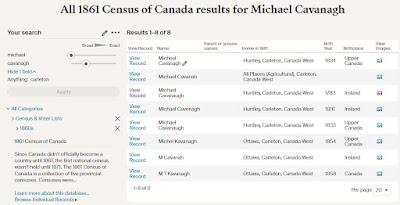
Screen capture of the results from searching the 1861 Census of Canada collection on Ancestry for Michael Cavanagh with the exact keyword of "carleton".

We find that there are several Michael Cavanaghs (with various spellings) in the Carleton district with their home in the Huntley sub-district. Only one stood out to me and that was the Michael Cavanaugh born in 1783 in Ireland since he matched the information provided my Lorraine. He was found in enumeration district number 7. However, to be on the safe side I checked the others:

  • Michael Cavenagh born 1816 in Ireland is recorded as single residing in enumeration district no. 5,
  • Michael Cavanagh born 1834 in Upper Canada is recorded as single residing in enumeration district no. 1 possibly in the household of John Cavanagh, and
  • Michael Cavanagh born in 1833 in Upper Canada is recorded as single residing in enumeration district no. 7 apparently in the household of the Michael Cavanaugh born 1873 in Ireland.

There is also that Michael Cavanah without a birth year and birth place with a home  of "All Places (Agricultural), Carleton, Canada West. Looking at the image we can see that it is for the agricultural schedule for enumeration district no. 7 in the Township of Huntley in Carleton County.

Census of 1861, Canada West, Carleton, Township of Huntley, Enumeration District No. 7, p 23 [stamped]; RG 31; digital images, Library and Archives Canada, Library and Archives Canada (www.bac-lac.gc.ca : accessed 16 Feb 2022); citing Library and Archives Canada microfilm C-1013.

Here we find a "Michael Cavanah" with property on lot 27 of the 11th concession in Huntley Township, Carleton County, Canada West. This looked very promising and Lorraine was able to confirm that was her "Michael Cavanagh".

That covers the easy work which most of us can do once we are familiar with using any of the major genealogy sites and searching the various censuses of Canada. Now we move away from the usual collections and on to Ontario land records and the challenges of looking at digitized microfilms.

Since we can now place Michael on the ground on lot 27 of the 11th concession in Huntley Township we can see if we can find him in the historical Abstract/Parcel Register Books within the Ontario Land Property Records Portal (AKA OnLand) or in the Abstract index books collections in the "Land and property" category for "Canada, Ontario, Carleton" on FamilySearch.

I personally like using the collections on FamilySearch since I don't have to worry about if OnLand is open for business when I'm searching Ontario land records late at night. Here is the start of the page for lot 27 on concession 11 in Huntley Township.

Abstract index books, ca. 1800-1959, of Carleton County, Huntley Township (v. A), Lot No. 27 Concession 11; Registrar's Office, Ottawa, Ontario; DGS 8,344,621, image 274, FamilySearch (https://www.familysearch.org/ark:/61903/3:1:3Q9M-CSTY-Z9FM-9 : accessed 16 Feb 2022).

It was fairly easy to find but it seems he received the land not from the Crown, like one might expect if it was from a grant, but from the Canada Company on 11 Apr 1835. He then sells the property to a Michael T Cavanagh on 23 Jul 1851...possibly his son?

Yet what got my attention was on the preceding page for the East 1/2 of lot 26 in the 11th concession of Huntley Township.

Abstract index books, ca. 1800-1959, of Carleton County, Huntley Township (v. A), East half Lot No. 26 Concession 11; Registrar's Office, Ottawa, Ontario; DGS 8,344,621, image 274, FamilySearch (https://www.familysearch.org/ark:/61903/3:1:3Q9M-CSTY-Z9FM-9 : accessed 16 Feb 2022).

Here a Michael Cavenagh received the land as a patent from the Crown on 13 Oct 1836 and then he sells it on 9 Mar 1937 to Andrew Whelan.

OK, time to pull in the sails and try another tack. Can I find information about that patent which was granted on 13 Oct 1836 on lot 26? Keep in mind that a patent isn't granted until all of the required duties to be performed on the land have been completed. So it may be a number of years from the time a petition is granted until a patent has been received.

This time it is over to the "Land Petitions of Upper Canada, 1763-1865" database at Library and Archives Canada. I've learned that for names which may have multiple interesting ways of being spelled to put in the minimum number of letters in the LAC database search system so I searched on the surname of "cav" and the given name "michael"

Screen capture of the results searching the Land Petitions of Upper Canada, 1763-1865 database on Library and Archives Canada for the surname "cav" and given name "michael".

Two results got my attention: the 1829 and the 1823 petitions. The 1848 petition is much too late for the patent granted in 1836.

Let's take a look at the 1823 petition found in the Upper Canada Sundries on microfilm C-4611 first since it is the earliest petition. The Upper Canada Sundries have been digitized on Héritage site of the Canadian Research Knowledge Network.

A search for microfilm C-4611 displays "Upper Canada Sundries : C-4611" at the top of the search results. Even better, almost all the pages have full-text search support. Searching for "cavanagh" gave me two matching pages: image 119 and image 781. Looking at image 119, in the top corner I could see "32254" stamped. This didn't match what was in the results from the Land Petitions of Upper Canada, 1763-1865 at LAC. However, image 781 has "32921" stamped in the corner and that is a number we want to see.

"Civil Secretary's Correspondence, Upper Canada Sundries, October-November 1823," page 1 of the petition of Michael Cavanagh, p. 32921 [stamped], image 781; digital images, Canadian Research Knowledge Network,  Héritage (https://heritage.canadiana.ca/ : accessed 16 Feb 2022); citing Library and Archives Canada, RG 5, A 1, vol. 62, pp 32850-33396, Reel C-4611.
"Civil Secretary's Correspondence, Upper Canada Sundries, October-November 1823," page 1 of the petition of Michael Cavanagh, p. 32921 [stamped], image 781; digital images, Canadian Research Knowledge Network,  Héritage (https://heritage.canadiana.ca/ : accessed 16 Feb 2022); citing Library and Archives Canada, RG 5, A 1, vol. 62, pp 32850-33396, Reel C-4611.

In this letter dated 13 Oct 1823 we learn some of the following details about Michael Cavanagh:

  • he was with the 57th Regiment of Foot
  • he was discharged in Vallencenes [Valenciennes] in France
  • he has been in Upper Canada for nearly three years
  • when he first went to apply for land he had four in his family left in Ireland
  • he initially applied in Lanark to get his "military locations" but was told the "land was of no use there was nether rations or utinsial alowed for me an to go an get my family before I trobled myself with land..."
  • it seems his family landed in St. John, New Brunswick and he has returned to Brockville, Upper Canada with his family

Alas, no details about if he was given land and where. Time to look at the next petition from 1829.

The microfilms for the RG 1 L3 reference are found in an archived microform collection on the LAC site. Most of the time I can't recall how I bookmarked it in my browser so I click on the "How to obtain copies" link found on the left side of the page where the results are displayed. There LAC has provided a link to "Upper Canada Land Petitions - Microform digitization". Microfilm C-1725 was easy to find and I clicked on that link.

After a bit of bouncing around the images I was able to relatively quickly find Upper Canada Land Petitions "C" Bundle 16, 1825-1831 (RG 1, L 3, vol. 109). That sort of information is supposed to be at the bottom of each microfilm image. The petition number is written at the top of the page in one of the corners. The first page of the bundle will just be a number and the subsequent pages will include a letter like "16a" followed by "16b", etc.

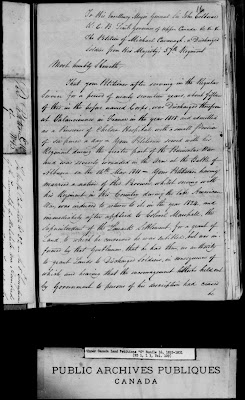
Here is the first of several pages from Michael Cavanagh's petition from 1829.

Upper Canada Land Petitions "C" Bundle 16, 1825-1831, Petition 16, page 1 of the petition of Michael Cavanagh; RG 1 L3, vol. 109, microfilm C-1725, images 758; Library and Archives Canada, Ottawa.

This petition has all kinds of wonderful details for this Michael Cavanagh such as:
  • he was a discharged soldier from his Majesty's 57th Regiment of Foot,
  • he was discharged at Valanciennes [Valenciennes] in France in 1818,
  • he served in the Peninsula War,
  • he was admitted as a pensioner of Chelsea Hospital with a small pension of 6 pence a day,
  • he was wounded in the arm at the Battle of Albuera on 16 May 1811, and
  • he now has five children to support.

It looks like he didn't get the reply he wanted from his 1823 petition and tried again but this time addressing it to the newly arrived Lieutenant Governor of Upper Canada His Excellency Major General Sir John Colborne KCB. It also seems that Michael served in the same brigade under Sir John.

Only one problem with this bundle...I didn't see any mention of what land was being granted to him only "In Council 6th Nov 1829 recommended as a discharged soldier for 100 acres". But at least we know that this petition was successful.

So it was off to the Ontario Crown Lands collection RG 1, C-I-3 which I had looked at in my post "Ontario Crown Land RG 1 C-I-1, C-I-2, C-I-3 Collections on FamilySearch". In that collection I had noticed a number of bundles for "Military warrants" on later pages.

Looking through the "RG 1, C-I-3, vol. 124, Register for Military Warrants" found in the digitized collection on FamilySearch under "Military warrants (v. 124-125) 1799-1869 (indexed) Locations to discharged soldiers and seamen (v. 126) 1815-1822 (indexed) Nominal return of troops entitled to land for service in the War of 1812-1814 (v. 127) Photostatic copy of v. 127, Prince Regent's land grant to Flank companies militia U.C. War of 1812-1814 (v. 127A)" in FHL 1376096 / DGS 8346076 I found a Michael Cavanagh listed in the hand written index at the start with a reference to folio 47. Based on my experience that meant I needed to look for page 47 in this register.

"Military warrants (v. 124-125) 1799-1869 (indexed) Locations to discharged soldiers and seamen (v. 126) 1815-1822 (indexed) Nominal return of troops entitled to land for service in the War of 1812-1814 (v. 127) Photostatic copy of v. 127, Prince Regent's land grant to Flank companies militia U.C. War of 1812-1814 (v. 127A),"  FamilySearch, Images (www.familysearch.org : accessed 16 Feb 2022), R.G. 1, C-I-3, vol. 124, Register for Military Warrants, folio 47, Michael Cavanagh; citing DGS 8346076, item 1, image 79 of 744.
"Military warrants (v. 124-125) 1799-1869 (indexed) Locations to discharged soldiers and seamen (v. 126) 1815-1822 (indexed) Nominal return of troops entitled to land for service in the War of 1812-1814 (v. 127) Photostatic copy of v. 127, Prince Regent's land grant to Flank companies militia U.C. War of 1812-1814 (v. 127A),"  FamilySearch, Images (www.familysearch.org : accessed 16 Feb 2022), R.G. 1, C-I-3, vol. 124, Register for Military Warrants, folio 47, Michael Cavanagh; citing DGS 8346076, item 1, image 79 of 744.

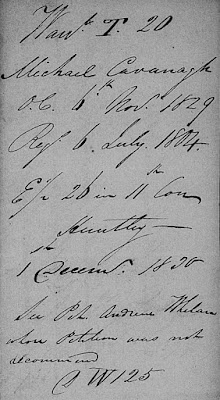
Above is the entry in this register for Michael Cavanagh. It is recorded that he is a "Soldier from the 57 Regiment of Foot As a discharged Soldier". What is even better is that it gives the location of the property as E 1/2 Lot 26 on the 11th Concession in Huntley. It was by the authority of OC 6 Nov 29 [Order in Council 6 Nov 1829] just like we saw in the bundle of his 1829 petition. This document ties the Michael Cavanagh found in the Land Petitions of Upper Canada to that property we found in the Abstract index books.

But we can't stop there since it gives a number for the warrant: T 20.

With a little bit of trial and error (how FamilySearch labels their collections can be a trial at times) I found the warrant in "Military warrants (v. 111-112) bundle A10-Z12, 1823-1829" (FHL 1376008 / DGS 8346063) under "R.G. 1, C-I-3, Vol. 112, Military Warrants, Bundle A19-Z21" starting at image 1294.

"Military warrants (v. 111-112) bundle A10-Z12, 1823-1829,"  FamilySearch, Images (www.familysearch.org : accessed 16 Feb 2022), R.G. 1, C-I-3, vol. 112, Military Warrants, bundle A19-Z21, Warrant T20, Michael Cavanagh; citing DGS 8346063, item 4, image 1294 of 1350.
"Military warrants (v. 111-112) bundle A10-Z12, 1823-1829,"  FamilySearch, Images (www.familysearch.org : accessed 16 Feb 2022), R.G. 1, C-I-3, vol. 112, Military Warrants, bundle A19-Z21, Warrant T20, Michael Cavanagh; citing DGS 8346063, item 4, image 1294 of 1350.

Looking within that bundle what do I see but a note from A Whelan...that same Andrew Whelan we saw in the Abstract index.

There is another place we can look for possible information about a property and that is in the Township Papers also found on FamilySearch within the Land and property category of "Canada, Ontario". There are actually two collection and both are labelled "Township papers, ca. 1783-1870's". One goes from A to H and the other goes from H to Z. What makes this a bit frustrating is that the index is not quite alphabetical by township name. So sometimes it takes a bit of effort to find the digitized microfilm for the township you are wanting. In the case of Huntley it wasn't too hard to find them and select "Huntley, North 1/2, Lot 1, 5th Con. to Lots17 & 18, 11th Con?" (FHL 1378112 / DGS 8346536). There I found the start of "Huntley Lots 26 & 27, Con. 11, Huntley". Within is a letter describing the issue concerning improvements made and confusion about who owned what part of the property. 

Of course, one might even look in the Deed books on FamilySearch for the instruments listed in the Abstract index books for the various transactions on the two properties on Concession 11 in Huntley Township which Michael owned for any additional insights into the property. 

Keep in mind that I'm just giving you the highlights of what I came across. Always read and then re-read all of the various documents, letters, and records for potential clues and hints as to where to look next.

The next step into learning more about Michael Cavanagh and his service to the Crown could be to look in the various registers concerning Chelsea Pensioners held by The National Archives (Kew, England). Some of these registers have been digitized and made available on sites such as Ancestry and Findmypast. There may be many Michael Cavanaghs listed but how many of them served in the 57th Regiment of Foot during the time of the Peninsular War? But I will leave that to you, gentle reader, to explore in your leisure.

As you can see, the process isn't always straight forward and we sometimes need to approach the research question from a different angle in order to connect the dots.


Thursday, November 12, 2020

Second World War: Researching the Canadian Fallen - Resources


For those who attended my presentation on Second World War: Research the Canadian Fallen that I gave to the Lambton Branch of Ontario Ancestors on November 12, 2020 here is the list of just some of the resources I use in my own research of those that served Canada in the Second World War.

Library and Archives Canada Pages

Ancestry Collections

Maps

Photographs

Other Sites


Friday, September 25, 2020

New CEF Collection on Fold3 - An Overview

Just over a month ago Fold3 added a new collection to their site, the "Canadian Expeditionary Force, 1915-1919" collection. When this collection was first released I found that there was a bit of confusion in several Facebook groups I frequent and in some blogs as to what it held.

Like any collection that is new to me on the various genealogy sites I try to find a collection overview or description. On Fold3 they make it easy:

Screen capture from Fold3 for the Canadian Expeditionary Force, 1915-1919 collection.

Note that it doesn't say personnel records or service files. For those records you can search the "Canada, World War I CEF Personnel Files, 1914-1918" collection on Ancestry or the Personnel Records of the First World War database on Library and Archives Canada (LAC). I will often use the Ancestry collection as my initial starting place just because the Ancestry search engine is more flexible when it comes to name searches than the system on Library and Archives Canada. However, once I have the regiment number I will go the LAC database to download the available service file as a PDF instead of the individual images of the pages as found on Ancestry.

You might also see that the overview page on Fold3 provides a starting template for your source citation (always a nice thing to do), and the "Content Source". It was the content source that got my attention. The documents came from the Internet Archive, one of the favourite places on the Internet for free, generally out of copyright or public domain, material. A search on "Subject:(Canadian Expeditionary Force)" on the Internet Archive returns 151 results.

Yet if all this stuff is free on the Internet Archive why should I use a pay site like Fold3 to look at the same material?

For me, it is a trade off between time and money.

Let's look at an example. In this case, I'm interested in learning more about my McKinlay relatives that served in the First World War for Canada. I know of the following, all sons of Samuel McKinlay and Elizabeth Murdoch residing in Peterborough, Ontario, Canada, that joined the CEF:

  • Samuel McKinlay, 7656
  • William Hamilton McKinlay, 111575
  • Francis Murdoch McKinlay, 195145

I had already retrieved their service files from Library and Archives Canada so I knew when and where they enlisted, their service details, and in the case of Samuel, when and where he died. However, I'm always interested to see what else I can learn about their service.

When I searched the Fold3 "Canadian Expeditionary Force, 1915-1919" collection I used "McKinl?y" as the name since I know that it is often written as "McKinley".

I found "Samuel McKinley" recorded in the "1st Canadian Contingent of British Expeditionary Force" unit as being in the 2nd Battalion, 1st Infantry Brigade, "A" Company. Using the virtual filmstrip icon at the bottom of the image I quickly moved to the start of the book where I found that the title is "List of Officers and Men Serving in the First Canadian Contingent of the British Expeditionary Force, 1914". Yes, that book is on the Internet Archive, but to find Samuel McKinlay on the Internet Archive I would have had to have known to look in that one book and to read possibly the 364 page (includes the cover) to locate his entry. Fold3 took a few seconds to bring up the page.

For Francis, AKA Frank, his entry was found in the "Canadian Expeditionary Force 93rd Battalion Nominal Roll of Officers, Non-Commissioned Officers and Men". Unlike Samuel's entry which only had his regimental number, if I didn't have Franks details I would have learned that he was formerly with the 57th Regiment, his next of kind was Mrs. Catherine Wallace McKinlay and her address was 310 Margaret Ave., Peterboro', Ont. He was born in Scotland and taken on strength with the 93rd on 31 Aug 1915. Oh, and his all important regimental number was 195145.

Could I have found Francis in that book on the Internet Archives? Sure. But his name is 11 pages in (at least it is alphabetical) and I would have to know that he was in the 93th Battalion.

You might also come across some war diaries. I stumbled up on the transcriptions of the war diaries of the 7th Canadian Infantry Brigade. Yes, there are digitized originals available from Library and Archives Canada with search instructions on their "War Diaries of the First World War" page but you have to manually find the applicable diary via the Collection Search and then read each page i nthe hopes of finding a name of interest to you. Having some of the transcribed war diaries available and searchable might help you learn if a relative was mentioned.

Sometimes, if you are really lucky, the regimental books and histories might have a picture of your ancestor like that of the Photographic Record and Souvenir of the Canadian Grenadier Guards Overseas Battalion "Eighty Seventh" from 1916.

Fold3, Canadian Expeditionary Force, 1915-1919 (/title/1094/canadian-expeditionary-force-1915-1919 :accessed September 23, 2020), database and images, https://www.fold3.com/title/1094/canadian-expeditionary-force-1915-1919; Photographic Record and Souvenir of the Canadian Grenadier Guards Overseas Battalion "Eighty Seventh", p 35

Fold3, Canadian Expeditionary Force, 1915-1919 (/title/1094/canadian-expeditionary-force-1915-1919 :accessed September 23, 2020), database and images,

This collection of Fold3 doesn't give the sort of details found in the service file but you may uncover additional information about your relative that served in the First World War for Canada. It is one more collection in your Canadian genealogy research toolkit.