Showing posts with label cemeteries. Show all posts

Sunday, January 28, 2024

Toronto Trust Cemeteries on FamilySearch - Updated

Back in February 2022 I wrote about "Toronto Trust Cemeteries on FamilySearch" where I discussed using browsing the digitized images to locate records not indexed in that collection of digitized books. However, with the November 2023 changes to the FamilySearch Catalog place names, especially when it comes to places in Ontario, the first part of that post using searching for that collection by place name needs to be updated.

Instead of searching by place name we are going to search using the Author field for the words "Toronto Trust Cemeteries" (without the quotes) like this:

Screen capture taken 28 Jan 2024 of the FamilySearch Catalog search screen searching by Author with the author name of "Toronto Trust Cemeteries" without the quotation marks.

This results in two groups being returned, "Toronto Trust Cemeteries (Ontario)" with 11 entries and "Toronto Trust Cemeteries. Superintendent of Administrative Services (Ontario)" with 1 entry.

Screen capture taken 28 Jan 2024 of the FamilySearch Catalog search results for the Author Name "Toronto Trust Cemeteries" (without quotation marks) with the "Toronto Trust Cemeteries (Ontario)" grouping opened.

When the "Toronto Trust Cemeteries (Ontario)" group is opened you can see all the cemeteries covered by the Toronto Trust Cemeteries. This list includes not just those cemeteries in Toronto but also those affiliated cemeteries in Scarborough, North York, Concord, Oshawa, and Richmond Hill. This is the same list of cemeteries, with the addition of the Toronto Crematorium collection, that we find listed on the Mount Pleasant Group cemeteries search page.

Screen capture taken 28 Jan 2024 of the Mount Pleasant Group cemetery search page at https://www.finditatmpg.com/Default.aspx.

Lesson for today:

With this latest update to the FamilySearch Catalog it is forcing many of us to adjust our thinking when it comes to using place names as the key item to search on when using this catalogue. So if you can't find the collections that you are looking for via a place try using the other fields to search on. I've been finding the Title and the Keywords to be particularly useful to hunt down the misplaced and reassigned collections within the FamilySearch Catalog.

Wednesday, February 9, 2022

Toronto Trust Cemeteries on FamilySearch

For those with ancestors and relatives who were buried in several of the Toronto Trust cemeteries FamilySearch has created a searchable name index as part of a project with the Toronto Branch of the Ontario Genealogical Society. You can find the search page at Canada, Ontario, Toronto Trust Cemeteries, 1826-1989.

Screen capture of the Canada, Ontario, Toronto Trust Cemeteries, 1826-1989 search page from FamilySearch.

However, just like any searchable database, before you dive right in and start your searching you really need to be aware of the limitations within that name index. 

Before you begin first click on that "How to use this collection" button on the search screen and read the page that appears. This helps set your expectations of what might be found in the searchable index. Note the cemeteries and the range of dates covered in the index:

  • York General Burying Ground (also called Potter’s Field), 1826-1855
  • Necropolis Cemetery, 1850-1912 (the index will continue to 1935)
  • Mount Pleasant Cemetery, 1876-1933
  • Prospect Cemetery, 1890-1935

You can even browse the images by clicking on the "Browse all 7,234 images" button. But, if you are like me, you will get very confused and puzzled when you see the list of volumes for the four cemeteries since, with the except of "Potters' Field Cemetery", they all have several volumes with the same volume number but different date ranges as you can see from this image for the image waypoints of Prospect Cemetery. There is also a gap in the dates for volume 4.

Screen capture of the image waypoints for Prospect Cemetery from the Canada, Ontario, Toronto Trust Cemeteries, 1826-1989 search page on FamilySearch.

So just where are these digitized volumes really found on FamilySearch?

For that we need to use the FamilySearch Catalog. If you aren't familiar with the catalogue then you are missing out on a huge (I mean really, really big!) part of FamilySearch. The catalogue is just that, a catalogue of all the books, manuscripts, microfilms, volumes, and digitized collections held by FamilySearch. Of course, not all of it is online. And even if it is online in a digitized format it may not be accessible from the comfort of your home due to licensing agreements. You can tell if a digitized set of records can only be viewed from a Family History Center or Affiliate since those records have a key above the camera icon in the collection list.

Just like searching the genealogy records, you can also search the FamilySearch Catalog [see the update at the end of this post for a better way to locate for this set of collections]. When searching for a place it goes from largest to smallest in terms of jurisdiction.

Screen capture of a search for the place Canada, Ontario, Toronto in the FamilySearch Catalog search screen.

You might note that it actually doesn't find "Canada, Ontario, Toronto" but the first item in the possible places to select from is "Canada, Ontario, York, Toronto". That is the place we want.
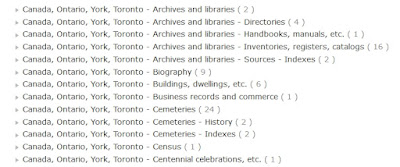
Screen capture of the partial list of subjects found in the "Canada, Ontario, York, Toronto" catalogue on FamilySearch.

You will see a really long list of possible subjects for just "Canada, Ontario, York, Toronto" but notice that one of the items is "Cemeteries". In the parentheses it indicates that there are 24 collections within. Clicking on that line will open up the list of collections. Even though I'm focusing on just a few of the items in the list make sure you glance through the full list. The ones I'm focused on for now are these four:

Screen capture of four burial records/registers of the Toronto Trust Cemeteries listed in Cemeteries within "Canada, Ontario, York, Toronto".

I'm going to pick on Prospect cemetery to highlight what can be found in most of those collections.
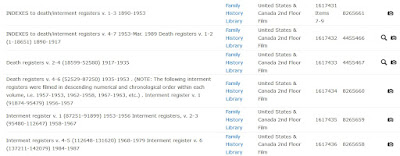
Screen capture showing death registers and interment registers for Prospect Cemetery in Toronto, Ontario, Canada found on FamilySearch.

Looking at the above image you might note that there are death registers and interment registers. If we look back at the list of images returned from the "Canada, Ontario, Toronto Trust Cemeteries, 1826-1989" search page and compare it to this list then you can see that the first "Volume 04", which has a date range of 1930-1935, is probably for a Death register. What about the second "Volume 04" from 1953-1962? That is probably from the "INDEXES to death/interment registers v.4-7" which started in 1953. So that searchable name index is probably a combination of an index created from the death registers directly and a a transcription of an existing index. Confused? That's normal so don't worry!

You might have also noticed that only two of the digitized items have a magnifying glass on the right side. Those are the ones which are searchable. The rest...well...we have to do the work by looking in those digitized but non-computer searchable indexes to find the number of the entry in the death or interment register. Then we have to manually go through the death/interment registers to find that number. I'm not going to walk you through how to bounce (my term for how I use the digitized images on FamilySearch) through the images of the pages from the index. It is just one of those skills you pick up the more you use FamilySearch. But it really isn't too hard!

From a death notice in the Toronto Star I know that my great-grandfather, George Kaye Warrener, who died in 1945 was supposed to have been buried in Prospect Cemetery. In theory I should be able to find him in the "INDEXES to death/interment registers v. 1-3 1890-1953". It is also important to realize that those digitized set of images are not the only collections on this specific virtual microfilm but are found in items 7-9. So I had to "fast forward" through the images and then take a look in each of the three registers.

"Index to Death Register, v. 2,"  FamilySearch, Images (www.familysearch.org : accessed 9 Feb 2022), p. 558, George Kaye Warrener [ name highlighted in a red box]; citing DGS 8265661, item 8, image 935 of 1113.
"Index to Death Register, v. 2,"  FamilySearch, Images (www.familysearch.org : accessed 9 Feb 2022), p. 558, George Kaye Warrener [ name highlighted in a red box]; citing DGS 8265661, item 8, image 935 of 1113.

Here he is in the index to the death registers. Since there was more than one index register I had to start with the first one and then move on to the next. I now know I need to find the death/interment register book which has number 71002 in it.

Even without knowing his date of death I could see that the "Death registers v. 4-6 (52529-87250)" is probably where I want to look. But note the little gotcha for the Interment registers:

(NOTE: The following interment registers were filmed in descending numerical and chronological order within each volume, i.e. 1957-1953, 1962-1958, 1967-1963, etc.)

This can really mess you up if you are expecting the pages for 1953 to be first in order in the images. So always read and pay attention to the notes. They are important!

Quickly I was able to find the page in the Death register with the entry for George Kaye Warrener. Since these registers are really two pages make sure you review the left and right page to see all the information.

"Death Register, v. 5,"  FamilySearch, Images (www.familysearch.org : accessed 9 Feb 2022), p. 267, no. 71002, George Kaye Warrener; citing DGS 8265660, item 2, image 371 of 841.
"Death Register, v. 5,"  FamilySearch, Images (www.familysearch.org : accessed 9 Feb 2022), p. 267, no. 71002, George Kaye Warrener; citing DGS 8265660, item 2, image 371 of 841.

From the left side of the page, if I didn't already have his date of death I now know it is 26 Feb 1945, that he died of myocarditis, and he was interred on 1 Mar 1945. On the right side of the page I learn that he was buried in section 26, lot 625 and the owner of that lot is Ernest and Mary Palmer. Also the nearest relation is Mrs. Henrietta Warrener of 688 Gladstone Avenue. Because this is my own family line I know that Henrietta is his wife.

What next?

It just so happens, at least for the Prospect, Mount Pleasant, and Necropolis Cemeteries, the Plot cards have also been digitized and made available to us also on FamilySearch. Looking at the list of digitized records I see that I need to look at FHL 1493608/DGS 8738039 "Plot cards: Section 26 (no. 426-942) Sections 27-28 Section 30 (no. 1-750)" to locate the plot card.

"Plot cards: Section 26 (no. 426-942) Sections 27-28 Section 30 (no. 1-750),"  FamilySearch, Images (www.familysearch.org : accessed 9 Feb 2022), Section 26, Lot 625; citing DGS 8738039, item 1, image 407 of 3078.
"Plot cards: Section 26 (no. 426-942) Sections 27-28 Section 30 (no. 1-750),"  FamilySearch, Images (www.familysearch.org : accessed 9 Feb 2022), Section 26, Lot 625; citing DGS 8738039, item 1, image 407 of 3078.

Now we know who is buried in Section 26, Lot 625 and even the dates of death. Those other two buried with George Kaye Warrener? From my research I know that Mary Adele Palmer is his daughter (my grand-aunt) and Ernest George Palmer is Mary's husband. I now have their register numbers and dates of death so I can quickly look up their entries in the death/interment registers.

But don't stop there!

If you go to the next image you will even see how the grave has been laid out. How cool is that!

"Plot cards: Section 26 (no. 426-942) Sections 27-28 Section 30 (no. 1-750),"  FamilySearch, Images (www.familysearch.org : accessed 9 Feb 2022), Section 26, Lot 625, plot layout; citing DGS 8738039, item 1, image 408 of 3078.
"Plot cards: Section 26 (no. 426-942) Sections 27-28 Section 30 (no. 1-750),"  FamilySearch, Images (www.familysearch.org : accessed 9 Feb 2022), Section 26, Lot 625, plot layout; citing DGS 8738039, item 1, image 408 of 3078.

Yet wait a second. Where is his wife Henrietta? She's not buried with him. From her death notice in the Toronto Star I know that she died in 1966 and never remarried. Is there any record of her?

Well, yes. In the "Crematorium records, 1933-1989" collection with "Toronto Crematorium (Ontario); Toronto Trust Cemeteries (Ontario)" listed as the author. Just like with the burial registers I soon found an entry for Henrietta Jane Whitfield Warrener, page 9358. This is one of the registers which was filmed backwards but it still didn't take long to find her in the cremation register.

"Cremation Register, v. 2,"  FamilySearch, Images (www.familysearch.org : accessed 9 Feb 2022), no. 9358, Henrietta Jane Whitfield Warrener; citing DGS 8362351, item 1, image 205 of 1170.
"Cremation Register, v. 2,"  FamilySearch, Images (www.familysearch.org : accessed 9 Feb 2022), no. 9358, Henrietta Jane Whitfield Warrener [image formatted for blog]; citing DGS 8362351, item 1, image 205 of 1170.

In that entry, on the far right side we can see that there is a notation of "Remains sent to Hespeler on Nov. 22/66".

There is even a collection of a number of digitized images from the Mount Pleasant Group from 1989 to 1995 titled "Ontario, Toronto cemetery records, 1989-1995" available for one to review from the comfort of one's home. Not just for the Necropolis, Prospect, or Mount Pleasant cemeteries but for several others managed by the Mount Pleasant Group.

Of course these collection aren't just the only resources for you if you have ancestors or relatives buried in those cemeteries. The Mount Pleasant Group has a database on their site called "Find A Grave". There are a few challenges with using this database since you have to know the cemetery the person is interred plus you need to know how the surname has been spelled in the database. Also you have to provide at least an initial for the first name. But it might help you find details about where someone is buried. Here is what was returned when I searched their site for Prospect Cemetery, surname: Warrener, first name: G

  • Given Name: George Kage
  • Surname: Warrener
  • Year of Burial: 1945
  • Age of Deceased: 0
  • Property Type: Land
  • Section: 26
  • Lot: 625

What is nice about the Mount Pleasant Group Find A Grave database is that they also provide a map so you can visit where the person is buried. This is always handy when dealing with large cemeteries. Additionally, with the section and lot information I could have gone directly to the Plot Cards to find his register number and then look him up the death/interment register.

Then there is also Find a Grave to help you locate a burial. However, with Find a Grave the information is quite often provided by volunteers based not just on what may be recorded on a marker but from their own research. So I always treat what is on Find a Grave as a clue unless I can actually view an image of the marker. Even then there may be errors.

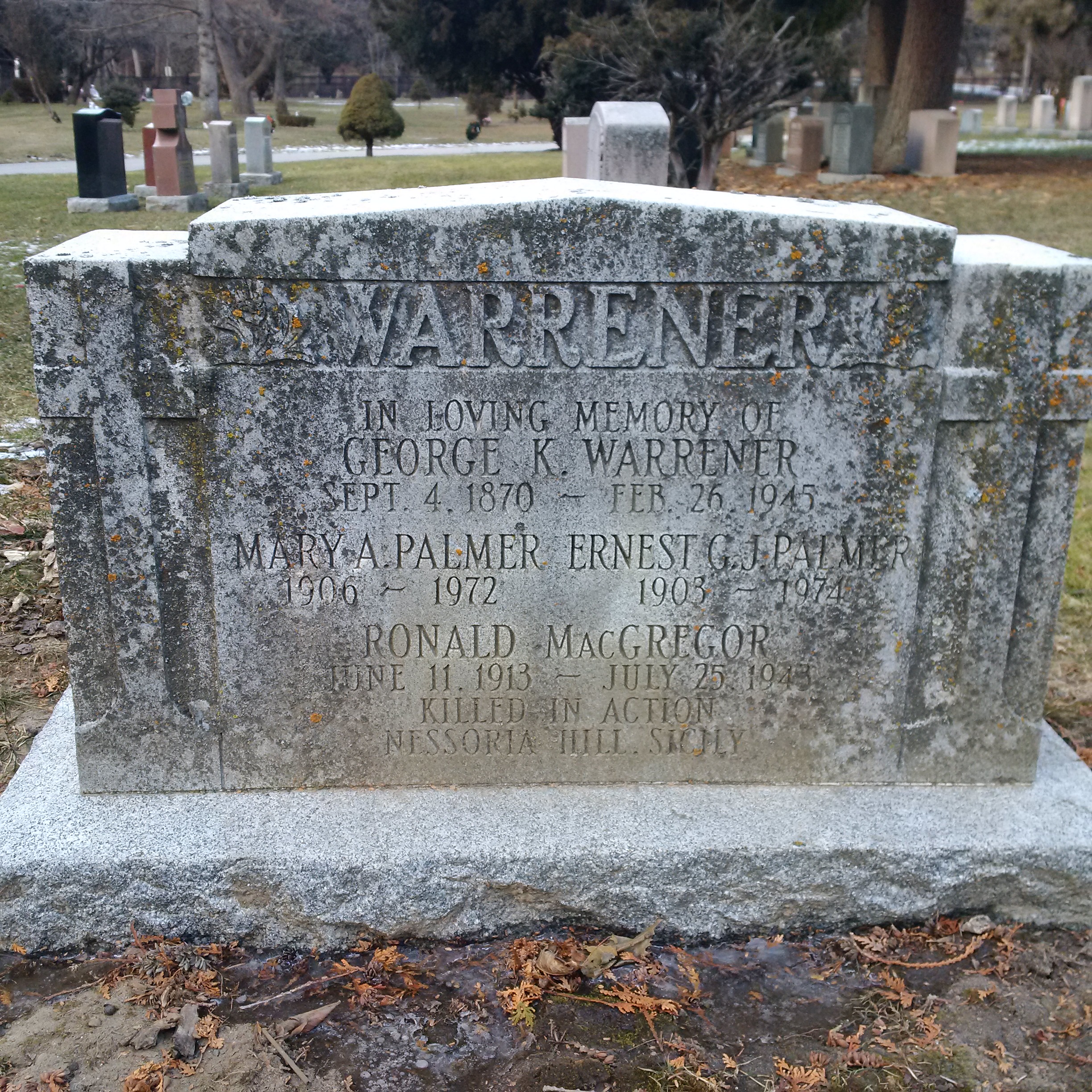
Here is the marker for George Kaye Warrener in Prospect Cemetery from his entry on Find a Grave.

Find a Grave, database and images (https://www.findagrave.com/memorial/169703644/george-kaye-warrener : accessed 9 February 2022), memorial page for George Kaye Warrener (1870–1945), Find a Grave Memorial ID 169703644, citing Prospect Cemetery, Toronto, Toronto Municipality, Ontario, Canada ; Maintained by Family Foliage (contributor 49085284).

You might notice a Ronald MacGregor Warrener recorded on that marker yet he's not listed on the plot card. Is the plot card wrong? Not at all! Ronald is actually buried with his fallen comrades at the Agira Canadian War Cemetery in Sicily. Just another reminder that one can't believe that everyone listed on a grave marker or memorial stone is actually buried there.

There are many other sites to help you in your search of an ancestor or relative in these cemeteries such as:


Happy researching!


[2024 Jan 28: With the changes to the FamilySearch Catalog when it comes to searching by places in Ontario, see the post "Toronto Trust Cemeteries on FamilySearch - Updated" for a different way of locating these collections on FamilySearch

Monday, September 28, 2020

Same Name, Different Person?

In my post, Not Trusting Trees -or- Make Sure You Read the Records!, I focused on the parents of Louisa Coulston/Colston Golding and the challenge with figuring out the maiden surname of her mother, Susanna. In this post I will look at the husband of Louisa, one Reuben Charles Short of England later of London, Middlesex County, Ontario, Canada.

According to the chart found in the family bible Reuben Charles Short was born 31 Mar 1807 and died 17 Mar 1880. As I had mentioned in the research concerning the mother of Louisa, charts found in family bibles always need to be taken with a grain of salt and backed up with other documents such as ecclesiastical and government created records. So far the information recorded in this specific family chart actually matches with the other records I've uncovered. So I trust it...as much as I trust any other record.

In the parish register for St. Michael Bassishaw in London, England we find a marriage recorded in Ancestry's "London, England, Church of England Marriages and Banns, 1754-1932" collection between Reuben Short and Louisa Coulston Golding taking place on 24 Mar 1829. 

"London, England, Church of England Marriages and Banns, 1754-1932," database and images, Ancestry Operations, Inc., Ancestry (www.ancestry.com : accessed 7 Sep 2020), Reuben Short and Louisa Coulston Golding, married 24 Mar 1829; citing London Metropolitan Archives; London, England; Reference Number: P69/MIC1/A/01/Ms 6990/1; Marriage register for St Michael Bassishaw, 1813-1835, p 63.
"London, England, Church of England Marriages and Banns, 1754-1932," database and images, Ancestry Operations, Inc., Ancestry (www.ancestry.com : accessed 7 Sep 2020), Reuben Short and Louisa Coulston Golding, married 24 Mar 1829; citing London Metropolitan Archives; London, England; Reference Number: P69/MIC1/A/01/Ms 6990/1; Marriage register for St Michael Bassishaw, 1813-1835, p 63.

To add a little bit to the confusion to Louisa's middle name she writes it as "Coston". Why do I think it is her handwriting and not that of the priest or clerk? This is where we have to look at the page as a whole. If she didn't know how to write her name the signature would have been like that of the witness to the following recorded marriage, "Ann Pyatt her Mark X". Also the letters, especially the 'd' in Golding, look different when compared to the rest of the record and page.

Unfortunately, unlike in the civil marriage registrations that started 1 Jul 1837 in England and Wales, the names of any parents are generally not recorded in parish marriage registers. This leaves us with a challenge, who are Reuben Charles Short's parents and where in England was Reuben born?

Once again I turned to the family trees on Ancestry that have been created by users of that site for potential clues. And much like the challenges with figuring out the maiden surname of Louisa's mother, Susanna, we face some in interesting challenges. Here an example of one profile hint from Ancestry:

Screen capture of an Ancestry profile hint for Reuben Edward Short Sr.

A few things I need to address or point out.

  • For the profile picture they are using the image of the family tree from the Short bible. That is the same family tree chart that I've also been using as a relatively trusted source. That document has recorded within the names of the children along with dates of significant events for that family.
  • Reuben's full name, according to that family chart is recorded not just once but twice as "Reuben Charles Short". The use of the "Sr" (senior) may have been used to distinguish him from his son, Reuben Edward Short especially if only the first name is used in business or in the family. Even his grave marker, as you will read a little further on, records his name as Reubn C Short.
  • Reuben was born in London, Middlesex, England. However, some have him also baptized on 5 Apr 1807 in Swanage, Dorset, England.
  • Reuben's father's name is Thomas Short and mother's name is Sarah Martin.
  • Six children are listed: Matilda Susannah (1829-1885), Louisa Susannah (1832-1903), Reuben Edward (1935-1928), Sarah Ann (1838-1913), Eliza Jane (1938-1902), and Fanny Charlotte (1842-1918). However, in the family chart found in the bible there is one other daughter, Elizabeth (1841-?). She is listed under the deaths on the chart but without a date recorded. Possibly the creator of the family chart didn't know when she died.

Knowing the dates of when the children were born is another little tidbit that may help us out in locating or even dismissing records in England: Reuben Charles' son Reuben Edward was born in England on 18 Mar 1835 and the next child, Sarah Ann, was born in Canada in 14 Oct 1837 with the remaining children also born in Canada. Reuben is also found in the 1871 census of Canada in the Township of London, Middlesex County, Ontario, Canada with wife Louisa and daughter Eliza Jane. His entry in that census is sandwiched between the family of his daughter Matilda, now married to William McKnight, and the household of his son Reuben. I've not yet found him in the earlier decennial censuses of Canada West.

So why do some have Reuben Charles Short born in London, Middlesex, England while also having him baptized some distance away in Swanage, Dorset, England. It comes down to two different sets of records. The first is a baptism record for a Reuben, child of Thomas and Sarah Short in 1807.

"Dorset, England, Church of England Baptisms, Marriages and Burials, 1538-1812," database and images, Ancestry Operations, Inc., Ancestry (www.ancestry.com : accessed 23 Sep 2020), Reuben of Thomas and Sarah Short, baptized 5 Apr 1807; citing Dorset History Centre; Dorchester, England; Dorset Parish Registers; Reference: PE/SW:RE6; Parish of Swanage.
"Dorset, England, Church of England Baptisms, Marriages and Burials, 1538-1812," database and images, Ancestry Operations, Inc., Ancestry (www.ancestry.com : accessed 23 Sep 2020), Reuben, of Thomas and Sarah Short, baptized 5 Apr 1807; citing Dorset History Centre; Dorchester, England; Dorset Parish Registers; Reference: PE/SW:RE6; Parish of Swanage.

The other is the entry for Find A Grave for Reuben Edward Short Sr. in Mount Pleasant Cemetery and Crematorium in London, Middlesex County, Ontario, Canada1 where someone has written:

REUBEN EDWARD SHORT was born and lived near St. Paul's Cathedral, London, England. He, his wife, two daughters and his son-age one left England in 1836 in a sailing vessel that took 7 weeks to reach America. He settled in Toronto, Canada for four years then went to London, Ontario, where he lived the balance of his life. He was in the shoe making business with his brother and built a log cabin. [Source unknown]

What would have been really nice to read in that Find A Grave memorial page was the source of that information. Also, the memorial page for Reuben on Find A Grave is without an image so how do we know that it is Reuben Edward Short written on the marker? Well, it isn't. The CanadaGenWeb's Cemetery Project has taken photographs of many of the markers on the grounds of Mount Pleasant Cemetery and Crematorium and Reuben's is one of them. The name engraved on the marker appears to my eyes to be "Reubn C Short"2

If that wasn't confusing enough, some people have linked a 1841 census of England to Reuben in their trees. Yet based on the places of birth for his children, he was residing in Canada by that time. That 1841 census of the Parish of Wimborne Minster, Dorset records a Reuben Short, age 35 years, born in Dorset County. Keeping in mind that in the 1841 census of England the ages were rounded down to the nearest multiple of five for those over 15 years of age, could that entry actually be referring to the the Reuben, child of Thomas and Sarah Short?

Curiously, on FamilySearch there is an indexed entry from the "England, Dorset, Parish Registers, 1538-2001" collection for a baptism of an Ellen Short, daughter of Reuben and Catherine Short taking place on 12 Jul 1840 in Wimborne Minster. In the "England and Wales Marriage Registration Index, 1837-2005" collection on FamilySearch we find a Reuben Short listed in the index along with a Catherine Mary Ann Primmer with their marriage registered in the 4th quarter of 1839 in the Southampton registration district.

The tricky part in using church records is that not all the parish registers have survived and not all have been digitized or even indexed. So where else can we turn to in these COVID-19 times when archives and libraries are effectively out of bounds for us? How about online newspaper collections. For this I looked to the British newspapers collection on Findmypast.

In the 19 Nov 1840 edition of the Dorset County Chronicle there is a servant, Reuben Short, recorded as a hedger3 with a master named Mr. Harry Small. He performed his hedging task in 2 hours 33 minutes. This was an actual event offered by the Blandford Agricultural Society in a Ploughing and Hedging competition on 11 Nov 1840. There are also mentions of Reuben Short in Lincolnshire and Wiltshire having to do with various criminal activities...all after when Reuben Charles Short was supposedly in Canada.

Could there be at least two Reuben Shorts born around the same time period in England? One that left England for Upper Canada and others that remained behind? The more I look at the records and explore other resources the more I have come to the option that there are indeed at least two people named Reuben Short.

What have we learned from this little exercise?

  1. Family trees may not always be correct. It doesn't matter if they are online trees or books compiled a century ago. The information found within need to be looked at with a critical eye and, where ever possible, verified against surviving records.
  2. Find A Grave entries or those found on any other grave marker site, unless accompanied by the image of the marker, should be treated as suspect.
  3. Newspapers can help when looking for a person. Of course, they may just highlight the issue of "same name, different person" like in this case.
  4. Family bibles and family charts can be invaluable but, like online family trees, the events recorded need to be corroborated.

So, at least for now, the names of the parents of Reuben Charles Short will have to remain a mystery.


1.  Find a Grave, database and images (https://www.findagrave.com : accessed 22 September 2020), memorial page for Reuben Edward Short Sr. (1807–17 Mar 1880), Find a Grave Memorial no. 33292270, citing Mount Pleasant Cemetery and Crematorium, London, Middlesex County, Ontario, Canada ; Maintained by Find a Grave (contributor 8). 

2. CanadaGenWeb, CanadaGenWeb's Cemetery Project, digital images (http://cemetery.canadagenweb.org/  : accessed 4 Sep 2020), memorial page for Reuben C Short (1807-1880), citing Mount Pleasant Cemetery, Middlesex County, Ontario, Canada; photographed by Margaret Yasui.

3. Hedger? What's a hedger? Someone who makes and trims hedges of course! It was considered a skilled art.


Wednesday, March 11, 2020

Researching Canadian Soldiers Who Died in the Second World War

Cross of Sacrifice at Beechwood Cemetery, Ottawa, Ontario, Canada
Cross of Sacrifice at Beechwood Cemetery, Ottawa, Ontario, Canada.

With the 75th anniversary commemorating the end of the Second World War in Europe approaching I've been seeing a number of posts in various Facebook genealogy groups asking about how to research family members that served in that war. This post will focus on some of the key resources I use to find information about those Canadians that served and died during the Second World War.

As an aside, for records for those that survived the war you will need to visit the Library and Archives Canada page "Requests for Military Service Files". Be forewarned, there appears to be about a 14-18 month backlog in processing the requests. If the service member is still alive, make sure that they request their file right now. Once they pass away, for a period of 20 years, only limited personal information will be released to an immediate family member (spouse, parent, sibling, child or grandchild) of the individual concerned if proof of relationship and proof of death are provided.

My starting point for any of research of a Canadian that served and died in the military during the Second World War is the Second World War: 1939-1945 at Library and Archives Canada. From that page you can learn about what databases and records are available, read the research guides, and find other sources of possible information. You can also go to the Service Files of the Second World War - War Dead, 1939-1947 to start your search.

When you search you can just put in the surname and given name(s) of the person. However, if you click on "Show Advanced Search Options" you can fill in additional details. I normally don't use the advanced search fields but for a common name it might help limit the number of entries returned.
Partial screen capture from a search for William Smith in the Library and Archives Canada database "Service Files of the Second World War - War Dead, 1939-1947".


What you will hopefully see is a short list of results with their name, date of birth, date of death, service number, a an item number you can click on to see additional details and possibly download the service file. Most of the results won't have a PDF of the service file attached to them. In fact, only a very small number of the files have been digitized and placed on the Library and Archives Canada site. But don't fret for there are other ways of viewing the files. Keep in mind that the digitization efforts have focused on creating a "genealogy package". This is a selection of what has been determined to be the most relevant documents from the file which highlights the service including enlistment, units served with, family details, medal entitlements, and circumstances of death.

One of the easiest ways of view the files is through Ancestry in their Canada, WWII Service Files of War Dead, 1939-1947 collection. According to the Library and Archives Canada page you only need a free account and not a paid subscription to access this collection. Alternately, if you don't want to give Ancestry your e-mail address you can get access to the institution version of Ancestry at your local library or Family History Center (and affiliates).
Partial screen capture of the abstracted record for William Scott, service number K23205, in the Ancestry "Canada, WWII Service Files of War Dead, 1939-1947" collection.
When you do find the entry on Ancestry don't click on the "View" button. That will only bring you to the attestation paper. Instead, click on the "View File Start" since that will bring you to the start of the file folder. From there you can download to your computer the individual pages in the service file. Be forewarned, some of these files can get quite large but there are all kinds of interesting details in the files.

Now that you have the service file, what next?

Stop and take the time to read the file.

Then re-read that file.

And then once more read the file!

There are all kinds of nuggets of information in those files. Often I will go through the file five or six times and record the details into my own genealogy database. To help me decipher the abbreviations in the file I sometimes consult the "Military Abbreviations used in Service Files" page on the LAC web site.

Once that is done I usually head over to the Commonwealth War Graves Commission site to search for the person there. If the name is relatively common you will probably want to filter by "Served with" and the "War". On that site you may find the pages from the Graves Registration Reports, Graves Concentration Reports, and what was written on the grave marker or memorial.

Next I head off to the Canadian Virtual War Memorial to see what they might have on their site. Yu might find an image of the grave marker or memorial, a link to the Second World War Book of Remembrance, and, since people can upload their own images, sometimes copies of newspaper articles or pictures of the person.

If there was a grave marker but I haven't found an image of it yet I will check Find A Grave to see if someone has uploaded the picture. That is how I first saw the marker for my Grand Uncle Ronald MacGregor Warrener who was buried in the Agira Canadian War Cemetery in Italy.

In the service file you may come across a "Field Service" report that details the cause of death and where the body was initially buried.

Canada, "Military Service Record: William Scott, Regimental Number K23205, RG 24, Volume 27004," Field Report; Library and Archives Canada, Ottawa.

Often this is a temporary burial but it usually fairly close to where the person died. Sometimes there is enough information in the burial location to find the place on Google Maps. For maps from the war I will often head over to the Digital Archive @ McMaster University Library Maps Collection and select the World War II (1939-1945) collection. However, most of those maps are from before the Invasion of Normandy on 6 Jun 1944. But sometimes I get lucky and find a map from after the invasion that has the details I am looking for.

If you are looking for the War Diaries from the Second World War of the unit they served in you might be fortunate enough to find them digitized on the LAC partner site Héritage. Visit the War Diaries, Ship Logs and Operations Record Books page for details about how to search for any diaries held by Library and Archives Canada.
Sample page of a War Diary for the 3rd Canadian Infantry Division, microfilm T-10530, Library and Archives Canada, http://heritage.canadiana.ca/view/oocihm.lac_reel_t10530.
Keep in mind that these are not the diaries written by the person that served in the war but of the activities of the unit. However, there will be details about what was happening with the unit including where they may have run into the enemy.

Don't forget to do a Google search of the unit that they served in. There are books that have been written about the various units in the Second World War. For example, in the case of William Scott above, he was in the "65 Cdn A/Tk Bty 5 Cdn A/Tk Regt". This translates into "65th Canadian Anti-Tank Battery, 5th Canadian Anti-Tank Regiment". A search on the "5th Canadian Anti-Tank Regiment" yields a link to WorldCat where you can find the book "The History of the 5th Canadian Anti-tank Regiment : 10 Sept., 1941-10 June, 1945" about the regiment's role in the Second World War. There is even a book written about the battery William Scott was in called "The History of the 65th Canadian Anti-tank Battery, Royal Canadian Artillery : 9 September 1941- 20 September 1945".

If the regiment has a museum or an archivist, like the the 48th Highlanders of Canada which my Grand Uncle Ronald Warrener served in, then reach out to them to see what they might have in their files. I actually visited the museum of the 48th Highlanders of Canada on one of my trips to Toronto. They didn't have much on hand about Ronald but a few weeks later I received a package in the mail with a chapter describing the battle he was in and he was even mentioned by name. I returned the favour and sent what I had about Ronald back to them for their files.

Hopefully some of the sites and tips in this post will help you to learn more about those Canadians that served and died in the Second World War.

Tuesday, August 20, 2019

A Black Hole No Longer - Queens County, New Brunswick, Canada

One of the many challenges faced by genealogy and family history researchers is accessing records for places that are a distance from you. Even with the Internet, this problem still exists since many of the records are still only available in archives and libraries. This has long been the case for me when researching my ancestors that lived in Queens County, New Brunswick, Canada. For many years I considered that region of New Brunswick a genealogical black hole...people may have gone there but, aside from the decennial census, almost no trace could be found of them except in indexes. That is until recently.

NordNordWest. “File:Map of New Brunswick Highlighting Queens County.png.” Wikimedia Commons. Wikimedia Commons, January 29, 2010. https://commons.wikimedia.org/wiki/File:Map_of_New_Brunswick_highlighting_Queens_County.png.

In the past year the New Brunswick Genealogical Society has freely made available to all a number of publications on their web site. This includes two extremely useful books pertaining to Queens County. The first is the often referred to but hard to find History of Queens Co., N.B. by E. Stone Wiggins, LL.D. This work is the copy, made in 1993, by George H. Hayward, of the 1876 history of Queens County that was originally published, starting on 7 Oct 1876 and ending in 17 Feb 1877, in the Saint John, New Brunswick newspaper The Watchman. What makes this book so important for those researching families in Queens County is that there are short biographies of many families that resided in that county at that time.

The second book of particular interest to Queens County family history researchers is the Queens County, New Brunswick, Marriage Records, Registers A, B and C, 1812-1887 found on the New Brunswick Marriage Records page. This compilation by Elizabeth S. Sewell & George H. Hayward had been a challenge for researchers to find in their local libraries and archives. It is a challenge no longer.

However, that extract of the marriage records is just that...an extract. Here is a snippet of one of the families that I am particularly interested in, the Jenkins line.

Elizabeth S. Sewell and George H. Hayward, editors, Queens County, New Brunswick, Marriage Records, Registers A, B and C, 1812-1887  (Fredericton, New Brunswick: Elizabeth S. Sewell and George H. Hayward, August 2002),  51.
Elizabeth S. Sewell and George H. Hayward, editors, Queens County, New Brunswick, Marriage Records, Registers A, B and C, 1812-1887  (Fredericton, New Brunswick: Elizabeth S. Sewell and George H. Hayward, August 2002),  5.
What if you want to see where this information came from? The preface of the book states that the records were transcribed from Provincial Archives of New Brunswick microfilm reels F15491 and F15492. If you have access to a library that participates in the interlibrary loan program then you might be able to arrange to have those microfilms delivered to a local library for you to view.

However, this is another option and that is to visit a hopefully nearby Family History Center. Due to the massive microfilm digitization project undertaken by FamilySearch you can view and download pages from the digitized version of the Marriage registers A-C, 1812-1888, for Queens County, New Brunswick found on film 851191.

Here is the entry in the digitized microfilm of the marriage register for Maria Jenkins and W F Howe.

Queens, New Brunswick, Marriage registers A-C, 1812-1888, W. F. Howe-Maria Jenkins; FHL microfilm 851,191, image 442.
However, this isn't the original source of the information. A little bit of searching within the FamilySearch Catalog for "Canada, New Brunswick, Queens" results in finding several additional catalogue entries including Marriage certificates, 1812-1887.

Queens, New Brunswick, Marriage certificates, 1812-1887, W F Howe-Maria Jenkins; FHL microfilm 1,508,597, item 1, image 549.
Without being there for the marriage or holding the original piece of paper, this is as close as you are going to get to the register entry for Maria Jenkins and W F Howe (William Franklin Howe).

Of course, those aren't the only records available but due to the ravages of time we do get bitten at times when researching Queens County. For the 1851 census of New Brunswick that took place on 11 Jan 1851 the only sub-district where that census enumeration has survived for Queens County is for Wickham found on microfilms C-996 and M-74821. If you had family in the Gagetown area in 1861 you are also out of luck since those records haven't survived2.

We are fortunate that land books for Queens County have been preserved on microfilm and digitized for us. They can be found on FamilySearch in the New Brunswick, Queens County, deed registry books, 1786-1919; index, 1786-1993 collection. Much like the marriage registers above, there is no electronic index to bring you to the right page but with a little bit of practice and patience you can learn to find the right documents fairly quickly. Even better, unlike the digitized marriage registers and certificates, you can do the research from the comfort of your home.

The Provincial Archives of New Brunswick site also has a number of useful resources that covers Queens County that are easily and freely accessible from the comfort of your home. In no particular order:
  • Vital Statistics from Government Records (RS141): These are the birth, marriage, and death records in the government records that we always hope to find. You will find the images of the actual records. Keep in mind that not all counties started keeping records at the same time and not all records may have survived.
  • Daniel F Johnson's New Brunswick Newspaper Vital Statistics: This is the database created out the work primarily by Daniel F. Johnson and his extracts from newspapers. Whenever possible, try to view the source of the transcription. Sometimes you will find additional information that wasn't transcribed.
  • Index to Marriage Bonds 1810-1932 (RS551A): This is only an index of the marriage bonds. Keep in mind that the bonds do not mean they actually married. To see the microfilmed copy of the original bond you will need to order the applicable microfilm through the interlibrary loan program.
  • Wallace Hale's Early New Brunswick Probate, 1785-1835: This used to be a book that you could either purchase or get at your local library or archive. Now it is available online to search from your home. You will find extracts of the wills of some of the people that lived in Queens County.
  • Queens County Genealogical Guide: This has been put together by the Provincial Archives of New Brunswick to let you know what records and microfilms they have in their collections.
  • Place Names of New Brunswick - Queens County: If you can't quite read the name of a place that is scrawled in a record then maybe this page will be of great help. Along with a bit of information on the location often there is a cadastral map to view showing lots and owners.
  • Index to New Brunswick Land Grants, 1784-1997 (RS686): A searchable index, here you will find details about the size of the grant and the microfilm, volume, and page to view the grant.
For cemeteries there are a few online resources for you to peruse:
  • Find A Grave: Cemeteries in Queens County, New Brunswick: If a marker you are interested in hasn't been photographed you can always place a request. Keep in mind that it may take months (or even years) before some kind hearted person takes the photograph for you and places it on the site.
  • CanadaGenWeb's Cemetery Project: This project may also have photographs of markers or point you to resources where you can find transcriptions of the markers in a cemetery
  • Queens County GenWeb Cemeteries: This site has sort of survived the great Offlining of Rootsweb. Here you may be able to find images and/or transcriptions for a number of cemeteries. Be forewarned that there are still some issues with the pages with SSL security errors/warning.
  • Canadian Forces Base Gagetown Cemeteries: There are 44 cemeteries on the land occupied by CFB Gagetown including some in Queens County. Most of the markers have been photographed. Make sure you read the "Introduction" page to learn more about this project.
Knowing who might have received property and goods after someone dies can help establish family relationships. The digitized microfilms in the Probate record books, 1788-1941 and Probate records, 1785-1885 collections are available for viewing at your local Family History Center. There are no quick and simple searchable indexes to those films but they have digitized the indexes to the volumes to help you find the right book to review.

Don't forget to check the Queens County Heritage site to view their virtual exhibition or, if you are a descendant of Samuel Tilley UE, read the Some Descendant of Samuel Tilley, UE c1740-1814 genealogy.

I hope that this helps you out if you too have ancestors that lived in Queens County, New Brunswick, Canada.


1. See Districts and Sub-districts: Census of 1851, New Brunswick on the Library and Archives Canada web site to find out what other enumerations didn't survive.
2. See Districts and Sub-district: Census of 1861, New Brunswick.