Wednesday, March 2, 2022

Elizabeth Florence Moodie...who's child is she?

Most of the time I write about different research techniques I use to solve a genealogy puzzle which comes my way either via a post in a group on Facebook or from the discussions in the Ottawa OGS/OPL genealogy drop-in. This time it is actually an issue I stumbled upon while reviewing a branch of my own tree. 

It all started with the following tree hint for Thomas Moodie who was born 25 Dec 1839 in Upper Canada and died 8 Dec 1913 in Perth, Lanark County, Ontario, Canada.
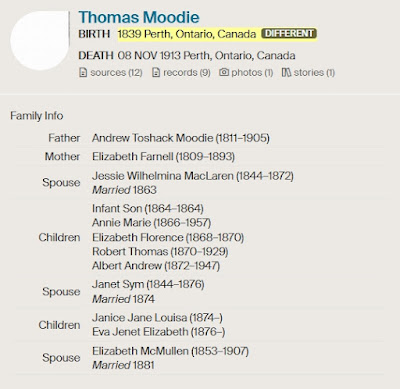
Screen capture from Ancestry for a family tree hint for Thomas Moodie (1839-1913), retrieved 2 Mar 2022.

Since I barely trust my own tree I'm definitely not going to trust what someone has recorded in their tree. So I, and hopefully you also, only use the hints from other trees as leads to follow up on. The majority of the time I can quickly discard the extra child or spouse. Yet in this case it sort of fit.

The extra child in this family was Elizabeth Florence Moodie (1868-1870). The reason I didn't immediately ignore this child was that she fit nicely in the gap between Annie Marie Moodie (1866-?) and Robert Thomas Moodie (1870-1929). The big stumbling block in just accepting this as correct is that the own of the tree didn't cite any sources. So it was off to do my own research.

The first step was just typing in Elizabeth Florence Moodie into Google (or your favourite search engine) to see what popped up. The second result was for a profile on WikiTree for an Elizabeth Florence Moodie born in 1868.

Screen capture of the WikiTree profile for Elizabeth Florence Moodie (1868), ID Moodie-204, retrieved 2 Mar 2022.

There (at least as on 2 Mar 2022) she is recorded as the daughter of Alexander Moodie and Rebecca Ferrier. Right away I know that something is not quite right with this profile information since it is unlikely that Elizabeth was actually born in "St Andrews Presby Church, Perth, Larark, Ont.". But it did give me a clue as to where to look...the church registers of St. Andrew's Presbyterian Church in Perth, Lanark County, Ontario, Canada. I've used those registers before and a digitized copy of the microfilm of the original records held at Library and Archives Canada are available on FamilySearch under "Church records, 1830-1887" for the Presbyterian Church in Canada. St. Andrew (Perth, Ontario).

St. Andrew's Church Presbyterian Church (Perth, Ontario, Canada), "Register of Baptisms St. Andrews Church Perth U.C.," baptism of Elizabeth Florence Moodie, born 21 Jul 1868, baptized 13 Mar 1869; FHL microfilm 8,632,136, image 60.

That baptism entry records that she was born 21 Jul 1868 and baptized 13 Mar 1869, the child of Alexander Moodie and Ferrier of the township of North Burgess. What is interesting is that her mother's first name is not recorded.

What about finding her death in the same book or books? It wasn't too difficult to find the start of the burials on that same digitized microfilm beginning at image 72.

St. Andrew's Church Presbyterian Church (Perth, Ontario, Canada), "Burials.," burial of Elizabeth Florence Moodie, died 13 Oct 1870; FHL microfilm 8,632,136, image 78.

There it records that Elizabeth Florence Moodie residing in N. Elmsley [North Elmsley], born in Canada, died  Oct 13 [1870] (July 21) [written above], age 2y 2m. The age and the "July 21" written above the Oct 13 matches the date of her birth found in the baptism register. Even the age matches closely to Elizabeth's age. Yet no parents are recorded.

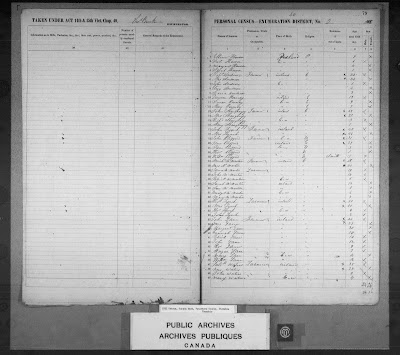
Fortunately she died in 1870 and the 1871 Census of Canada has "Schedule No. 2 - Nominal Return of the Deaths within last twelve months." and that schedule, like all nine other schedules for the 1871 Census of Canada, has survived and has even been digitized.

“Census of Canada, 1871,” images, Library and Archives Canada (https://central.bac-lac.gc.ca/.item/?app=Census1871&op=img&id=4396356_00287 : accessed 2 Mar 2022), Schedule No. 2, line for Elizabeth Florence Moodie (age 2 years); citing Ontario Province, Lanark South (79) District, Elmsley North (C) Sub-District, p. 1.

There it has been recorded that Elizabeth Florence Moodie, female, age 2 years, C Pres [Canadian Presbyterian Church as the religion], died Sept from a bowel complaint and she was sick for 2 weeks.

We are even lucky enough to find her Ontario civil registration of death:

Ancestry.com, "Ontario, Canada, Deaths, 1869-1938 and Deaths Overseas, 1939-1947," database with images, Ancestry.com (www.ancestry.com : accessed 1 Mar 2022), Elizbth F Moodie, died Sep 1870; citing Archives of Ontario; Toronto, Ontario, Canada; Collection: MS935; Reel 2, no. 013442.
Ancestry.com, "Ontario, Canada, Deaths, 1869-1938 and Deaths Overseas, 1939-1947," database with images, Ancestry.com (www.ancestry.com : accessed 2 Mar 2022), Elizbth F Moodie, died Sep 1870; citing Archives of Ontario; Toronto, Ontario, Canada; Collection: MS935; Reel 2, no. 013442.

But we have another mystery for both Schedule 2 of the 1871 Census and the Ontario civil death registration states that she died in Sep 1870 and not in October. What's going on here? The first thing that leaps out is that Thomas Moodie registered the death six months after Elizabeth died so he might not have had the correct date. Also in looking at the pages of "Schedule No. 1 - Nominal Return of the Living" from the 1871 Census it would seem that the household of Thomas Moodie was visited on 13 Apr 1871. With the law in effect as of 1 Jul 1869 for the civil registration of births, marriages, and death Thomas Moodie may have been advised that he had best register the death of Elizabeth before the enumerator came knocking on the door.

Something is curious on this death registration form though. If Alexander Moodie is supposed to be the father, a least according to that baptism register, why is Thomas Moodie of North Elmsley the informant?

Let's rewind just a little bit and go back to the WikiTree profile of the household of Alexander Moodie and Rebecca Ferrier. One of the siblings of the Elizabeth Florence Moodie is James A. Moodie. It so happens that he has a birth date recorded as 2 Oct 1868 on WikiTree. When I went to edit and save his profile to include a date and place of death, with a citation of course, WikiTree even brought it to my attention that another sibling had a birth date too close to his.

If Elizabeth Florence Moodie was born 21 Jul 1868 and James A. Moodie was born 2 Oct 1868 then they can't have the same mother. So I looked into James A. Moodie a little bit. On his 1944 Ontario civil death registration it states that the informant, his wife Sarah Jane, believed that James was born on 2 Oct 1868 and his parents were Alexander Moodie and Rebecca Ferrier. Even on the registration record for his marriage to Sarah J. Armstrong it states his parents are Alexander Moodie and Rebecca Ferrier. A quick check of the baptism register for St. Andrew's Presbyterian Church in Perth, Lanark County, Ontario finds on the page before Elizabeth's baptism the record of James' baptism in 11 Dec 1868 with a birth date recorded as 2 Oct 1868 and the father listed as Alexander Moodie and his mother Ferrier. Again, the mother's first name is not recorded.

Someone's record isn't telling the truth and my gut feeling is the baptism of Elizabeth is out of sorts.

But where to look next since "gut feelings" don't make for good citations?

A check of Find a Grave has a memorial page for Elizabeth Florence Moodie without an image. This always raises red flags for me since if the information in the memorial profile isn't recorded on the stone then where did the information come from?

In this case the biography provides some information concerning the source:

Name: Elizabeth Flora Moodie; Residence: N. Elmsley; Birthplace: Canada; Died: 13 Octr. (1870); Age: 2yr 2 mo. (July 21)
[St. Andrew's Burial Register]

Name: Moodie, Elizabeth Florence; Sex: F(emale); Age: 2; Religion: C. Pres.; Birthplace: O(ntario); Died: Sept.; Disease: Bowel Complaint
[1871 Census; N. Elmsley Twp., Lanark Co.]

I've already looked at those sources. Sigh.

Maybe there might be a newspaper clipping but I don't have a subscription to Paper of Record which has digitized the Perth Courier and, for right now, a visit to Library and Archives Canada is out of the question for me. But the Ontario GenWeb Project has a page for Lanark County which has a whole section with newspaper transcriptions from the Perth Courier which were supplied by Christine M. Spencer of Northwestern University in Evanston, Illinois. These transcriptions are even searchable via Google. The search I used was:

site:sites.rootsweb.com/~onlanark moodie

That "site:" thing tells Google to only search URLs starting with the address of "sites.rootsweb.com/~onlanark". Note that there is not a space after the colon (:).

Yet I don't find anything from around that time for the death of a child of a Moodie.

What about Alexander Moodie and his family? If the death in 1870 of Elizabeth Moodie was recorded in Schedule 2 in the Elmsley North sub-district then Alexander would have to be also living there. I already know that Thomas Moodie and his family were in that sub-district since they were found on page 34

I could take the easy way out and just rely on searching Ancetsry or any of the other genealogy sites for Alexander Moodie in Lanark county but this is one case I want to double check the indexes in the off chance that family was not transcribed. So first it was a check on Ancestry for any Alex Moodie in Lanark. Two results came back but only one had the right age. That was Alexander Moodie, age 40 years, residing in Burgess North sub-district, with wife "Rebcca" and children including a James who was 2 years old. That is highly likely the James we've already seen in the baptism register and tracked through his marriage and death. But no Alexander Moodie in Elmsley North. Even manually walking through the records for Elmsley North results in no Alexander Moodie.

So based on all these little but very important clues and records I can state with confidence that the baptism registration is incorrect when it comes to listing the parents of Elizabeth Florence Moodie.

Elizabeth Florence Moodie who was born 21 Jul 1868 and died 13 Oct 1870 is the daughter of Thomas Moodie and very likely her mother is Jessie McLaren. She is not the daughter of Alexander Moodie and Rebecca Ferrier.

I'm going to let this sit for a little while before I update WikiTree with my findings and also the one-world tree on FamilySearch (unless someone beats me to it). So I ask you, gentle reader, have I missed something? Is my analysis of the available records totally off base? Let me know what you think.

Monday, February 21, 2022

Case Study - Diving Deep into Ontario Lands Records

An intriguing question appeared in the Ontario Ancestors Facebook group I follow that got my attention since it involved a possible military and land record connection. These are two areas of genealogy research that can often lead to many challenges if you don't know where to look.
Be warned, this is a long post and covers quite a few digitized non-computer indexed collections to pull all the parts together. Yet it also highlights some of the skills needed to be developed beyond using the search systems on most genealogy sites.

Lorraine Foley posted:

Michael Cavanagh, born Ireland abt 1781 , was a soldier in France in 1817, had a child there, came to Canada 1818, and raised family around Perth or Huntley, Ontario. I have seen some military record possibilities, but without collaborating info, I don't know which one is him. I assume he was given land.

Lorraine provided some good bits of information but I needed a bit more. So after I posted a possible lead to a Sgt. Michael Cavanaugh who settled on lot 12 of the 9th concession in Bathurst township she replied back with:

The earliest I can find Michael is in the Richmond and Perth church records. The 1851/61 census state family lives in Huntley township. I am having no luck finding lot # for him in the land record sites mentioned by others below. 

That little bit of information about finding Michael in the 1851 and 1861 census enumerations of Canada West allowed me to start digging into the property records.

The first step for me would be to put the family "on the ground" and to locate them in the population schedule for the 1851/52 census and then find him hopefully in the agricultural schedule since that would provide me with a concession and lot number. But since so many of the agricultural schedules for the 1851/52 census of Canada West have been lost to the ravages of time I usually check the "Districts and Sub-districts: 1851 Census" page for Canada West on the Library and Archives Canada site before looking for something which might not exist. Huntley is in District 4, Carleton County and as we can see, the agricultural census is missing for the Huntley sub-district.

Sub-District
Number
Sub-District
Name
MicrofilmNotes
​24​FitzroyC-11716
​25GloucesterC-11716Agricultural census is missing.
​26​GoulbourneC-11716Agricultural census is missing.
​27​GowerC-11716Agricultural census is missing.
​28HuntleyC-11716Agricultural census is missing.
​29​MarchC-11716Agricultural census is missing.
​30​MarlboroughC-11716Agricultural census is missing.
​31​NepeanC-11716Agricultural census is missing.
​32​OsgoodeC-11716Only the agricultural census has survived.
​33​RichmondC-11716Agricultural census is missing.
​34​TorboltonC-11716Agricultural census is missing.

That is unfortunate but not unexpected. So on to the 1861 census since most of those agricultural schedules did survive.

I've already written about some of the challenges in using the 1861 Census of Canada West in my posts "A Challenge: 1861 Census of Canada - Agricultural Schedule" and "Missing images from the 1861 Census of Canada West on Ancestry?" but fortunately, at least in this case, I didn't run into these issues for Michael Cavanagh since I was only looking for the concession and lot details. However, there were other challenges (aren't there always!)

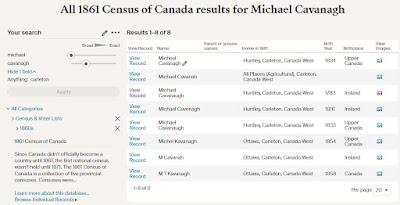
Screen capture of the results from searching the 1861 Census of Canada collection on Ancestry for Michael Cavanagh with the exact keyword of "carleton".

We find that there are several Michael Cavanaghs (with various spellings) in the Carleton district with their home in the Huntley sub-district. Only one stood out to me and that was the Michael Cavanaugh born in 1783 in Ireland since he matched the information provided my Lorraine. He was found in enumeration district number 7. However, to be on the safe side I checked the others:

  • Michael Cavenagh born 1816 in Ireland is recorded as single residing in enumeration district no. 5,
  • Michael Cavanagh born 1834 in Upper Canada is recorded as single residing in enumeration district no. 1 possibly in the household of John Cavanagh, and
  • Michael Cavanagh born in 1833 in Upper Canada is recorded as single residing in enumeration district no. 7 apparently in the household of the Michael Cavanaugh born 1873 in Ireland.

There is also that Michael Cavanah without a birth year and birth place with a home  of "All Places (Agricultural), Carleton, Canada West. Looking at the image we can see that it is for the agricultural schedule for enumeration district no. 7 in the Township of Huntley in Carleton County.

Census of 1861, Canada West, Carleton, Township of Huntley, Enumeration District No. 7, p 23 [stamped]; RG 31; digital images, Library and Archives Canada, Library and Archives Canada (www.bac-lac.gc.ca : accessed 16 Feb 2022); citing Library and Archives Canada microfilm C-1013.

Here we find a "Michael Cavanah" with property on lot 27 of the 11th concession in Huntley Township, Carleton County, Canada West. This looked very promising and Lorraine was able to confirm that was her "Michael Cavanagh".

That covers the easy work which most of us can do once we are familiar with using any of the major genealogy sites and searching the various censuses of Canada. Now we move away from the usual collections and on to Ontario land records and the challenges of looking at digitized microfilms.

Since we can now place Michael on the ground on lot 27 of the 11th concession in Huntley Township we can see if we can find him in the historical Abstract/Parcel Register Books within the Ontario Land Property Records Portal (AKA OnLand) or in the Abstract index books collections in the "Land and property" category for "Canada, Ontario, Carleton" on FamilySearch.

I personally like using the collections on FamilySearch since I don't have to worry about if OnLand is open for business when I'm searching Ontario land records late at night. Here is the start of the page for lot 27 on concession 11 in Huntley Township.

Abstract index books, ca. 1800-1959, of Carleton County, Huntley Township (v. A), Lot No. 27 Concession 11; Registrar's Office, Ottawa, Ontario; DGS 8,344,621, image 274, FamilySearch (https://www.familysearch.org/ark:/61903/3:1:3Q9M-CSTY-Z9FM-9 : accessed 16 Feb 2022).

It was fairly easy to find but it seems he received the land not from the Crown, like one might expect if it was from a grant, but from the Canada Company on 11 Apr 1835. He then sells the property to a Michael T Cavanagh on 23 Jul 1851...possibly his son?

Yet what got my attention was on the preceding page for the East 1/2 of lot 26 in the 11th concession of Huntley Township.

Abstract index books, ca. 1800-1959, of Carleton County, Huntley Township (v. A), East half Lot No. 26 Concession 11; Registrar's Office, Ottawa, Ontario; DGS 8,344,621, image 274, FamilySearch (https://www.familysearch.org/ark:/61903/3:1:3Q9M-CSTY-Z9FM-9 : accessed 16 Feb 2022).

Here a Michael Cavenagh received the land as a patent from the Crown on 13 Oct 1836 and then he sells it on 9 Mar 1937 to Andrew Whelan.

OK, time to pull in the sails and try another tack. Can I find information about that patent which was granted on 13 Oct 1836 on lot 26? Keep in mind that a patent isn't granted until all of the required duties to be performed on the land have been completed. So it may be a number of years from the time a petition is granted until a patent has been received.

This time it is over to the "Land Petitions of Upper Canada, 1763-1865" database at Library and Archives Canada. I've learned that for names which may have multiple interesting ways of being spelled to put in the minimum number of letters in the LAC database search system so I searched on the surname of "cav" and the given name "michael"

Screen capture of the results searching the Land Petitions of Upper Canada, 1763-1865 database on Library and Archives Canada for the surname "cav" and given name "michael".

Two results got my attention: the 1829 and the 1823 petitions. The 1848 petition is much too late for the patent granted in 1836.

Let's take a look at the 1823 petition found in the Upper Canada Sundries on microfilm C-4611 first since it is the earliest petition. The Upper Canada Sundries have been digitized on Héritage site of the Canadian Research Knowledge Network.

A search for microfilm C-4611 displays "Upper Canada Sundries : C-4611" at the top of the search results. Even better, almost all the pages have full-text search support. Searching for "cavanagh" gave me two matching pages: image 119 and image 781. Looking at image 119, in the top corner I could see "32254" stamped. This didn't match what was in the results from the Land Petitions of Upper Canada, 1763-1865 at LAC. However, image 781 has "32921" stamped in the corner and that is a number we want to see.

"Civil Secretary's Correspondence, Upper Canada Sundries, October-November 1823," page 1 of the petition of Michael Cavanagh, p. 32921 [stamped], image 781; digital images, Canadian Research Knowledge Network,  Héritage (https://heritage.canadiana.ca/ : accessed 16 Feb 2022); citing Library and Archives Canada, RG 5, A 1, vol. 62, pp 32850-33396, Reel C-4611.
"Civil Secretary's Correspondence, Upper Canada Sundries, October-November 1823," page 1 of the petition of Michael Cavanagh, p. 32921 [stamped], image 781; digital images, Canadian Research Knowledge Network,  Héritage (https://heritage.canadiana.ca/ : accessed 16 Feb 2022); citing Library and Archives Canada, RG 5, A 1, vol. 62, pp 32850-33396, Reel C-4611.

In this letter dated 13 Oct 1823 we learn some of the following details about Michael Cavanagh:

  • he was with the 57th Regiment of Foot
  • he was discharged in Vallencenes [Valenciennes] in France
  • he has been in Upper Canada for nearly three years
  • when he first went to apply for land he had four in his family left in Ireland
  • he initially applied in Lanark to get his "military locations" but was told the "land was of no use there was nether rations or utinsial alowed for me an to go an get my family before I trobled myself with land..."
  • it seems his family landed in St. John, New Brunswick and he has returned to Brockville, Upper Canada with his family

Alas, no details about if he was given land and where. Time to look at the next petition from 1829.

The microfilms for the RG 1 L3 reference are found in an archived microform collection on the LAC site. Most of the time I can't recall how I bookmarked it in my browser so I click on the "How to obtain copies" link found on the left side of the page where the results are displayed. There LAC has provided a link to "Upper Canada Land Petitions - Microform digitization". Microfilm C-1725 was easy to find and I clicked on that link.

After a bit of bouncing around the images I was able to relatively quickly find Upper Canada Land Petitions "C" Bundle 16, 1825-1831 (RG 1, L 3, vol. 109). That sort of information is supposed to be at the bottom of each microfilm image. The petition number is written at the top of the page in one of the corners. The first page of the bundle will just be a number and the subsequent pages will include a letter like "16a" followed by "16b", etc.

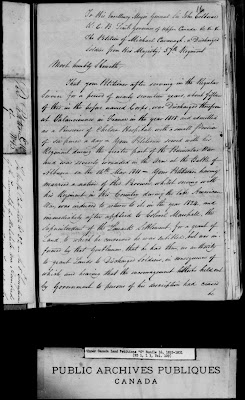
Here is the first of several pages from Michael Cavanagh's petition from 1829.

Upper Canada Land Petitions "C" Bundle 16, 1825-1831, Petition 16, page 1 of the petition of Michael Cavanagh; RG 1 L3, vol. 109, microfilm C-1725, images 758; Library and Archives Canada, Ottawa.

This petition has all kinds of wonderful details for this Michael Cavanagh such as:
  • he was a discharged soldier from his Majesty's 57th Regiment of Foot,
  • he was discharged at Valanciennes [Valenciennes] in France in 1818,
  • he served in the Peninsula War,
  • he was admitted as a pensioner of Chelsea Hospital with a small pension of 6 pence a day,
  • he was wounded in the arm at the Battle of Albuera on 16 May 1811, and
  • he now has five children to support.

It looks like he didn't get the reply he wanted from his 1823 petition and tried again but this time addressing it to the newly arrived Lieutenant Governor of Upper Canada His Excellency Major General Sir John Colborne KCB. It also seems that Michael served in the same brigade under Sir John.

Only one problem with this bundle...I didn't see any mention of what land was being granted to him only "In Council 6th Nov 1829 recommended as a discharged soldier for 100 acres". But at least we know that this petition was successful.

So it was off to the Ontario Crown Lands collection RG 1, C-I-3 which I had looked at in my post "Ontario Crown Land RG 1 C-I-1, C-I-2, C-I-3 Collections on FamilySearch". In that collection I had noticed a number of bundles for "Military warrants" on later pages.

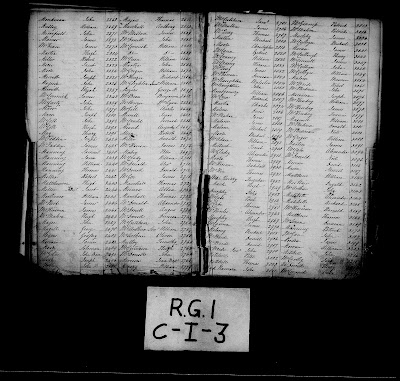
Looking through the "RG 1, C-I-3, vol. 124, Register for Military Warrants" found in the digitized collection on FamilySearch under "Military warrants (v. 124-125) 1799-1869 (indexed) Locations to discharged soldiers and seamen (v. 126) 1815-1822 (indexed) Nominal return of troops entitled to land for service in the War of 1812-1814 (v. 127) Photostatic copy of v. 127, Prince Regent's land grant to Flank companies militia U.C. War of 1812-1814 (v. 127A)" in FHL 1376096 / DGS 8346076 I found a Michael Cavanagh listed in the hand written index at the start with a reference to folio 47. Based on my experience that meant I needed to look for page 47 in this register.

"Military warrants (v. 124-125) 1799-1869 (indexed) Locations to discharged soldiers and seamen (v. 126) 1815-1822 (indexed) Nominal return of troops entitled to land for service in the War of 1812-1814 (v. 127) Photostatic copy of v. 127, Prince Regent's land grant to Flank companies militia U.C. War of 1812-1814 (v. 127A),"  FamilySearch, Images (www.familysearch.org : accessed 16 Feb 2022), R.G. 1, C-I-3, vol. 124, Register for Military Warrants, folio 47, Michael Cavanagh; citing DGS 8346076, item 1, image 79 of 744.
"Military warrants (v. 124-125) 1799-1869 (indexed) Locations to discharged soldiers and seamen (v. 126) 1815-1822 (indexed) Nominal return of troops entitled to land for service in the War of 1812-1814 (v. 127) Photostatic copy of v. 127, Prince Regent's land grant to Flank companies militia U.C. War of 1812-1814 (v. 127A),"  FamilySearch, Images (www.familysearch.org : accessed 16 Feb 2022), R.G. 1, C-I-3, vol. 124, Register for Military Warrants, folio 47, Michael Cavanagh; citing DGS 8346076, item 1, image 79 of 744.

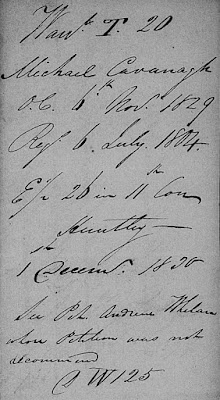
Above is the entry in this register for Michael Cavanagh. It is recorded that he is a "Soldier from the 57 Regiment of Foot As a discharged Soldier". What is even better is that it gives the location of the property as E 1/2 Lot 26 on the 11th Concession in Huntley. It was by the authority of OC 6 Nov 29 [Order in Council 6 Nov 1829] just like we saw in the bundle of his 1829 petition. This document ties the Michael Cavanagh found in the Land Petitions of Upper Canada to that property we found in the Abstract index books.

But we can't stop there since it gives a number for the warrant: T 20.

With a little bit of trial and error (how FamilySearch labels their collections can be a trial at times) I found the warrant in "Military warrants (v. 111-112) bundle A10-Z12, 1823-1829" (FHL 1376008 / DGS 8346063) under "R.G. 1, C-I-3, Vol. 112, Military Warrants, Bundle A19-Z21" starting at image 1294.

"Military warrants (v. 111-112) bundle A10-Z12, 1823-1829,"  FamilySearch, Images (www.familysearch.org : accessed 16 Feb 2022), R.G. 1, C-I-3, vol. 112, Military Warrants, bundle A19-Z21, Warrant T20, Michael Cavanagh; citing DGS 8346063, item 4, image 1294 of 1350.
"Military warrants (v. 111-112) bundle A10-Z12, 1823-1829,"  FamilySearch, Images (www.familysearch.org : accessed 16 Feb 2022), R.G. 1, C-I-3, vol. 112, Military Warrants, bundle A19-Z21, Warrant T20, Michael Cavanagh; citing DGS 8346063, item 4, image 1294 of 1350.

Looking within that bundle what do I see but a note from A Whelan...that same Andrew Whelan we saw in the Abstract index.

There is another place we can look for possible information about a property and that is in the Township Papers also found on FamilySearch within the Land and property category of "Canada, Ontario". There are actually two collection and both are labelled "Township papers, ca. 1783-1870's". One goes from A to H and the other goes from H to Z. What makes this a bit frustrating is that the index is not quite alphabetical by township name. So sometimes it takes a bit of effort to find the digitized microfilm for the township you are wanting. In the case of Huntley it wasn't too hard to find them and select "Huntley, North 1/2, Lot 1, 5th Con. to Lots17 & 18, 11th Con?" (FHL 1378112 / DGS 8346536). There I found the start of "Huntley Lots 26 & 27, Con. 11, Huntley". Within is a letter describing the issue concerning improvements made and confusion about who owned what part of the property. 

Of course, one might even look in the Deed books on FamilySearch for the instruments listed in the Abstract index books for the various transactions on the two properties on Concession 11 in Huntley Township which Michael owned for any additional insights into the property. 

Keep in mind that I'm just giving you the highlights of what I came across. Always read and then re-read all of the various documents, letters, and records for potential clues and hints as to where to look next.

The next step into learning more about Michael Cavanagh and his service to the Crown could be to look in the various registers concerning Chelsea Pensioners held by The National Archives (Kew, England). Some of these registers have been digitized and made available on sites such as Ancestry and Findmypast. There may be many Michael Cavanaghs listed but how many of them served in the 57th Regiment of Foot during the time of the Peninsular War? But I will leave that to you, gentle reader, to explore in your leisure.

As you can see, the process isn't always straight forward and we sometimes need to approach the research question from a different angle in order to connect the dots.


Monday, February 14, 2022

Ontario Crown Land RG 1 C-I-1, C-I-2, C-I-3 Collections on FamilySearch

Recently at the virtual Genealogy Drop-in jointly sponsored by the Ottawa Branch of The Ontario Genealogical Society and the Ottawa Public Library a question arose from one of our regular attendees concerning an entry in a set of digitized records available from FamilySearch and where to find the document in question the index points to. 

"Index to warrants (v. 57) 1816-1869,"  FamilySearch, Images (www.familysearch.org : accessed 10 Feb 2022), R.G. 1, C-I-3, Henry McCullough, 3043; citing DGS 8346013, item 6, image 934 of 965.
"Index to warrants (v. 57) 1816-1869,"  FamilySearch, Images (www.familysearch.org : accessed 10 Feb 2022), R.G. 1, C-I-3, Henry McCullough, 3043; citing DGS 8346013, item 6, image 934 of 965.

Fortunately they provided really useful information on how to find this image by posting in the chat the following information:

"https://www.familysearch.org/search/catalog/283269?availability=Family%20History%20Library on page 3 of 5 FHL DGS 8346013 image 934 of 965, first page at image 897" and also "Henry McCullough 3043" for the entry they had the question about.

Normally at these drop-in sessions we can use our collective experience in genealogy research to point people in a direction to continue their research...but not this time. So it remained unanswered during the meeting but I had a strange feeling that I had seen that designation of "R.G.1 C-I-3" somewhere before. So later that night I started actually reading the information provided on FamilySearch and paying attention to all the little clues.

The first step was to go back to catalogue entry 283269. In the FamilySearch Catalog it is recorded as "Land records, ca. 1792-1876". The notes also state:

"Microfilm of original records in possession of the Provincial Archivist, Ontario Archives, Toronto"

The first page consists of undigitized microfilms (actually microfiche) of the Ontario Archives land record index or OLRI so that probably explains why I really never paid much attention to this collection since I couldn't view them from home. I've been patiently hoping and waiting for this very useful set of microfiche to be digitized since they hold an index to land transactions between the Crown and individuals along with transactions between individuals and Canada Company or Peter Robinson.

Yet once again I'm proven wrong in another of my assumptions since if one goes to the next page of films, there are five in total, and scroll down the page there appears digitized microfilms. Many digitized microfilms/volumes/documents! 

But on with the looking into the original question.

If I was starting to look at this problem from the beginning the first thing I would do is to read the title card which can be found at the start of any collection digitized by the Genealogical Society Salt Lake City, Utah. The Genealogical Society Salt Lake City? For those who have been doing genealogy research in the days before digitization where one needed to visit a Family History Center to use microfilm readers you might know them through their initials "GSU" or as the "Genealogical Society of Utah". We now know them as FamilySearch. 

"Index to warrants (v. 57) 1816-1869,"  FamilySearch, Images (www.familysearch.org : accessed 10 Feb 2022), R.G. 1, C-I-3, Index Warrants, Regulations, 6 July 1804, vol. 57, microfilm title card; citing DGS 8346013, item 6, image 897 of 965.
"Index to warrants (v. 57) 1816-1869,"  FamilySearch, Images (www.familysearch.org : accessed 10 Feb 2022), R.G. 1, C-I-3, Index Warrants, Regulations, 6 July 1804, vol. 57, microfilm title card; citing DGS 8346013, item 6, image 897 of 965.

That card has all sorts of clues which I missed during the drop-in. First of all it tells me where it was filmed at: Ontario Archives in Toronto, Ontario. That place is more properly known as the Archives of Ontario. I probably wouldn't have spun my wheels using the "Search the Collection" feature at Library and Archives Canada if I had paid attention to this card or the notes in the catalogue description.

We also know that the records were held by the Crown Lands Department. The title or description of this specific set of digitized records is "R.G. 1, C-I-3, Index Warrants, Regulations, 6 July 1804, Vol. 57". The entry in the FamilySearch Catalog list for this digitized set of records is "Warrants, bundle 5775-5850 1858-1869 Register for warrants (R.J. no. 2) no. 1-366 (v. 54) 1819-1873 Index to warrants no. 1-366 (v. 55) 1820-1845 Index to warrants (books 4 and 6, R.J. no. 2) (v. 56) Index to warrants (v. 57) 1816-1869"

Scrolling through the list of digitized warrants after that catalogue entry I come to "Warrants (v. 61) no. 2801-3200, 1815-1816". That looks like a really promising collection since number 3043 is within that range.

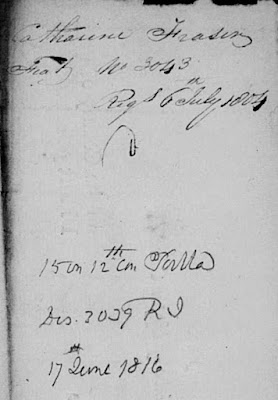
"Warrants (v. 61) no. 2801-3200, 1815-1816,"  FamilySearch, Images (www.familysearch.org : accessed 10 Feb 2022), R.G. 1, C-I-3, Warrants v. 61, bundles 3001-3100, no,. 3043, Catherine Fraser; citing DGS 8346020, item 3, image 897 of 1195.
"Warrants (v. 61) no. 2801-3200, 1815-1816,"  FamilySearch, Images (www.familysearch.org : accessed 10 Feb 2022), R.G. 1, C-I-3, Warrants v. 61, bundles 3001-3100, no,. 3043, Catherine Fraser; citing DGS 8346020, item 3, image 897 of 1195.

Only one problem, number 3043 in that volume is not for Henry McCullough but Catherine Fraser and there is no mention of a Henry McCullough on the subsequent documents in that packet.

Whereas Dr. Stephen Strange states "The warnings come *after* the spells" in the 2016 film "Doctor Strange" I'm thinking that the same sort of rule can apply to us here, except

The volume holding the index comes after the volumes with the bundles.

Looking at the digitized volumes before the index in volume 57 we find "Warrants (v. 43-44), bundle 2801-3060, 1824" in FHL 1318376/DGS 8345801. Again, it holds the correct range of bundles we are looking for.

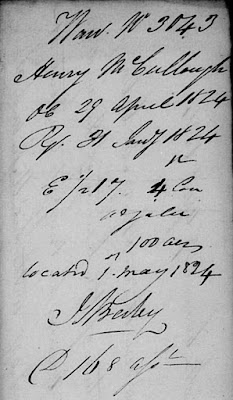
Fairly quickly I came across this image:

"Warrants (v. 43-44), bundle 2801-3060, 1824,"  FamilySearch, Images (www.familysearch.org : accessed 10 Feb 2022), R.G. 1, C-I-3, Warrants v. 44, bundles 3001-3100, no,. 3043, Henry McCullough; citing DGS 8345801, item 3, image 1291 of1391.
"Warrants (v. 43-44), bundle 2801-3060, 1824,"  FamilySearch, Images (www.familysearch.org : accessed 10 Feb 2022), R.G. 1, C-I-3, Warrants v. 44, bundles 3001-3100, no,. 3043, Henry McCullough; citing DGS 8345801, item 3, image 1291 of1391.

That certainly looks to be the right name and bundle number!

Additionally, now that I know that these collections come from the Archives of Ontario I can check the Archives of Ontario Archives Descriptive Database for "RG 1 C-I-3" (without the quotes) to learn more about these records. I quickly find that they have been renumbered since they were filmed by the GSU. I'll leave it to you to read through the numerous collection descriptions in that Archives Descriptive Database but if you are researching early Ontario land records this is yet another treasure trove for you to explore without having to brave the weather or traffic.

There are a few good takeaways from this little research journey:

  1. the RG 1 C-I-1, C-I-2, and C-I-3 collections from the Archives of Ontario are digitized and available for viewing from home,
  2. it always pays to check the other digitized volumes in a collection to see if there might be another item which could suit what is being sought, and
  3. assumptions will constantly cause us grief in our research!


Wednesday, February 9, 2022

Toronto Trust Cemeteries on FamilySearch

For those with ancestors and relatives who were buried in several of the Toronto Trust cemeteries FamilySearch has created a searchable name index as part of a project with the Toronto Branch of the Ontario Genealogical Society. You can find the search page at Canada, Ontario, Toronto Trust Cemeteries, 1826-1989.

Screen capture of the Canada, Ontario, Toronto Trust Cemeteries, 1826-1989 search page from FamilySearch.

However, just like any searchable database, before you dive right in and start your searching you really need to be aware of the limitations within that name index. 

Before you begin first click on that "How to use this collection" button on the search screen and read the page that appears. This helps set your expectations of what might be found in the searchable index. Note the cemeteries and the range of dates covered in the index:

  • York General Burying Ground (also called Potter’s Field), 1826-1855
  • Necropolis Cemetery, 1850-1912 (the index will continue to 1935)
  • Mount Pleasant Cemetery, 1876-1933
  • Prospect Cemetery, 1890-1935

You can even browse the images by clicking on the "Browse all 7,234 images" button. But, if you are like me, you will get very confused and puzzled when you see the list of volumes for the four cemeteries since, with the except of "Potters' Field Cemetery", they all have several volumes with the same volume number but different date ranges as you can see from this image for the image waypoints of Prospect Cemetery. There is also a gap in the dates for volume 4.

Screen capture of the image waypoints for Prospect Cemetery from the Canada, Ontario, Toronto Trust Cemeteries, 1826-1989 search page on FamilySearch.

So just where are these digitized volumes really found on FamilySearch?

For that we need to use the FamilySearch Catalog. If you aren't familiar with the catalogue then you are missing out on a huge (I mean really, really big!) part of FamilySearch. The catalogue is just that, a catalogue of all the books, manuscripts, microfilms, volumes, and digitized collections held by FamilySearch. Of course, not all of it is online. And even if it is online in a digitized format it may not be accessible from the comfort of your home due to licensing agreements. You can tell if a digitized set of records can only be viewed from a Family History Center or Affiliate since those records have a key above the camera icon in the collection list.

Just like searching the genealogy records, you can also search the FamilySearch Catalog [see the update at the end of this post for a better way to locate for this set of collections]. When searching for a place it goes from largest to smallest in terms of jurisdiction.

Screen capture of a search for the place Canada, Ontario, Toronto in the FamilySearch Catalog search screen.

You might note that it actually doesn't find "Canada, Ontario, Toronto" but the first item in the possible places to select from is "Canada, Ontario, York, Toronto". That is the place we want.

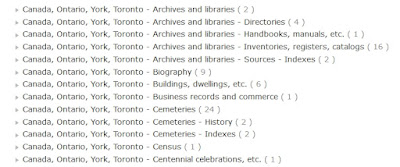
Screen capture of the partial list of subjects found in the "Canada, Ontario, York, Toronto" catalogue on FamilySearch.

You will see a really long list of possible subjects for just "Canada, Ontario, York, Toronto" but notice that one of the items is "Cemeteries". In the parentheses it indicates that there are 24 collections within. Clicking on that line will open up the list of collections. Even though I'm focusing on just a few of the items in the list make sure you glance through the full list. The ones I'm focused on for now are these four:

Screen capture of four burial records/registers of the Toronto Trust Cemeteries listed in Cemeteries within "Canada, Ontario, York, Toronto".

I'm going to pick on Prospect cemetery to highlight what can be found in most of those collections.

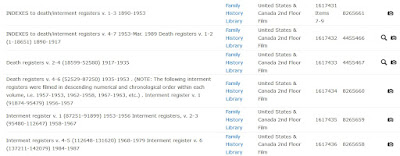
Screen capture showing death registers and interment registers for Prospect Cemetery in Toronto, Ontario, Canada found on FamilySearch.

Looking at the above image you might note that there are death registers and interment registers. If we look back at the list of images returned from the "Canada, Ontario, Toronto Trust Cemeteries, 1826-1989" search page and compare it to this list then you can see that the first "Volume 04", which has a date range of 1930-1935, is probably for a Death register. What about the second "Volume 04" from 1953-1962? That is probably from the "INDEXES to death/interment registers v.4-7" which started in 1953. So that searchable name index is probably a combination of an index created from the death registers directly and a a transcription of an existing index. Confused? That's normal so don't worry!

You might have also noticed that only two of the digitized items have a magnifying glass on the right side. Those are the ones which are searchable. The rest...well...we have to do the work by looking in those digitized but non-computer searchable indexes to find the number of the entry in the death or interment register. Then we have to manually go through the death/interment registers to find that number. I'm not going to walk you through how to bounce (my term for how I use the digitized images on FamilySearch) through the images of the pages from the index. It is just one of those skills you pick up the more you use FamilySearch. But it really isn't too hard!

From a death notice in the Toronto Star I know that my great-grandfather, George Kaye Warrener, who died in 1945 was supposed to have been buried in Prospect Cemetery. In theory I should be able to find him in the "INDEXES to death/interment registers v. 1-3 1890-1953". It is also important to realize that those digitized set of images are not the only collections on this specific virtual microfilm but are found in items 7-9. So I had to "fast forward" through the images and then take a look in each of the three registers.

"Index to Death Register, v. 2,"  FamilySearch, Images (www.familysearch.org : accessed 9 Feb 2022), p. 558, George Kaye Warrener [ name highlighted in a red box]; citing DGS 8265661, item 8, image 935 of 1113.
"Index to Death Register, v. 2,"  FamilySearch, Images (www.familysearch.org : accessed 9 Feb 2022), p. 558, George Kaye Warrener [ name highlighted in a red box]; citing DGS 8265661, item 8, image 935 of 1113.

Here he is in the index to the death registers. Since there was more than one index register I had to start with the first one and then move on to the next. I now know I need to find the death/interment register book which has number 71002 in it.

Even without knowing his date of death I could see that the "Death registers v. 4-6 (52529-87250)" is probably where I want to look. But note the little gotcha for the Interment registers:

(NOTE: The following interment registers were filmed in descending numerical and chronological order within each volume, i.e. 1957-1953, 1962-1958, 1967-1963, etc.)

This can really mess you up if you are expecting the pages for 1953 to be first in order in the images. So always read and pay attention to the notes. They are important!

Quickly I was able to find the page in the Death register with the entry for George Kaye Warrener. Since these registers are really two pages make sure you review the left and right page to see all the information.

"Death Register, v. 5,"  FamilySearch, Images (www.familysearch.org : accessed 9 Feb 2022), p. 267, no. 71002, George Kaye Warrener; citing DGS 8265660, item 2, image 371 of 841.
"Death Register, v. 5,"  FamilySearch, Images (www.familysearch.org : accessed 9 Feb 2022), p. 267, no. 71002, George Kaye Warrener; citing DGS 8265660, item 2, image 371 of 841.

From the left side of the page, if I didn't already have his date of death I now know it is 26 Feb 1945, that he died of myocarditis, and he was interred on 1 Mar 1945. On the right side of the page I learn that he was buried in section 26, lot 625 and the owner of that lot is Ernest and Mary Palmer. Also the nearest relation is Mrs. Henrietta Warrener of 688 Gladstone Avenue. Because this is my own family line I know that Henrietta is his wife.

What next?

It just so happens, at least for the Prospect, Mount Pleasant, and Necropolis Cemeteries, the Plot cards have also been digitized and made available to us also on FamilySearch. Looking at the list of digitized records I see that I need to look at FHL 1493608/DGS 8738039 "Plot cards: Section 26 (no. 426-942) Sections 27-28 Section 30 (no. 1-750)" to locate the plot card.

"Plot cards: Section 26 (no. 426-942) Sections 27-28 Section 30 (no. 1-750),"  FamilySearch, Images (www.familysearch.org : accessed 9 Feb 2022), Section 26, Lot 625; citing DGS 8738039, item 1, image 407 of 3078.
"Plot cards: Section 26 (no. 426-942) Sections 27-28 Section 30 (no. 1-750),"  FamilySearch, Images (www.familysearch.org : accessed 9 Feb 2022), Section 26, Lot 625; citing DGS 8738039, item 1, image 407 of 3078.

Now we know who is buried in Section 26, Lot 625 and even the dates of death. Those other two buried with George Kaye Warrener? From my research I know that Mary Adele Palmer is his daughter (my grand-aunt) and Ernest George Palmer is Mary's husband. I now have their register numbers and dates of death so I can quickly look up their entries in the death/interment registers.

But don't stop there!

If you go to the next image you will even see how the grave has been laid out. How cool is that!

"Plot cards: Section 26 (no. 426-942) Sections 27-28 Section 30 (no. 1-750),"  FamilySearch, Images (www.familysearch.org : accessed 9 Feb 2022), Section 26, Lot 625, plot layout; citing DGS 8738039, item 1, image 408 of 3078.
"Plot cards: Section 26 (no. 426-942) Sections 27-28 Section 30 (no. 1-750),"  FamilySearch, Images (www.familysearch.org : accessed 9 Feb 2022), Section 26, Lot 625, plot layout; citing DGS 8738039, item 1, image 408 of 3078.

Yet wait a second. Where is his wife Henrietta? She's not buried with him. From her death notice in the Toronto Star I know that she died in 1966 and never remarried. Is there any record of her?

Well, yes. In the "Crematorium records, 1933-1989" collection with "Toronto Crematorium (Ontario); Toronto Trust Cemeteries (Ontario)" listed as the author. Just like with the burial registers I soon found an entry for Henrietta Jane Whitfield Warrener, page 9358. This is one of the registers which was filmed backwards but it still didn't take long to find her in the cremation register.

"Cremation Register, v. 2,"  FamilySearch, Images (www.familysearch.org : accessed 9 Feb 2022), no. 9358, Henrietta Jane Whitfield Warrener; citing DGS 8362351, item 1, image 205 of 1170.
"Cremation Register, v. 2,"  FamilySearch, Images (www.familysearch.org : accessed 9 Feb 2022), no. 9358, Henrietta Jane Whitfield Warrener [image formatted for blog]; citing DGS 8362351, item 1, image 205 of 1170.

In that entry, on the far right side we can see that there is a notation of "Remains sent to Hespeler on Nov. 22/66".

There is even a collection of a number of digitized images from the Mount Pleasant Group from 1989 to 1995 titled "Ontario, Toronto cemetery records, 1989-1995" available for one to review from the comfort of one's home. Not just for the Necropolis, Prospect, or Mount Pleasant cemeteries but for several others managed by the Mount Pleasant Group.

Of course these collection aren't just the only resources for you if you have ancestors or relatives buried in those cemeteries. The Mount Pleasant Group has a database on their site called "Find A Grave". There are a few challenges with using this database since you have to know the cemetery the person is interred plus you need to know how the surname has been spelled in the database. Also you have to provide at least an initial for the first name. But it might help you find details about where someone is buried. Here is what was returned when I searched their site for Prospect Cemetery, surname: Warrener, first name: G

  • Given Name: George Kage
  • Surname: Warrener
  • Year of Burial: 1945
  • Age of Deceased: 0
  • Property Type: Land
  • Section: 26
  • Lot: 625

What is nice about the Mount Pleasant Group Find A Grave database is that they also provide a map so you can visit where the person is buried. This is always handy when dealing with large cemeteries. Additionally, with the section and lot information I could have gone directly to the Plot Cards to find his register number and then look him up the death/interment register.

Then there is also Find a Grave to help you locate a burial. However, with Find a Grave the information is quite often provided by volunteers based not just on what may be recorded on a marker but from their own research. So I always treat what is on Find a Grave as a clue unless I can actually view an image of the marker. Even then there may be errors.

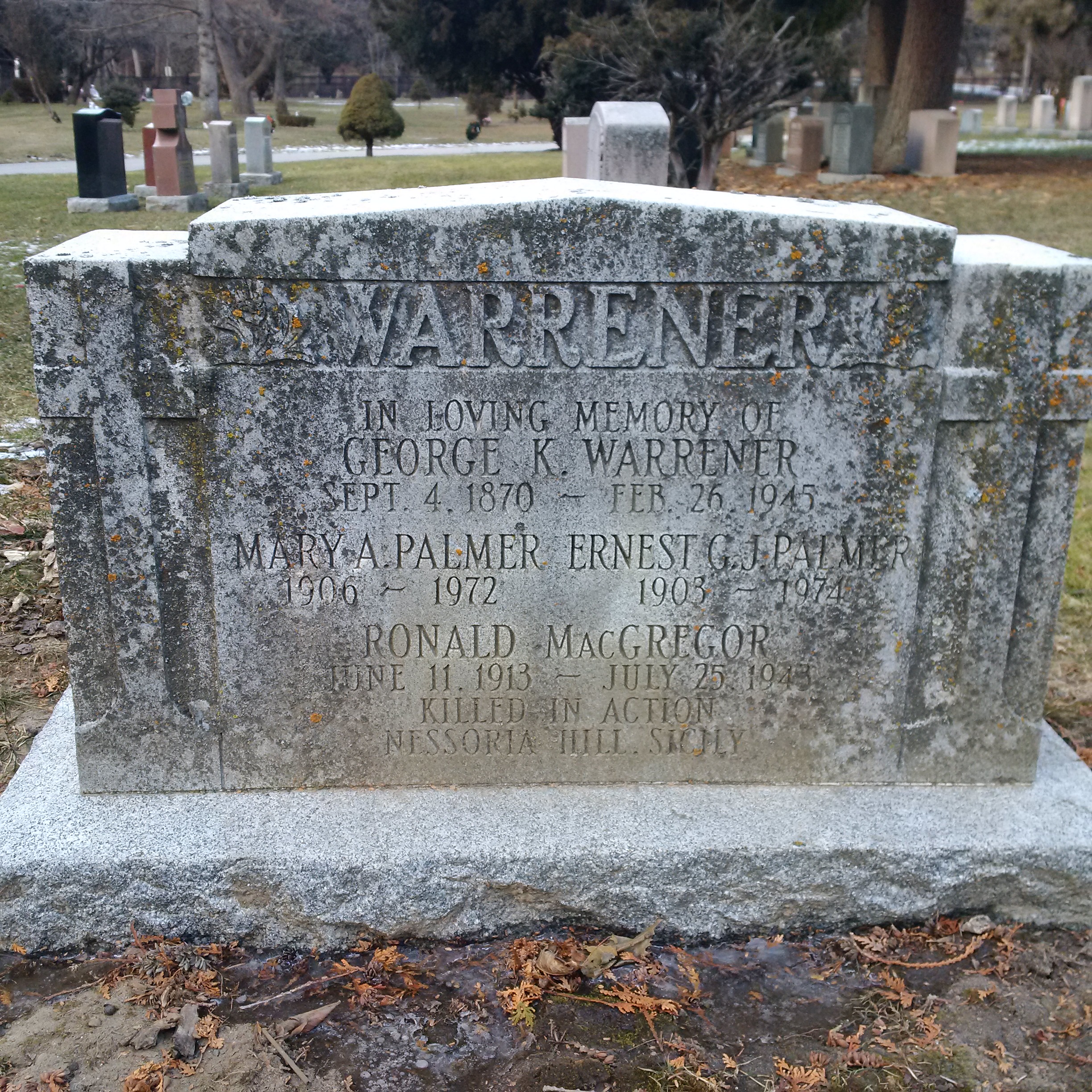
Here is the marker for George Kaye Warrener in Prospect Cemetery from his entry on Find a Grave.

Find a Grave, database and images (https://www.findagrave.com/memorial/169703644/george-kaye-warrener : accessed 9 February 2022), memorial page for George Kaye Warrener (1870–1945), Find a Grave Memorial ID 169703644, citing Prospect Cemetery, Toronto, Toronto Municipality, Ontario, Canada ; Maintained by Family Foliage (contributor 49085284).

You might notice a Ronald MacGregor Warrener recorded on that marker yet he's not listed on the plot card. Is the plot card wrong? Not at all! Ronald is actually buried with his fallen comrades at the Agira Canadian War Cemetery in Sicily. Just another reminder that one can't believe that everyone listed on a grave marker or memorial stone is actually buried there.

There are many other sites to help you in your search of an ancestor or relative in these cemeteries such as:


Happy researching!


[2024 Jan 28: With the changes to the FamilySearch Catalog when it comes to searching by places in Ontario, see the post "Toronto Trust Cemeteries on FamilySearch - Updated" for a different way of locating these collections on FamilySearch

Sunday, January 23, 2022

FamilySearch + LAC = Canada, 1851 Census Success

A fellow researcher sent me something similar to the text below concerning looking up the images on FamilySearch for the 1851/52 Census which took place in Canada East, Canada West, Nova Scotia, and New Brunswick:

I am researching in Family Search and all the 1851 Canada Census records. Yet all of the records for John Lane results in “No Image Available”. Am I looking in the wrong area of Family Search to find the images so I can see the information? Is there something else I should be doing?

This was an interesting question since many of us have access to Ancestry, Findmypast, or MyHeritage where the images of at least the first page with the names can be found. However, those are all commercial pay sites and not everyone has access to those resources from home. So what can we do?

With a little bit of work on our part we can combine two free sites, FamilySearch and Library and Archives Canada, to achieve the same end result.

But why use two sites when one can just use the LAC 1851 Census of Canada search page? Honestly, the census search system on LAC is, I think the polite word would be, "lacking". Their search system doesn't take in account name various spellings of a name like the other genealogy sites and the only wildcard character available is '*'. So it makes searching just a bit of a challenge. Additionally, and if I'm mistaken please someone correct me, the current index comes from the original Ancestry indexes before people submitted corrections for any questionable transcriptions.

To search just the "Canada Census, 1851" on FamilySearch go to the search page at https://www.familysearch.org/search/collection/1325192.

Screen capture of the FamilySearch Canada Census, 1851 search page with More Options selected and John Lane born in 1811 in Ireland filled in.

On that screen click the "More Options" button so that additional details such as where someone was born can be included up front. In this case I'm looking for a John Lane born in Ireland in 1811.

As an aside and before anyone asks, as far as I am aware I'm not related to this family. I'm just using him as an example.

A whole bunch of John Lane's appeared in the search results since I didn't give an end date for his birth year but the one I'm looking for is the John Lane residing in Otonabee, Peterborough, Ontario, Canada. When I click on his record I get the following details:

Screen capture of the Family Search Canada Census, 1851 page for John Lane born 1811 in Ireland and residing in Otonabee, Peterborough, Ontario, Canada.

As we can see in the upper left corner it states "No Image Available". But in the details section there are actually some important pieces of information we can use to search for the census image he can be found on in the 1851/52 census of Canada using the LAC Census of 1851 search page. We need to record the following from this FamilySearch page:

  • District Number
  • Sub-District Number
  • Page

Since this census took place is before there was a Dominion of Canada we also need to record the province and that we can get from the "Event Place (Original)". Note that we're not writing down his name or age. They aren't important in the search we will be doing on the LAC page.

So for this John Lane we need to write down:

  • District Number: 30
  • Sub-District Number: 295
  • Page: 79
  • Province: Canada West (Ontario)

One gotcha which you might notice later on the LAC Census of 1851 search page is that FamilySearch lists the Sub-District Number and then the District Number while the LAC search page asks for the District Number and then the Sub-District Number. So if you are doing this either late at night or before your first cup of caffeine in the morning you just might do like I've done in the past and mix up the order of the District and Sub-District numbers.

The next step is to go to the Library and Archives Canada search page for the Census of 1851 at https://www.bac-lac.gc.ca/eng/census/1851/Pages/1851.aspx. If you haven't used the LAC 1851 Census before, please take the time to read the various items listed in the Table of Contents on the main census page for 1851 so you have a basic understanding of this census.

Screen Capture of Library and Archives Canada "Search: Census of 1851" page searching for District Number 30, Sub-District 295, Page 79 in Canada West (Ontario).

The first step once you get to the "Search: Census of 1851" page is to click on the "Hide/Show Advanced Search Options" link so that the District, Sub-District, and Page Number search options are available.

As you can see in the screen capture I've already filled in the Province, District Number, Sub-District Number, and Page Number search boxes. Make sure that the District and Sub-District Numbers go in the Number boxes and not the Name boxes (yes, I've done that way too many times!)

Screen Capture of Library and Archives Canada "Search: Census of 1851" search results for District Number 30, Sub-District 295, Page 79 in Canada West (Ontario).

There will probably be around 50 results with about ten names shown on the first page of the search results. However, we don't need to find the person we are looking for in the list since all we care about is the image of that page.

To see the page image just click on the JPG link for the first person in the search results. In this case it is the "JPG (Image No.: e002367651)" link

1851 census of Canada East, Canada West, New Brunswick, and Nova Scotia, Canada West, district 30, sub-district 295, p. 79; RG 31; digital images, Library and Archives Canada, Library and Archives Canada (www.bac-lac.gc.ca : accessed 22 Jan 2022); citing microfilm C-11748.

If everything works out you will then be able to find the person you are looking for on the image which is displayed in your browser. You can right-click the image and save the image to your computer so you can look at it again without having to do these steps all over again.

However, don't forget that the 1851/52 Census is actually four pages for Canada East and Canada West. To see the other pages you need to do a little playing with the URL in your browser. 

In the URL or Location line in your browser you see something like "https://central.bac-lac.gc.ca/.item/?app=Census1851&op=img&id=e002367651" when you are viewing the image. All you need to do is increment that "id" number. In this case we want to change it to be e002367652 for the images of pages two and three and then e002367653 to see the image of page four and the start of the next set of people enumerated in that area.

Once you get the hang of doing something like this it really isn't too hard to do.