Showing posts with label Canada West. Show all posts

Thursday, June 11, 2026

Full-Text Search + Research = A Win!

FamilySearch's Full-Text Search is a real game changer when it comes to finding records that we might not have come across in the past. The Optical Character Recognition (OCR) and Handwriting Recognition Technology tools that create the transcriptions used by Full-Text Search just don't index the names of the principal parties mentioned on the processed documents. These transcriptions and subsequent indexes index every word in the documents. It means we can search on not just names but occupations, addresses, and phrases. Of course, there will be interesting transcription errors created by the machines. So, we can't rely on Full-Text Search to find every record.

I will say it again for those in the back:

We can't rely on Full-Text Search to find every record.

Let's take a look at a case where FamilySearch's Full-Text Search helped remove the mortar that loosed a brick to help tear down a brick-wall I've had for some years in my research.

It was a simple question I've been struggling with for some time: Who were the parents of Mary Foley, my 3rd great-grandmother, and wife of Thomas Well, who lived in Blanchard Township, Perth County, Canada West/Ontario?

I had made some assumptions in my research:

  • Mary Foley and Thomas Wells lived and met in Blanchard Township.
  • Mary Foley was of the Protestant faith. This was based on the 1861 Census of Canada West and the 1871 Census of Canada of their household.

These two starting assumptions were reasonable based on the facts I had but, as we will soon see, wrong.

There were trees online with various possible names for her parents. However, none of them provided any evidence of their assertions. Since I barely trust my own genealogy research, I'm definitely not going to take the word of anyone else without some sort of evidence.

It all started while FamilySearch's Full-Text Search was still in the experiment phase and I was playing around with it.

FamilySearch Full-Text Search search box with the keywords '+"Thomas Wells" +Mary +Foley'.

It was a simple search using keywords. I wanted all documents that had all the following words or phrases: "Thomas Wells", Mary, and Foley found in the resulting transcription generated by the Full-Text Search tools.

I got something like this:

Screen capture of the results page from FamilySearch's Full-Text Search for '+"Thomas Wells" +Mary +Foley' from 11 Jun 2026 with a result from Pelham Township at the top.
Screen capture of the results page from FamilySearch's Full-Text Search for '+"Thomas Wells" +Mary +Foley' from 11 Jun 2026.

That first result returned was a land record from Pelham Township in Welland County, Ontario, Canada. The associated transcription hint was enticing:

108 No 2418 . Quit Claim Thomas Wells et, al To Mary Scanlan E Registered 25th Feby . 1868 at 3 . O'Clock P.M. …
…of Ontario in the Dominion of Canada, Farmer, and Mary Wells of the same placewife of the said Thomas Wells, of…
…and Satisfaction of the Legacy to the above named Mary Wells, under the Will of the late James Foley deceased, …
…full, 2nd That I was personally present and did see, Thomas Wells, and Mary Wells the grantors named in the …

Looking and reading the document — several times in fact — provided a whole bunch of possible clues

Pelham Township, book F, Instrument 2418, Quit Claim, p. 108-109 [stamped]; imaged, “Land records of Welland County, 1796-1922,” FamilySearch (https://www.familysearch.org: accessed 11 Jun 2026), image group number (IGN) 8636751 > image 417 of 675.

  • It was a land record quit claim where Thomas and Mary Wells were relinquishing any possible claims they might have had to the lot in question
  • Thomas Wells was of the Township of Blanshard in the County of Perth, Ontario
  • Mary Wells is the wife of Thomas Wells
  • The lot was part of the North part of Lot Number 12 in the Tenth Concession of the Township of Pelham
  • That lot was owned by the late James Foley, the elder
  • John Foley and James Foley, the younger, had paid Mary Wells $10 per the will of the late James Foley

That seemed like a good match to my Thomas and Mary Wells.

Since I now had the location of the lot in Pelham Township, I could semi-quickly locate the abstract register of the lot and maybe even find a copy of the will in the land record copy books.

Time for me to stop searching and to start researching. So I switched from using search boxes to browsing collections, a bit researching, some thinking, and a bit of luck.

I could have used OnLand since they usually gather all the associated pages for a lot into a easily findable group of images, but I stayed with FamilySearch and their digitized copy of what they call their "Abstract index books, 1796-1958" collection created by the Registrar of Deeds for Welland County, Ontario to find this page.

Pelham Township, book A, Abstract register for Lot No. 12 in 10th Concession for the Township of Pelham [extract], p. 203 [stamped]; imaged, “Abstract index books, 1796-1958,” FamilySearch (https://www.familysearch.org: accessed 11 Jun 2026), image group number (IGN) 8636746 > image 114 of 284.

There is a listing for the "Probate of Will" as instrument 481 dated 20 May 1863 and registered on 18 May 1866 in the Land Registry Office for James Foley which was transferring 20 acres to his sons John Foley and James Foley.

Pelham Township, book E, Instrument 481, Probate of Will, p. 210-211 [stamped]; imaged, “Land records of Welland County, 1796-1922,” FamilySearch (https://www.familysearch.org: accessed 11 Jun 2026), image group number (IGN) 8636751 > image 138 of 675.

This copy of James Foley's will along with the preamble in the land record copy book provided even more details:

  • He died on or about 3 Nov 1865 at Pelham
  • The will included in the land record copy book is a true copy of his Last Will and Testament
  • John Foley and James Foley received lot 12 in the 10th Concession of Pelham
  • He has a daughter named Anna Foley, the wife of John Hicks, and she received $200
  • He has a daughter Mary Wells, and she received $10
  • He has a wife named Jane

I also looked up his probate file in FamilySearch's "Probate records, 1856-1903 // index, 1856-1969" collection created by the Surrogate Court of Welland County. There in the digitized microfilm titled "Probate papers nos. 254-383 1865-1869", starting at image 127 of 1472, just in case there might be other tidbits of information.

What stood out to me in the will was that Mary only got $10 while Anna got $200. Also, Anna's husband was mentioned but Mary's husband wasn't. 

"Died: Foley," The Ingersoll Chronicle [Ingersoll, Ontario], 1 Dec 1865, page 3, column 2; imaged, Newspapers.com (https://www.newspapers.com : accessed 22 Aug 2025).

Using Newspapers.com, I even found a mention in the 1 Dec 1865 edition of the Ingersoll Chronicle a death notice for James Foley and his wife Jane. I thinking her age in this notice is a bit exaggerated.

I next looked for the family in the 1861 Census of Canada West to see if there might be another clue.

Census of 1861, Canada West, Welland County, Pelham Township, population schedule, page 31 [stamped]; imaged in "Census of 1861 (Canada East, Canada West, Prince Edward Island, New Brunswick and Nova Scotia)," Library and Archives Canada (https://central.bac-lac.gc.ca/.redirect?app=census&id=45180961&lang=eng&ecopy=4108422_00504 : accessed 11 Jun 2026).

On that page I found what appears to be the household of James Foley with the following basic details abstracted:

  • James Foley, farmer, born in Ireland, Catholic, age 53 years, male, married, living in a shanty
  • Jane Foley, born in Ireland, Catholic, age 70 years [see, the death notice was lying!], female, married 
  • James Foley, born in Canada West, Catholic, age 19 years, male, single
  • Ann Foley, born in Canada West, Catholic, age 15 years, female, single 

Just a second...Catholic?

That changes my religion assumption big time.

It also might explain why Mary only got $10 in the will of James Foley and Mary's husband, Thomas, wasn't mentioned. Might she have been "punished" for marrying out of her faith?

Yet I couldn't find the family in the Census of 1851 (which was taken in 1852) for Canada West in Pelham Township. After doing a few hours of research into the land records using FamilySearch's Full-Text Search and reviewing abstract registers, I learned that between 13 Mar 1847 and 23 Sep 1853, James Foley was residing in Grantham Township, Lincoln County, Canada West.

Guess what? The Census of 1851 for that township didn't survive. Of all the rotten luck!

Now that I learned the family followed the Catholic Church, and from prior research that Mary was born about 1836 in Canada West, I took a look at what records for Catholic Churches in the Niagara area can be found on FamilySearch for the 1830s. One collection immediately stood out — "Parish registers, 1827-1910" for Saint Vincent de Paul (Niagara, Ontario) Catholic Church. Of course, it wasn't name indexed or even added to Full-Text Search. But that's never stopped me in the past.

It only took a few minutes of leafing though the images before I found her entry of baptism in the parish register:

Baptisms, marriages, burials 1827-1849, Register for the year 1835, B. 40, Mary Foley; imaged, “Parish registers, 1827-1910,” FamilySearch (https://www.familysearch.org: accessed 11 Jun 2026), image group number (IGN) 5107199 > image 53 of 351.
St. Vincent de Paul [Niagara-on-the-Lake], Baptisms, marriages, burials 1827-1849, Register for the year 1835, B. 40, Mary Foley; imaged, “Parish registers, 1827-1910,” FamilySearch (https://www.familysearch.org: accessed 11 Jun 2026), image group number (IGN) 5107199 > image 53 of 351.

There I learned that Mary was baptized on 4 May 1835, aged 1 week, the daughter of James Foley and Margaret McKenna, residing in St. Catharines. 

I finally had the names of Mary's parents! 

But the journey doesn't end there.

If Mary was baptized at St. Vincent de Paul, might her parents have been married there too?

St. Vincent de Paul [Niagara-on-the-Lake], Baptisms, marriages, burials 1827-1849, Register of Baptisms, Marriages and Interments in 1834, M. 1, marriage for James Foley and Margaret McKenny; imaged, “Parish registers, 1827-1910,” FamilySearch (https://www.familysearch.org: accessed 11 Jun 2026), image group number (IGN) 5107199 > image 41 of 351.

Recorded as the first marriage for 1834 we find an entry for James Foley and Margaret McKenny. And it is a treasure trove of information for someone who came from Ireland:

June 29th Were married, by me, the undersigned Priest, James Foley Son of John Foley and Mary Power, late of the Parish of Shanagolden Co Limerick Ireland; and Margaret McKenny, Daughter of John McKenny and Sarah Kelly, Co Tyrone Ireland. After one publication of their Banns.

I really struck gold in that record!

It all started with Full-Text Search which turned up that initial land record. Yet it took actual research to get to the parish register with the baptism of Mary and the marriage of her parents. Of course, it was a bit of luck too in that the register had been digitized and made available online.

I can only hope that you have similar success in using FamilySearch's Full-Text Search to start a breakthrough in your genealogical brick-wall. 


Monday, April 6, 2026

Finding LAC's Upper Canada Land Petitions

Recently a colleague passed on a message they received where someone was being frustrated with trying to use find and use the Upper Canada Land Petitions found on the Library and Archives Canada site. They were annoyed in part due to the changes that LAC has made to their site over the past several years, something I could completely understand. I provided a bit of guidance but I also thought that a blog post might also be helpful for others.

The first challenge is figuring out how to search for those Upper Canada Land Petitions in the first place.

There are two approaches.

The first is to scroll down the Library and Archives Canada home page to the "Most requested" section and, in the "Collection" column, select my favourite page on the LAC site, "A to Z research tools and guides".

Screen capture of Library and Archives Canada "A to Z research tools and guides" page with "petitions" entered into the Filter items text box.

In the screen capture above, I've already typed in the "Filter items" box on the "A to Z research tools and guides" page the word "petitions". We can see only two results are returned, one for the Land Petitions of Lower Canada, and the other being Land Petitions of Upper Canada. When we click on the"Land Petitions of Upper Canada, 1763-1865" link, we are brought to the advanced search page of LAC's Collection search system.

Screen capture of Library and Archive's Canada "Collection search" advanced view page with the search limited to "Genealogy" and the Collection to "Land Petitions of Upper Canada, 1763 to 1865".

Here we can see that two of the search boxes have already been filled in for us. The first is that we are only searching the "Genealogy" collections. The second, and this is the important one, the only collection to be searched is the "Land Petitions of Upper Canada, 1763 to 1865".

Alternately, on the Library and Archives Canada home page we can click on the green "Search the collection" button that is so prominently visible.


That brings us to the "Search Library and Archives Canada's collections" page. Towards the top of the page we find the search box to do a Collection search. Before we actually do a search, we need to click on the Advanced search link. I've circled it on the screen capture of that search box found on the page.

Doing that brings us to the same screen we saw when we clicked on the "Land Petitions of Upper Canada, 1763-1865" on the "A to Z research tools and guides" page. Yet there is one more step we need to do.

Screen capture of Library and Archives Canada Collection search advanced search view with the "Collection" item circled.

I've circled the Collection search drop-down box where we can select one of the many databases to only search in LAC's collections. We want to find and select "Land Petitions of Upper Canada, 1763 to 1865" from this ever growing list of topic specific databases.

It really doesn't matter which way we get to the search screen with the correct database collection to search. I personally prefer using the "A to Z research tools and guides" page in the hopes that one day it won't bring initially me to the search screen but to a topic page with details of what is available. That topic page does exist but we have to get to it in a round about manner at this time.

However, at this time we can just type in the name of the person we are searching for in the Upper Canada Land Petitions collection. We might also add in the place of registration but I often just start with just the name

In this example, I've search for my 4th great-grandfather, Alexander Fraser, and have included the word military since I know that he settled in the Perth Military Settlement when he came to Upper Canada. 

Screen capture of the first two search results looking for the keywords "alexander fraser military" (without quotes) in the "Land Petitions of Upper Canada, 1763 to 1865 collection with the Library and Archives Canada Collection search system.

There are a few things to note in the above screen capture. The first is if you want to change the search parameters then use the "Modify search" button. LAC seems to have fixed the quirk with using the browser's back button and it not keeping the search details you filled in. However, I find that "Modify search" button always works so I recommend using that button to make any changes to your search criteria.

The next is that in the search results we see a question mark followed by a link to "Land Petitions of Upper Canada, 1763 to 1865". This is the link to the topic page associated with this database. That page is still in the old format and will be moving to the new look and feel sometime in the future. This page is very important for us. Not only does it give some background details about how and why the petitions were created but it also has the all important link to the digitized copies of the petitions found within the old "Upper Canada Land Petitions - Microform digitization" page.

Although the petition details can be seen in the result list, we should still click on the name to get to the item detail page like I did for the entry of my Alexander Fraser:

Screen capture of the item details section for the Alexander Fraser found in Library and Archives Canada RG 1 L3, vol. 421, p. 64a.

Again we see a link to the topic page as the "Help page".

The important details for our purposes are found on the "Reference" line. There it states his name can be found within the RG 1 L3 series in volume 421 on page 64a. Just as importantly, that document is found on microfilm C-2739.

From that help page we know that we can go to the "Upper Canada Land Petitions - Microform digitization" page and look for the microfilm in that list.

However, if we are lucky, the microfilm might also be available for viewing from home in the "Petitions for land grants and leases, 1791-1867" collection on FamilySearch. I wrote "if we are lucky" since not all the microfilms from Library and Archives Canada are viewable from home on FamilySearch. However, I have created a PDF file of a spreadsheet I use that lists the LAC microfilms with links to the digitized microfilms on FamilySearch. Personally, if I can use the digitized microfilm on FamilySearch to locate the document I will. Not only because I find the FamilySearch image viewer easier to use, but also that the microfilms in this collection have been added to the Full-Text Search system on FamilySearch.

Regardless of how we are looking at the digitized images from microfilm, we want to pay attention to the information added at the bottom of the images.

Page reference information found at the bottom of the image from the Library and Archives Canada digitized microfilm C-2739, "Canada Land Petitions, Perth Military Settlement (RG 1, L 3, Vol. 420), p. 14b.

Most of the time we find the key information that is mentioned in the "Reference" line from the Library and Archives Canada item detail page for the person. Of course, sometimes that information is missing or hidden. If that happens, check the images before or after the one we are looking at. We will likely have to leap through the digitized images to find the correct volume and/or bundle.

Then we will want to start paying attention to the top corners of the pages since that is where we will find the page numbers.

Fairly quickly we should be able to find the page 64a in the "RG 1, L 3, Vol.421" for my Alexander Fraser I used in the example. Below is the image I came across on FamilySearch since microfilm C-2739 is viewable from home.

Upper Canada Land Petitions, Bundle Perth Military Settlement, RG 1 L3, vol. 421, petition 64, p. 64a, imaged, “Petitions for land grants and leases, 1791-1867”, FamilySearch, image group number 8630352 > image 490 of 1130; citing Library and Archives Canada microfilm C-2739.
Upper Canada Land Petitions, Bundle Perth Military Settlement, RG 1 L3, vol. 421, petition 64, p. 64a, imaged, “Petitions for land grants and leases, 1791-1867”, FamilySearch, image group number 8630352 > image 491 of 1130 (https://www.familysearch.org/ark:/61903/3:1:3Q9M-C3H4-79VZ-P: accessed 3 Apr 2026); citing Library and Archives Canada microfilm C-2739.

Of course, the entry on the page that is on the fold is the one for my Alexander Fraser. Isn't that always the case!

The Perth Military Settlement is a bit different from other petitions in this collection from Library and Archives Canada since we don't find the individual petitions made by the potential settlers.

When it comes to these petitions, there are often several pages in the petition. I recommend that you save all the pages for a petition to your computer for safe keeping and so that you don't have to do this every single time you want to look at the petition again.


[Updated: 10 Jun 2026 with link to a PDF of the LAC Upper Canada Land Petitions microfilms found on FamilySearch] 


Monday, April 29, 2024

Ontario Assessment Rolls and the Militia

A little while back, someone posted a query in one of the Facebook groups that deal in Ontario, Canada genealogy. It was a simple question that was interesting to explore:

"I have a tax assessment roll from 1864 and along with it is a militia roll. Can someone explain what that is please."

Westmeath Township, Renfrew, Ontario, Canada, "Canada, Ontario Tax Assessment Rolls, 1834-1899,"; database with digital images, FamilySearch, FamilySearch  (https://www.familysearch.org/ark:/61903/3:1:3QHV-F3CV-25P6 : accessed 29 Apr 2024), 1864, p 23, Militia Roll for Westmeath.
Westmeath Township, Renfrew, Ontario, Canada, "Canada, Ontario Tax Assessment Rolls, 1834-1899,"; database with digital images, FamilySearch, FamilySearch (https://www.familysearch.org/ark:/61903/3:1:3QHV-F3CV-25P6 : accessed 29 Apr 2024), 1864, p 23, Militia Roll for Westmeath.

When a question like this is posted, I always like to look at the pages and even years before for clues. 

I just happened to realize that this image was probably from the assessment rolls made available in a digitized format on FamilySearch. Otherwise, I would have prompted the original poster for the source. I want to reminder folks to always state the source of an image in their queries so that others can also find it and other possible related documents.

What we find for the first page for 1864 assessment of Westmeath Township is a list of names, ages, and details about the property.

Westmeath Township, Renfrew, Ontario, Canada, "Canada, Ontario Tax Assessment Rolls, 1834-1899,"; database with digital images, FamilySearch, FamilySearch (https://www.familysearch.org/ark:/61903/3:1:3QHV-F3CV-2R7F : accessed 29 Apr 2024), 1864, p 1.

That is what I expected to see.

In the 1863 assessment we don't see those Militia columns. So what gives?

Also, what is that "First Class Service", "Second Class Service", and "Reserve"?

Over the past few years I've learned that understanding the law as it has been passed by the various legislatures can often answer many questions when it comes to government created forms.

In this case we need to look at "An Act respecting the Militia", 27 Vict., Cap 2. This act was assented to on October 15, 1863. There we find the definitions for those First Class Service, Second Class Service, and Reserve:

2. The Militia shall consist of all the male inhabitants of the Province of the age of eighteen years or upwards and under sixty, not exempted or disqualified by law.

3. The Militia shall be divided into three classes, to be called respectively first class Service Men, second class Service Men and Reserve Men : the first class Service Men shall be those of eighteen years of age and upwards, but under forty-five years, who are unmarried Men or widowers without children, and the second class Service Men shall be those between the ages last aforesaid who are married Men or widowers with children, — and the Reserve Men shall be those of forty-five years of age and upwards, but under sixty years.

We even find the exemptions in section 4 of the act.

Why, as genealogists and family historians, should we care about these details? Knowing which class a man has been assigned to can provide clues as to their marital status and if they have any children.

But why did we not have these militia columns in previous years?

Well, in section 6 the act states for service enrolment in Upper Canada (section 10 covers Lower Canada):

6. The mode of enrolment of the Militia shall, in Upper Canada, be as follows, that is to say; — the Assessor or Assessors for each Municipality in Upper Canada shall, annually, commencing with the year one thousand eight number and sixty-four, and at the same lime when they are engaged in taking the Assessment of real and personal property in their respective Municipalities, include in their Assessment Roll, the names and residences of all male persons in their respective Municipalities, between the ages of eighteen and sixty years; and they shall prepare three additional columns in such Assessment Roll, which shall be headed respectively "First Class Service Militia Roll,'" "Second Class Service Militia Roll" and "Reserve Militia Roll,"...

So it seems it wasn't until the 1864 assessments that this started.

What we also need to remember is that not every assessor recorded the information the same way on the forms. For the 1864 assessment of the Township of Westmeath, we've already seen that the assessor just wrote a "F", "S", "R", or a place in the columns and added all the men who didn't seem to own land to a separate list. 

For the 1864 assessment of the Township of Enniskillen in Lambton County we see that the names are recorded in the columns and there might be more than one name recorded for a property.

Enniskillen, Lambton, Ontario, Canada, "Canada, Ontario Tax Assessment Rolls, 1852-1899,"; database with digital images, FamilySearch, FamilySearch (https://www.familysearch.org/ark:/61903/3:1:3QHV-X3CK-3173 : accessed 29 Apr 2024), 1864, p 31.

So make sure you pay attention to how the assessor actually completed the forms.

Additionally, depending on the assessor, there may be other sorts of information recorded on the forms, especially on the pieces of paper at the end of the assessment rolls. So always check the end of each year's assessment.

Finally, if you want to know which Ontario assessment rolls have been digitized by FamilySearch, there is a simple query you can use to search the FamilySearch Catalog:

Screen capture of the FamilySearch Catalog search page with titles: assessment, subjects: taxation, keywords: canada ontario, Availability: Online.
  • Titles: assessment rolls
  • Subjects: taxation
  • Keywords: canada ontario
  • Availability: Online

Just keep in mind that not all places will have the assessment rolls on FamilySearch. Many townships and municipalities still have them only available in paper or microfilm format at a local archive or genealogy or historical society. So if you can't find the township listed on FamilySearch then check with the organizations local to that township.


Thursday, May 25, 2023

1861 Census of Canada West - The Census That Keeps Giving Challenges

One of my fellow genealogy researchers sent me the following question:

"I have found the 1861 agricultural census for Huron County in Canada West.  I have searched through the pages, and the only page for Stanley Township is found on page 1274 of 1274 pages.  On the LAC webpage, I tried changing the number at the end of the sequence, as you advised, and the next image says "end of reel".  Increasing the number I find a list of Townships and eventually I get an error message.  I think that probably means there are no more images.

Sadly my Alexander Fraser, on lot 29, Concession V is not on the single page for Stanley Township, and therefore his information is lost to the angels.

Is there anywhere else I can search?  Possibly a microfilm at LAC?
"

It just seems like the 1861 Census of Canada West keeps giving us challenges.

Curiously, I had experienced a very similar problem in February so I actually had knew where to start. Yet, like all adventures, I really didn't know where this journey would ultimately take me and the discoveries I'd make.

The short answer to that initial question was to look at the Census of Canada, 1861 collection on FamilySearch. Many of these microfilms in this collection aren't available for viewing from home but only at a FamilySearch Center and not a FamilySearch Affiliate. However, in this case we were lucky enough that the "ONTARIO Huron (townships of Usborne and Wawanosh, and agricultural census)" (Film 349282 / DGS 4108085) is available for viewing from home. On image 530 of 597 of that digitized microfilm we find Alexander Fraser, recorded on line 47, as residing on part of lot 29, concession 5. So that was almost easy.

"Census of Canada, 1861," images, FamilySearch (https://www.familysearch.org/ark:/61903/3:1:S3HY-6G1Z-Q9B : accessed 25 May 2023), Agricultural Census, Huron District, Stanley Township Sub-district, Enumeration District No. 4, stamped page 146; DGS 4108085, image 530 of 597.
"Census of Canada, 1861," images, FamilySearch (https://www.familysearch.org/ark:/61903/3:1:S3HY-6G1Z-Q9B : accessed 25 May 2023), Agricultural Census, Huron District, Stanley Township Sub-district, Enumeration District No. 4, stamped page 146; DGS 4108085, image 530 of 597. 

However, like much of our research, there is much more to this question than we can imagine. So let's dig into the challenges and discoveries I encountered.

My colleague mentioned that they looked for the images on the Library and Archives Canada site using the techniques I mention in blog posts "A Challenge: 1861 Census of Canada - Agricultural Schedule" and "Missing images from the 1861 Census of Canada West on Ancestry?". However, the LAC reel ended with the pages for Enumeration District No. 1 for Ward No. 1 Stanley in the County of Huron, Canada West and then the dreaded "CONTINUED-NEXT REEL" image.

"Census of 1861," images, Library and Archives Canada (https://central.bac-lac.gc.ca/.item/?app=Census1861&op=img&id=4391938_00688 : accessed 25 May 2023), List of sub-districts for Huron District with "CONTINUED-NEXT REEL" notation; microfilm C-1037.
 

We actually find that image on FamilySearch as image 505 on the "ONTARIO Huron (townships of Usborne and Wawanosh, and agricultural census)" (Film 349282 / DGS 4108085) film. But if the digitized reel ends on the Library and Archives Canada site how can it continue on the FamilySearch digitized film? Even more importantly, where is that image for Stanley Township on the FamilySearch film to be found on the LAC site?

This is where we need to look at the "Districts and Sub-districts: Census of 1861, Canada West" page at Library and Archives Canada and look at the list of physical microfilms for the Huron district. This list doesn't include the Agricultural Census in the list of Sub district names but, based on looking on the various images on the LAC digitized reel and on FamilySearch, it would appear that the Huron County Agricultural Census is found on microfilm C-1037. If the Agricultural Census is supposedly continued on the next reel, it might be safe to assume (a dangerous word in any research endeavour) that the rest of the Agricultural Census is found on microfilm C-1038. Looking on the list of microfilms on the "Districts and Sub-districts: Census of 1861, Canada West" page we see that the Population Census for Camden and Gore sub-district of Kent County are found on microfilm C-1038.

We can use the Advanced Search Options on LAC for the Census of 1861 to go to the first page of the Population Census for Camden and Gore Townships of Kent County.

Screen capture of the Library and Archives Canada Search: Census of 1861 form with Advanced Search Options shown searching for Canada West, District Name Kent, Sub-District Name Camden, Page Number 1.

Picking the first name returned we notice that the id in the URL pointing to the image on the LAC site is 4391555_00098. For those who have used my tips of searching and wandering through the images of the Census of 1861 on the LAC site you probably will be thinking "Hmmm, we are already on image 98. What might be on those earlier images?"

Starting at image 4391555_00001 we can step through the images until we get to something interesting. On image 10 of LAC's digitized microfilm we find an image just like what we saw at the end of the last LAC digitized microfilm, an image listing the sub-districts of the Huron District. By image 12 we start seeing the Agricultural Census for Enumeration District No. 2 of the Township of Stanley for the County of Huron. Lo and behold, a few images later on the Library and Archives Canada site, we find the same image we found on FamilySearch for Enumeration District No. 4 of Stanley Township in the County of Huron on LAC's image id 4391555_00028.

Just a moment...

FamilySearch has this Agricultural Census all together on a single digitized microfilm and Library and Archives Canada has it spread across two digitized microfilms. 

What is going on? 

Which "digitized microfilm" accurately reflects the actual microfilm? 

I'm fortunate to live in Ottawa where the main LAC public facility is located so this question warranted a trip in to check the physical microfilm(s). Unsurprisingly, the LAC digitized microfilms would appear to be a true and accurate copy of the physical microfilms. The County of Huron Agricultural Census for 1861 is spread across two physical microfilms.

It seems that, at least in this case, the FamilySearch Image Group Number (DGS) film 4108085 is not a true copy of the physical microfilm. All the details are there but they have "helped" us out by splicing together images from several physical microfilms. It's just one more thing to watch for in our research and possible citations.

What about my fellow researcher's challenge with finding the image on Ancestry?

I've noted in my own travels that Ancestry has done some strange things with the Census of 1861 and how the images have been put together on their virtual filmstrip. My colleague had found the image for the Agricultural Census of Enumeration District no. 1 for Ward No. 1 Stanley in Huron County on page 1274 of 1274. The URL that Ancestry uses to display that image is https://www.ancestry.ca/imageviewer/collections/1570/images/4391938_00686. That image number in the Ancestry URL really looks like the image id from Library and Archives Canada. So plugging in the number from LAC we can create the Ancestry URL https://www.ancestry.ca/imageviewer/collections/1570/images/4391555_00028. Going to that web address we find that image we found on the LAC and FamilySearch sites. 

But it is image 438 of 1274 on Ancestry's virtual filmstrip! 

Ancestry, in their creation of their virtual filmstrip, has placed the images from LAC's microfilm C-1038 for the County of Huron smack dab between the Personal Census Enumeration District No. 3 Ward of the Township of Hay in the County of Huron, stamped page 25 (image 430) and Personal Census Enumeration District No. 3 Ward of the Township of Hay in the County of Huron, stamped page 27 (image 473). Talk about confusing!

Ultimately it turns out that Ancestry had not properly indexed the entries on that Agricultural Census page since the entry for Alexander Fraser is only listed under his Given Name "Alexander" and no surname has been transcribed into the index. About a quarter of the names on that page are missing the surname. Even knowing the stamped page number didn't help me out. With not putting any names in and searching on just the exact keyword "agricultural" and the exact page number "146"  for anyone who lived in "Huron, Ontario, Canada" Ancestry returned 5774 entries and my listed started on page 137. That's why my fellow research couldn't find their Alexander Fraser in the index. Ancestry really doesn't make it easy for us at times!

Of course, another issue with the images on Ancestry is that they only imaged the first page of the two page forms so we still need to use the images available on the Library and Archives Canada site to see the whole picture of what is recorded for each person or lot. I've covered that challenge in "Missing images from the 1861 Census of Canada West on Ancestry?"

I wonder (and sort of dread) what the next challenge the Census of 1861 for Canada West will bring!


Wednesday, April 6, 2022

Burford Township...Lost in the Census of 1861 for Canada West

I've already written about one of the challenges with using the copy of the Census of 1861 for Canada West that is found on Ancestry in my post "Missing images from the 1861 Census of Canada West on Ancestry?". Recently though another challenge surfaced and that is one of a missing township.

In a post on Facebook someone was looking help in locating death records in Brant County, Ontario and had mentioned that the couple was married in Burford Township, Brant County and suspected that the husband, who died only a few years after their 1860 marriage, died in the Burford Township area.

The name being sought was John White and his wife Jane (nee Chant) Fox.

Being curious about the family I searched for the couple in the Census of 1861 for Canada West. To my surprise I couldn't find the couple in that census in Burford Township. Maybe the handwriting or the image quality was really poor so I searched just on the keyword "Burford" to see if I could find the start of the enumeration for that township. I got back all kinds of results but they weren't for a place but for people's names.

Something just wasn't right.

That is when my curiosity really took hold and I followed the rabbit down the hole.

I know that FamilySearch has the 1861 Census of Canada West and it is searchable but not all the digitized microfilms are viewable from home.

https://www.familysearch.org/search/catalog/179027
Screen capture from Census of Canada, 1861 microfilm list showing Burford Township found in the FamilySearch Catalog list at https://www.familysearch.org/search/catalog/179027.

There I found for Brant the microfilm which contained images for the town of Brantford and the townships of Brantford and Burford. I couldn't view the images since they are not available to see from home but I could still search that location on FamilySearch.

Screen capture of the partial results searching the "ONTARIO Brant (town of Brantford and townships of Brantford and Burford)" microfilm DGS 4107375 on FamilySearch for John White.

I could confirm that FamilySearch knows about Burford Township and a enumeration did take place in the sub-district. At least I'm not totally losing my mind.

I wanted to check again what Ancestry had, via their virtual filmstrip, for Brant County in their copy of the 1861 Census of Canada West. However, how Ancestry has stitched together the various microfilms doesn't make it easy in this case. Their virtual microfilm starts with the Township of South Dumfries, which based on how FamilySearch has listed the microfilms, is the second microfilm. It wasn't until I got to image 274 of 473 that I finally came across Enumeration District No. 1, Kings Ward, of Brantford in the County of Brant. 

What is interesting is that I was able to find the Agricultural Census for the Township of Burford starting at image 260 (of 473) on Ancestry and it definitely states that it is in the County of Brant.

I know from my previous research into how the various sub-districts are usually arranged on the microfilms for the 1861 Census of Canada West that the Personal census sub-districts are in alphabetical order followed by the Agricultural census returns for that district. So it would seem that Ancestry got the order of microfilms mixed up. That is an annoyance but not too many folks manually search the images for names...but there are enough of us.

So I went to the end of Ancestry's virtual microfilm for Brant and the last image, 473, was for the Personal census of Enumeration District No. 4 for the Township of Brantford in the County of Brant. No Burford Township. The next virtual microfilm was for Bruce County in Canada West and Burford wasn't found at the start of that filmstrip.

So I was off to Library and Archives Canada's "Census of 1861" page to search for a "J White" in Brant District. 

Why "J White"? 

That was one of the names returned in the results on FamilySearch for someone who was listed in Burford Township, Brant county in their results.

Screen capture of Search: Census of 1861 at Library and Archives Canada looking for "J White" in Canada West (Ontario), Brant District.

Not surprisingly I got "Nothing here matches your search" as the answer. It wasn't a surprise to me since Library and Archives Canada uses an index provided by Ancestry for LAC's searchable database for the Census of 1861. So if we can't find the name on Ancestry it is highly unlikely that we will be able to find the name using LAC's database.

Fortunately there is a workaround to view these Census of 1861 images on the Library and Archives Canada site.

On Ancestry the last image on their virtual filmstrip for Brant County had the URL of "https://www.ancestry.ca/imageviewer/collections/1570/images/4107375_00419". That URL actually holds a clue I can use. With the numbers after the "image" part: "4107375_00419" I can build my own URL to access the images on LAC. I just need to add those number to the end of "https://central.bac-lac.gc.ca/.item/?app=Census1861&op=img&id=" (without the quotes) and paste it into my browser. That should get me to the same image on Library and Archives Canada which we found on Ancestry. That newly constructed URL is "https://central.bac-lac.gc.ca/.item/?app=Census1861&op=img&id=4107375_00419" (without the quotes).

When I plunked that URL into my browser I did indeed get the same image I saw on Ancestry. On Ancestry the page number was stamped in the upper right corner and it said "68".

So I started incrementing the last 3 digits going from 419 to 420 to 421, etc. I was hoping to see Burford Township. However, instead I on image 421 it was still in Brantford Township with page number "69" stamped in the corner. Um...69? It looks like we have a real problem. Not only is Burford Township not on Ancestry in this census but there may be missing pages for Enumeration District No. 4 for the Township of Brantford in the County of Brant.

As I kept incrementing that image number on LAC I also found Enumeration District No. 5 for the Township of Brantford in the County of Brant. Then it was Enumeration District No. 6 in the same township. So I decided to try to see if Ancestry might have any of these images just misfiled. So I took the "4107375_00421" number and replaced the "4107375_00419" in Ancestry's URL. Ancestry gave me the "We’re sorry, this page is temporarily unavailable." error. So it looks like Ancestry is missing several Enumeration Districts (different from the District/County) and a Sub-district from this microfilm.

When I got to image 573 on LAC I finally came across the image I always like to find. 

Census of 1861, Canada West, Brant County, sub-district list; RG 31; digital images, Library and Archives Canada, Library and Archives Canada (www.bac-lac.gc.ca : accessed 6 Apr 2022); citing image ID 4107375_00573.

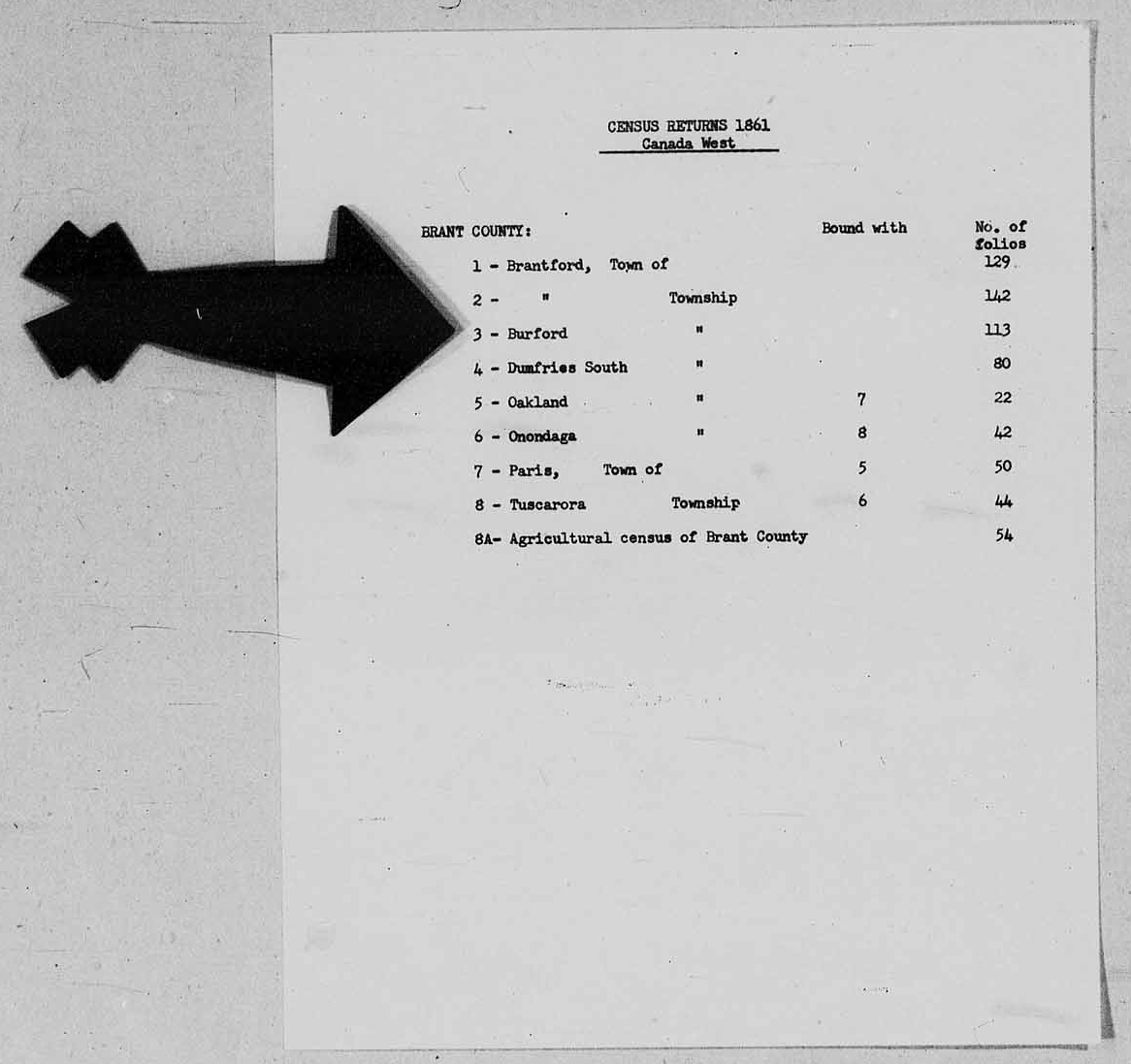
This is the page with the list of sub-districts enumerated in a district. According to this list found on the LAC microfilm there is definitely a Burford Township and it has 113 pages.

A few pages further on I came across the first set of pages of the elusive enumeration of the Township of Burford in the 1861 Census of Canada West.

Census of 1861, Canada West, Brant County, Burford Township, Enumeration District 1, p 1; RG 31; digital images, Library and Archives Canada, Library and Archives Canada (www.bac-lac.gc.ca : accessed 6 Apr 2022); citing image ID 4107375_00576.

It turns out that the last census image on that microfilm is image 813 which the second half of the stamped page 113 for Enumeration District No. 3 of Burford Township in the County of Brant.

So for those attempting to find their family residing in Burford in the 1861 Census of Canada West it becomes a bit trickier than just typing a name into Ancestry and clicking search. Here are the general steps I would take:

1. Find the person in the searchable index on FamilySearch but restricting the search to DGS 4107375, the digital microfilm number found on FamilySearch, like I did here:

Screen capture of search results and search query on FamilySearch for "J White" in DGS 4107375.

2. View the record for the person that is of interest. It is important to view the record since there are key details we need that are found in the "Cite This Record" section and elsewhere in the record.

Screen capture of the Record Screen for J White found in Burford, Brant, Ontario, Canada born 1834 found in the "Canada, Ontario Census, 1861" database on FamilySearch.

3. In the transcribed section write down the Enumeration District. There are three enumerations districts for Burford Township so it makes it a bit easier if you know the enumeration district number.

4. From the "Cite This Record" section record the page number and possibly even the line number.

5. With that information you can jump to the start of the correct Enumeration District (ED) on the Library and Archives Canada image site. The URL for the starting image for each ED is as follows

Then it is just incrementing those last few digits until you get to the right page. The page numbers in the FamilySearch information are not those stamped page numbers in the upper right. FamilySearch is referencing the hand written numbers found in the top corner. These numbers may be a little faint at times.

By the way, there are actually two images for each "page". The first image covers questions 1 to 36 and the next image has the responses for questions 37 to 60. So to see the next group of families you would have to increment the number by two, e.g. "00576" to "00578". Once you get the hang of doing this it isn't too painful. Pay attention to the Enumeration District number at the top of the page to make sure that you are actually looking in the right place.

I've flagged this issue to Ancestry's attention but I have no idea when it will be corrected and then when the corrected index will be sent to LAC.

UPDATE - 9 Apr 2022

Library and Archives Canada is aware of this issue and it even appears in the "Issues about this census and this database" section on their Census of 1861 page. Thank you to one of my readers, Lois, for bringing this to my attention.


However, that notice is outdated since the pages and sub-districts I've covered in this post are available as images on the Library and Archives Canada site. The issue is now in the indexing of the names. Yet many of the Family History Centers (FHC) are still closed throughout Canada. Also, unless an FHC has the microfilms available on premise we cannot order in the microfilms to be viewed since that is no longer an option and many of the digitized reels for this census can only be viewed at an FHC...which may not have reopened yet due to the pandemic restrictions and out of an abundance of caution.