Saturday, January 9, 2021

A "Lost" Child - Henrietta Warrener

It isn't very often when I can discover a new close relative to add to my family tree. Today is one of those days.

While waiting for the January BIFHSGO monthly meeting to start I decided to pay attention to a hint on the FamilySearch one-world tree where it suggested that there may be a missing child for George Kaye Warrener and Henrietta Jane Whitfield McGregor, my great-grandparents. I've been researching my own tree for about 20 years and for the lines to my great-grandparents I thought I had everyone recorded but I figured, a quick check wouldn't hurt.
 
Looking at the family for George and Henrietta I have:
  • Winifred Violet (1904-1983)
  • Mary Adela (1906-1972)
  • George (1908-1966)
  • Ronald McGregor (1913-1943)
  • Lillian Barbara (1916-1998)
You might notice that there is a larger gap between George and Ronald between 1908 and 1913 than between the other children. I also knew that George Kaye Warrener's family was residing in the Dalmuir area of Dumbartonshire, Scotland when the known children were born.

So it was off to do a quick check on ScotlandsPeople to see what might appears.
 
Screen capture from ScotlandsPeople of the Warrener 1908-1913 search query.

As you can see, my search is very simple, the last name of Warrener and the date range of 1908 to 1913.
 
Screen capture from ScotlandsPeople for Statutory registers results from Warrener 1908-1913 search query.

In the returned information there are 3 birth and 1 death record. Since the range included the birth years for George and Ronald I expected two records but not three. Since viewing the index return on ScotlandsPeople is free I clicked on the "view 3 records" to see what names appear.
 
Screen capture from ScotlandsPeople for Statutory birth registers results from Warrener 1908-1913 search query.
Screen capture from ScotlandsPeople for Statutory birth registers results from Warrener 1908-1913 search query. 
 
The RD or registration district that encompasses Dalmuir is "Old or West Kilpatrick" so seeing George and Ronald McGregor make sense. But who the heck is this Henrietta born in 1911 and registered in that same district? Henrietta is the name of my great-grandmother so could it be a daughter of George Kaye and Henrietta Warrener?

Now is when I needed to shell out a pound or so to view the digitized image for the record of Henrietta Warrener to learn who her parents are.
 
Dumbartonshire, Scotland, "Statutory Births 1855-2009," 1911 Births in the Parish of Old Kilpatrick, p. 228, Henrietta Warrener; digital image, General Register Office for Scotland,  ScotlandsPeople (www.scotlandspeople.gov.uk: 9 Jan 2021).
Dumbartonshire, Scotland, "Statutory Births 1855-2009," 1911 Births in the Parish of Old Kilpatrick, p. 228, Henrietta Warrener; digital image, General Register Office for Scotland,  ScotlandsPeople (www.scotlandspeople.gov.uk: 9 Jan 2021).

This is when my jaw dropped. I had missed a child of George Kaye Warrener and Henrietta Jane Whitfield McGregor. I had never heard of this child from my grandmother Winifred or my Dad. She was born 24 May 1911 at 1 Shaftsbury Place in Dalmuir. I know of that address since it is same place many of the children of George Kaye and Henrietta Warrener were born.

There is also a single death record for that period.
 
Screen capture from ScotlandsPeople for Statutory death registers results from Warrener 1908-1913 search query.

That looks to be the same person but the only way to be certain is to pay my 6 credits (£1.50) to view the digitized image of the death record.
 
Dumbartonshire, Scotland, "Statutory Deaths 1855-2009," 1912 Deaths in the Parish of Old Kilpatrick, p. 2, Henrietta Warrener; digital image, General Register Office for Scotland,  ScotlandsPeople (www.scotlandspeople.gov.uk: 9 Jan 2021).
Dumbartonshire, Scotland, "Statutory Deaths 1855-2009," 1912 Deaths in the Parish of Old Kilpatrick, p. 2, Henrietta Warrener; digital image, General Register Office for Scotland,  ScotlandsPeople (www.scotlandspeople.gov.uk: 9 Jan 2021).

And, unfortunately or fortunately depending on your perspective, it is the civil statutory death registration for Henrietta. She died on 31 Dec 1911 at about 11 p.m. from measles.

Why, until this time, was she missed by me and others?

One reason is that she was born just after the 1911 census of Scotland took place on 2 Apr 1911. If she had been born 2 months earlier then she would have appeared in that enumeration.
 
However, the main reason is on me. I just didn't pay attention to the several year gap between George and Ronald. It wasn't until FamilySearch prodded me that there may be missing child that I took the time to do a quick check.

So welcome to the family Henrietta. You are no longer lost to the sands of time and will now be remembered by generations to come.

Sunday, January 3, 2021

Just When Did Caleb Howe Die? June or July 1755?

Over the Christmas-New Year week I decided to update the various profiles for my ancestors recorded in the FamilySearch "one-world" or common family tree. One reason for doing this was to see if others had posted any additional events, documents, or even family members that I might not have known about. It turns out I was able to uncover several distant cousins that were born and died between census enumerations plus find where a few branches of the family disappeared to.

But that's not what this post is about. Instead I'm going to write about the challenges of verifying a date of death from the mid 1700s.

My 6th great-grandfather, Caleb How(e), the second husband of Jemima Sawtell and the father of my 5th great-grandfather, Lt. Caleb Howe of the Queens Rangers, was killed in a raid by Native Americans as probably part of the actions stemming from what became known as the French and Indian War of 1754–1763. I've come across several different dates but most either have him killed on 27 Jun 1755 or 27 Jul 1755. However, which month is it? June or July?

I've written about Jemima in my post "The Fair Captive" when I attempted to trace through the various footnotes and endnotes to locate details about her captivity and subsequent release. In the tale "Narrative of the Captivity of Mrs. Jemima Howe, taken by the Indians at Hinsdale, New-Hampshire, July 27, 1755." in The American Preceptor published in 1801, a story told by Jemima Howe, Caleb's wife, a number of years after the events she says that the attack happened on 27 Jul 1755.

Caleb Bingham. American Preceptor; Being a New Selection of Lessons for Reading and Speaking. Designed for the Use of Schools (Boston, Massachusetts: Manning and Loring, 1801), p 176; digital images, Internet Archive (https://archive.org/details/americanprecept09binggoog/page/n1/mode/2up : accessed 3 Jan 2021).
Caleb Bingham. American Preceptor; Being a New Selection of Lessons for Reading and Speaking. Designed for the Use of Schools (Boston, Massachusetts: Manning and Loring, 1801), p 176; digital images, Internet Archive (https://archive.org/details/americanprecept09binggoog/page/n1/mode/2up : accessed 3 Jan 2021).

However, if the attack took place on July 27, 1755 and Caleb was found alive the next morning before passing away after he was brought to Fort Hinsdale, then he would have died on July 28, 1755. Also, in the Gazetteer of Cheshire County, N.H., 1736-1885 published in 1885 it states: "...and July 27 they ambushed Caleb How, Hilkiah Grout and Benjamin Gaffield as they were returning from their labor in the field."

Even a few years later in 1758 a letter concerning Mrs. Jemima How states that she was taken in July 1755.

[John Farmer, Nathaniel Bouton, Isaac Hill]. Collections of the New-Hampshire Historical Society, Vol. V (Concord, New Hampshire: New Hampshire Historical Society, 1837), pp.254-256, Letter of Col. Ebenezer Hindsdale to Gov. Benning Wentwork-1755; digital images, Internet Archive (https://archive.org/details/collectionsnewh06socigoog/page/n7/mode/2up : accessed 18 May 2020).
[John Farmer, Nathaniel Bouton, Isaac Hill]. Collections of the New-Hampshire Historical Society, Vol. V (Concord, New Hampshire: New Hampshire Historical Society, 1837), pp.254-256, Letter of Col. Ebenezer Hindsdale to Gov. Benning Wentwork-1755; digital images, Internet Archive (https://archive.org/details/collectionsnewh06socigoog/page/n7/mode/2up : accessed 18 May 2020).

However, in the "New Hampshire Death Records, 1654-1947" database found on FamilySearch we come across this image of a card created on 29 Aug 1905:

"New Hampshire Death Records, 1654-1947," database, FamilySearch (familysearch.org : accessed 20 Feb 2012), entry for Caleb How, died 27 Jun 1755; citing Death Records, FHL film 1,001,086; New Hampshire Bureau of Vital Records and Health Statistics, Concord, New Hampshire.

Here we see that it is recorded that he died on June 27, 1755 at Hinsdale, New Hampshire "Killed by the Indians". But we don't know the source of that information in that "modern" record. Could it be from the grave marker?

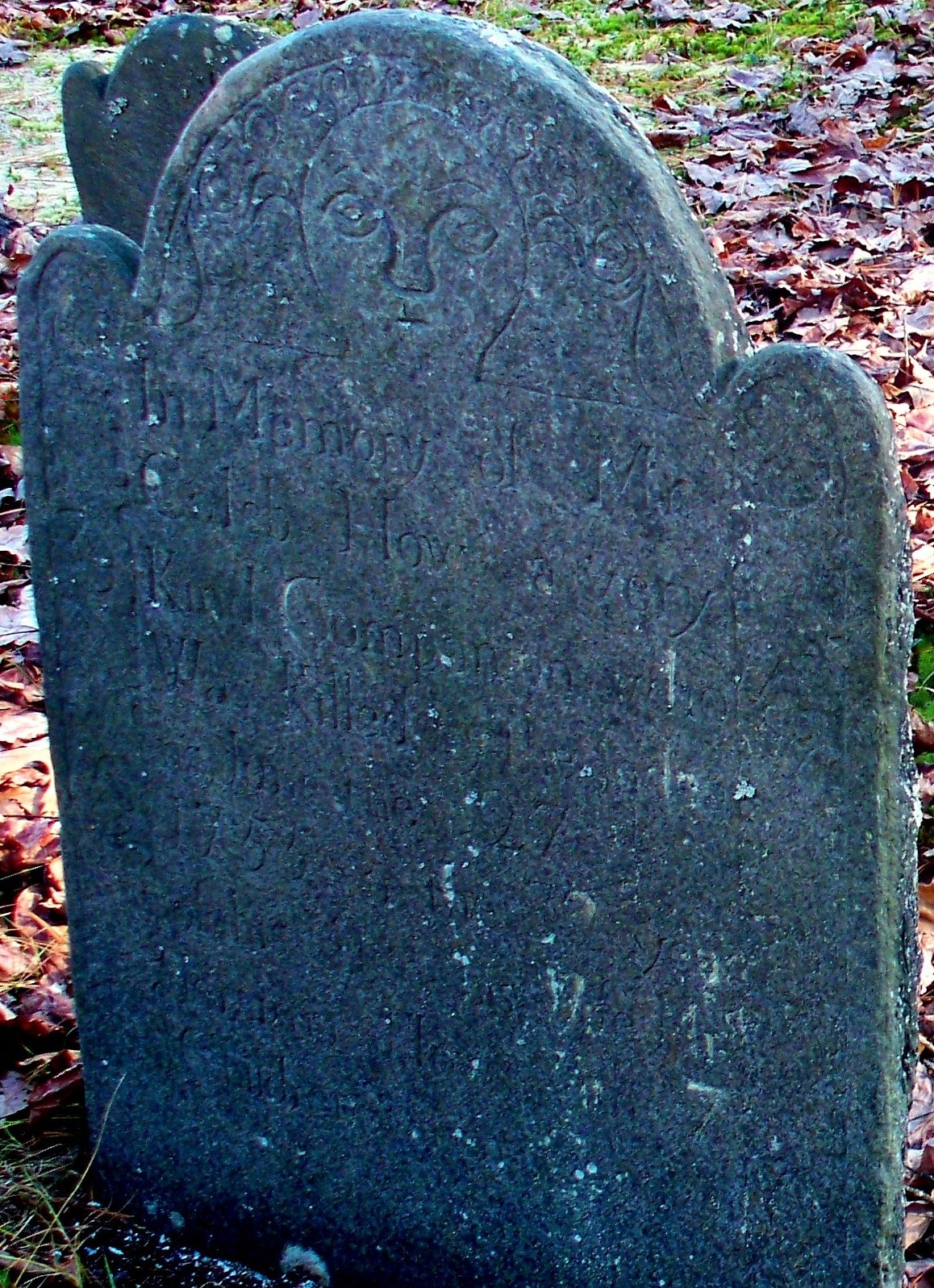
The marker found on Find A Grave appears to confirm that detail:

Find a Grave, database and images (https://www.findagrave.com : accessed 03 January 2021), memorial page for Caleb Howe (3 Dec 1723–28 Jun 1755), Find a Grave Memorial no. 69042959, citing Hooker Cemetery, Hinsdale, Cheshire County, New Hampshire, USA ; Maintained by John Clay Harris (contributor 47322896).

In memory of Mr. Caleb How a very Kind Companion who Was killed by the Indians June the 27th 1755 in the 32nd year of his age, his wife Mrs.Jemima How With 7 Children taken Captive at the Same time.

A bit more searching led me to a letter from Colonel Ebenezer Hinsdale to Governor Benning Wentworth date 22 Jul 1755 in the Provincial Paper: Documents and Record relating to the Province of New-Hampshire, from 1749 to 1763, Volume VI with a copy found at the Internet Archive. There on page 412 at the tail end of a letter from Col. Hinsdale is mentioned within a postscript by Abigail Hinsdale the following:

"Mr. Hinsdale wrote to his excellency the 28 of June of the mischief that was done upon the other side of the River, one man kill'd, three women, eleven children captivated, the Indians burnt two buildings."

A copy of that letter has been digitally preserved by the New Hampshire Historical Society and can be viewed at their site at "Letter from Colonel Ebenezer Hindsdale to Govenor Benning Wentworth, 1755 July 22".

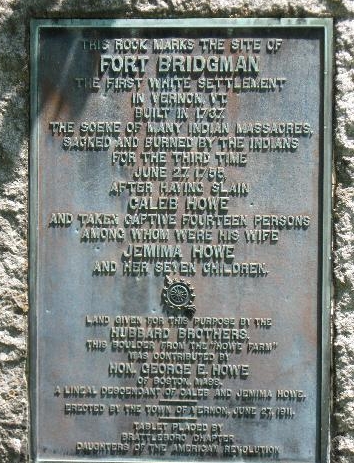
On 27 Jun 1911 at Vernon, Vermont there was a dedication of a marker on the site of Fort Bridgman where the attack took place:

Find a Grave, database and images (https://www.findagrave.com : accessed 03 January 2021), memorial page for Caleb Howe (3 Dec 1723–28 Jun 1755), Find a Grave Memorial no. 69042959, citing Hooker Cemetery, Hinsdale, Cheshire County, New Hampshire, USA ; Maintained by John Clay Harris (contributor 47322896).

With the information from the dedication and the letter from Colonel Hinsdale/Hindsdale that included the postscript by his wife Abigail it would seem that the date of the attack was 27 Jun 1755. Yet if Caleb passed away at Fort Hinsdale the morning following the attack then the date of his death is actually 28 Jun 1755. So that's the date I'm going with at this time.


Monday, December 21, 2020

Ontario Township Papers on FamilySearch

Recently the Township papers, ca. 1783-1870's collection of records were opened up on FamilySearch so that you can view them from the comfort of your home.

So just what is this collection? From the description page found within the digitized microfilms they state:

"These are the earliest land files. If a document or letter mentions a specific lot and contains nothing of general interest, it has been defined as a township paper."

Additionally, from the description on the FamilySearch catalogue pages, they mention that these are the digitization of the microfilms within the RG 1, series C-IV collection in the possession of the Archives of Ontario.  The series is a group of land-related records where you might be able to find copies of various documents such orders-in-council, location certificates, assignments, patents, and various correspondence concerning the land. The records were created by various agencies over the years:

  • ca. 1783-1791: Surveyor General's Office of the Province of Quebec
  • 1791-1827: Surveyor General's Office of Upper Canada
  • 1827-1867: Crown Lands Department for the Province of Canada
  • 1867-ca. 1870: Department of Crown Lands for the Province of Ontario

So how do you find this collection on FamilySearch? 

For starters, it isn't just one entry in the FamilySearch catalogue but two:

Screen capture of a partial list of townships from Ontario Township papers, ca. 1783-1870's on FamilySearch.

As you might noticed from the above listing the townships/villages/towns are in alphabetical order. The various digitized microfilms may hold the records of one township, parts of a township, or several townships or villages.

Within each digitized microfilm the pages are ordered by Concession number and within the Concessions the records are ordered by Lot number. However, for villages and towns, the papers are arranged alphabetically by the name of the locatee.

For each group of pages for a piece of property you will come across a starting page within the digitized microfilm with the name of the township, the lot number, and the concession number. Here is an example of one such page:

Ontario, Township papers, ca. 1783-1870's, Haldimand Township, Lot 2; 5th Con. cover page; Archives of Ontario, Toronto; FHL microfilm 1,402,724, image 13.

By the way, when looking at the multi-image view on FamilySearch, after a bit of experience, you will be able to easily pick out those pages as guideposts in your search for the concession and lot that you are looking for.

So what might be found in these files? 

How about the details of a grant. Here we have the details of a grant of 800 acres (less 114 2/7 acres for a Protestant Clergy) in Haldimand township made via a 2 Jun 1798 Order in Council describing, in chains and various angles, the property given to James Stuart, a Barrister at Law, of the City of Quebec in the Province of Lower Canada.

Ontario, Township papers, ca. 1783-1870's, Haldimand Township, Lot 1, 3, 4, 22; 5th Con. Grant; Archives of Ontario, Toronto; FHL microfilm 1,402,724, image 11.

Maybe a letter asking for money to be refunded like we have here after the lots a Mr. Angus McDonell had purchased were assigned to Mr. John Lane via an Order in Council.

Ontario, Township papers, ca. 1783-1870's, Cornwall Town, Lots 17 & 18 North side of Sixth Street, Letter from Angus McDonell; Archives of Ontario, Toronto; FHL microfilm 1,402,636, image 375.

You can even come across a Location Ticket that describes a person's military service such as the one for John Alison (or Allison) who was a Sergeant in the First Flank Companies of the 1st Regiment of Prince Edwards Militia who settled in Madoc Township.

Ontario, Township papers, ca. 1783-1870's, Madoc Township, Concession 1, Lot 4, Location Ticket for John Alison or John Allison; Archives of Ontario, Toronto; FHL microfilm 1,378,328, image 247.

These are just some of the kinds of documents found in the files of the Ontario Township Papers. 

Keep in mind that just like using the various land records for the counties found on OnLand or elsewhere within FamilySearch, you will need to first find your ancestors "on the ground."

Wednesday, December 16, 2020

A Land Records Challenge

Recently, with the British Isles Family History Society of Greater Ottawa (BIFHSGO), I held an online workshop on using Ontario land records that you can find online. Over the next few days several of the participants of that workshop reached out to me asking for additional assistance with their research. One of them, Suzanne, had this quandary:

"My MacDonald (McDonald/MacDonell/McDonell) family from Glengarry County owned Lot 11, 1st Concession, Twp Kenyon for 3 or 4 generations from 1808 to about 1900. I have a copy of the land record that you talked about. The land was Patented from the Crown to Alexander McDonell April 14, 1798. I do not have a copy of the land grant but now I know where to find it. Then all 200 acres were given to John McDonell as a Grant April 9, 1808. The problem I have encountered is that the Registration Number for that transaction is incorrect. Years ago I hired a researcher to find some information and he said that the number is for a document connected to a lot in Charlottenburg. I visited Alexandria and went to the land records office a few years ago and they also said that is the wrong number. The Registration Number for the Grant is 608 and the next one on the list is 107 for a Will."

For me the first step was to verify the information stated by checking the Abstract book on FamilySearch and in the Ontario Land Property Records Portal (OnLand) to make sure that both copies matched.

Glengarry County, Ontario, Abstract index books, ca. 1800-ca. 1959, Kenyon Township: 11, Lot 11 Concession 1; FHL microfilm 201,723, item 1, image 11.
Glengarry County, Ontario, Abstract index books, ca. 1800-ca. 1959, Kenyon Township: 11, Lot 11 Concession 1; FHL microfilm 201,723, image 11.

"Abstract/Parcel Register Book," images, ONLAND (www.onland.ca : accessed 16 Dec 2020), Lot 11, Concession 1, Kenyon Township, Glengarry Land Registry Office; citing Glengarry (LRO 14), Kenyon Township (Book 48), p 91, image 130 of 405.
"Abstract/Parcel Register Book," images, ONLAND (www.onland.ca : accessed 16 Dec 2020), Lot 11, Concession 1, Kenyon Township, Glengarry Land Registry Office; citing Glengarry (LRO 14), Kenyon Township (Book 48), p 91, image 130 of 405.

The basic details are the same although the typed copy from OnLand of the abstract entry from 1808 states "grant" whereas the written entry from the microfilm filmed by the Genealogical Society of Utah states "B & S". The instrument or registration numbers match with the written copy actually providing the additional detail of the Liber. or Book letter.

Screen capture from FamilySearch "Land records of Glengarry County, 1798-1957" catalogue listing.

From the partial listing above from the FamilySearch catalogue for the "Land records of Glengarry County, 1798-1957" we can see the various volumes for Glengarry County, Ontario. However, do you notice a little bit of a problem?

If we are looking for an instrument dated 1807 and registered in 1808 I don't think we are going to find it in volumes A or B in the above listings since those volumes start from 1815. I think the issue that the hired researcher had was that he was looking in the wrong book.

The land record books for just Kenyon Township started in 1848 so, after confirming that little detail, I kept looking around on FamilySearch. That is when I noticed "Register of deeds for Lancaster Township, Charlottenburgh Township and Kenyon Township" in the catalogue. There is no date listed so I decided to take a closer look. The microfilm description page gave this:

Glengarry County, Ontario, Register of deeds for Lancaster Township, Charlottenburgh Township and Kenyon Township, microfilm title card; FHL microfilm 201,714, item 1, image 3.
Glengarry County, Ontario, Register of deeds for Lancaster Township, Charlottenburgh Township and Kenyon Township, microfilm title card; FHL microfilm 201,714, image 3.

I don't know about you, but when I come across a title card like that I want to dig deeper into the collection. So I set out going through the digitized microfilm and I came across this page:

Glengarry County, Ontario, Register of deeds for Lancaster Township, Charlottenburgh Township and Kenyon Township, p. 361; FHL microfilm 201,714, item 1, image 198.
Glengarry County, Ontario, Register of deeds for Lancaster Township, Charlottenburgh Township and Kenyon Township, p. 361; FHL microfilm 201,714, image 198.

There is the illusive instrument 608 concerning a deed between Alexander McDonell and John McDonell dated June 3rd, 1807 and registered on April 9th, 1808. Just like the Abstract index stated. But we have another problem...This appears to be only an index entry. Where are the details?

I looked through all the various land record books on FamilySearch for Glengarry County with no luck. So I started reading from the beginning of that "Register of deeds for Lancaster Township, Charlottenburgh Township and Kenyon Township" book again to see if there might be a clue. And there was right on the inside of the book cover.

Glengarry County, Ontario, Register of deeds for Lancaster Township, Charlottenburgh Township and Kenyon Township, inside cover; FHL microfilm 201,714, image 6.

"The within Book Contains a Statement of such Titles of in relating to Lands in the Townships of Lancaster Charlottenburgh and Kenyon Between the Thirty First days of March 1798 and the Thirteen days of March 1816 as were Recorded in the Registry Office for the County of Stormont during that period."

Just a moment...Recorded in the Registry Office for the County of Stormont?

Might there be a book in the Land Registry Office in Stormont County that has the detailed instruments? 

A quick check on FamilySearch in the Land and property group for "Canada, Ontario, Stormont" shows "Land records of Stormont County, 1798-1877" in the catalogue listing. This looks hopeful.

Delving into that collection we find the following microfilms/books, along with many others, listed:

  • Stormont County (v. A-B, 1-660) 1798-1808
  • Stormont County (v. C-D, 661-202) 1808-1816
  • Stormont County (v. E-F, 203-883) 1816-1823

Recall that the FamilySearch Abstract index book entry included the Liber. letter whereas the OnLand copy didn't and that entry stated Liber. "B". That first entry just might have the instrument we are looking for.

After a little bit of searching through the digitized microfilm catalogued as "Stormont County (v. A-B, 1-660) 1798-1808" I came across the memorial below.

Stormont County, Ontario, Land records of Stormont County, 1798-1877, B: 420, Instrument 608; FHL microfilm 201,747, item 2, image 461.

This is the document that Suzanne was looking for. The one that the researcher couldn't find and the Land Records Office said was the wrong number.

There are a few lessons to be learned here:

  1. Not everything may be copied from one version of a document to another. Always see if you can find an older version of the document for comparison.
  2. Pay attention to the little details. In this case it was the date of the registration of the instrument that indicated that the wrong books were being consulted.
  3. Always read those first few pages of any book containing registration details, whether it a land book, parish register, or census. Often there are descriptive clues held within that can help you confirm that you are looking at the right book or if you need to look elsewhere.
Remember to also be persistent (stubborn) when doing your research. This little journey took about two hours of research that involved not only the Land and Property collections on FamilySearch but collections on Library and Archives Canada and the Ontario Township Books on FamilySearch before I finally found what Suzanne was looking for. Of course, it would have taken a little bit less time if I had followed lesson #3!

Saturday, December 5, 2020

Ontario Land Records: Where are they Online? Workshop handout

 Ontario Land Records: Where are they Online?

For those who attended my "Ontario Land Records: Where are they Online?" workshop presented on December 5, 2020 for the British Isles Family History Society of Greater Ottawa (BIFHSGO) you can find a copy of the handout under the Links of Interest in my blog or here. As I come across additional resources I will be updating the copy of the handout there.

In the next week or so BIFHSGO will be posting the videos from the workshop on their website for two weeks for those that couldn't make it to the workshop or had to drop offline early due to other commitments or technical challenges. After that time the videos will be made available to only BIFHSGO members as a membership perk.


Thursday, November 12, 2020

Second World War: Researching the Canadian Fallen - Resources


For those who attended my presentation on Second World War: Research the Canadian Fallen that I gave to the Lambton Branch of Ontario Ancestors on November 12, 2020 here is the list of just some of the resources I use in my own research of those that served Canada in the Second World War.

Library and Archives Canada Pages

Ancestry Collections

Maps

Photographs

Other Sites


Monday, October 12, 2020

My Top 10+ Free Genealogy Sites


In my post "My Top 10 Fee-Based Genealogy Sites" I limited myself to only 10 fee-based genealogy sites that I regularly depend upon in my research. However, in the case of the free genealogy sites, as I started making the list, it quickly got out of hand and I just couldn't keep the list at ten sites. So here is my top 10+ free genealogy sites that I regularly check. 

Remember, these are my top free genealogy sites and I've selected them based on the names, places and time periods that I'm researching. I am positive I'm missed at least one of your favourite sites.

There is one site I didn't put on the list since its focus isn't on genealogy. That site is Google. Often when I get stuck looking for information I will use Google to explore what is out there. Often I come across those genealogy and family history gems buried on page two or three of the returned results.

1. FamilySearch

With your free account you have access to millions indexed abstracts and images along with their one world tree where anyone can contribute or correct information FamilySearch is a key tool in my genealogy toolbox. Yet there is a whole bunch of images not indexed and once you get comfortable with using their catalogue what is available to you is phenomenal. Although some of the image collections may not be viewable from home once their Family History Centers reopen many more digitized records will be accessible.

2. Library and Archives Canada

If you are researching your ancestors that at any time settled in Canada then Library and Archives Canada (LAC) is a site to visit. You may be disappointed that a vast majority of their collections are not digitized but I've found that the real value from LAC is from their various subject matter pages such as Census and the Military Heritage pages. Those pages help point you to where you can find the information, whether at LAC in Ottawa or on partner sites. Also, much like with FamilySearch, once you become familiar with using the catalogue search system so much more can be found.

3. Internet Archive

I make use of the Internet Archive to locate those out of copyright books that are often referred to as sources in family history compilations or in online databases. But that's not all that there is on the site. Maybe you are looking for the Canada Gazette for 1898-1899, you can find it here and can even download it in PDF or even EPUB format for reading on your computer later. You just don't know what is available unless you look for it. The other reason I use the Internet Archive is the Wayback Machine. This is an archive of over 477 billion (and growing) web pages on the Internet. A number of times when a web site has disappeared from the Internet I've been able to find an older copy in the Wayback Machine's archive.

4. Canadiana Héritage

First of all, this is not exactly your usual friendly genealogy web site. If you think of it as a collection of digitized microfilms that may or may not be name indexed or even fully catalogued then you will have set your expectations appropriately. Yet this has become an important site for my Canadian research. Many of the "C", "H", and "T" microfilms from Library and Archives Canada may be found here. In these often frustrating COVID-19 times where we can't get to an archive to review a microfilm, having any digitized microfilms can be wonderful. You will even find parish records from some churches in Nova Scotia, New Brunswick, Ontario, Quebec, and Manitoba.

5. Provincial Archives of New Brunswick

I wish all provinces were like New Brunswick when it comes to the free availability of indexed vital statistics records with images. It isn't just those birth, marriage, and death records that make the Provincial Archives of New Brunswick (PANB) site so invaluable in my research. You will find indexes to land petitions and grants, very early port returns from 1816-1838, marriage bonds between 1810-1932, Daniel F. Johnson's Newspaper Vital Statistics collection, and a lot of information contributed by Wallace Hale in the Fort Havoc pages concerning the Loyalists in New Brunswick. Those are just a few of the highlights on this site. If you have New Brunswick ancestors you really need to visit the PANB site.

6. BC Archives Genealogy Collection at the Royal BC Museum

It seems that in the various branches of my family tree sooner or later a group goes to British Columbia to live. Ancestry may have their British Columbia birth, marriage, or death indexed but the BC Archives Genealogy collection hosted by the Royal BC Museum has the births (1854-1903), marriages (1871-1944), deaths (1872-1999), colonial marriages (1859-1872) and baptisms (1836-1888) index is searchable with many of the records having images of the documents available for you to save to your computer.

7. WorldCat

WorldCat is one of those site that doesn't provide the records that we are so often looking for in our research. Instead it can help us find those sometimes hard to find books that have those transcriptions in libraries, archives, and museums. I remember one time looking for a book on the family of Simon Baxter and learned that the Canadian Museum of History had a copy in their reference library. I didn't even know that they had a reference library. A few days later I was able to review that book and learn more about that line on my family tree.

8. Commonwealth War Graves Commission

When researching one of those 1.7 million men and women of the Commonwealth forces who gave their lives in the First and Second World War then a visit to the Commonwealth War Graves Commission site is a requirement. There you will learn where the person is buried or memorialized, their service number (so important to later research), unit, and possibly other personal information. There may be additional documents such as what was to be recorded on the marker or panel.

9. Find A Grave

Find A Grave is one of those sites I either really love or hate depending on what I find and my mood. I love it when I comes across a memorial page that has the image of the marker that is readable or at least correctly transcribed. I hate it when there is no marker image but someone has created a memorial and they haven't stated where they got their facts. So I have learned to treat Find A Grave like a user contributed tree on Ancestry, don't trust but verity everything. That said, those memorials with images have helped me considerably in my own research. Even those without images have been handy as possible pointers to find the key records.

10. Public Libraries [Ottawa Public Library in my case]

Many of public libraries have genealogy databases available to anyone. These databases are often specific to the area and help point the way to find documents in the library. For example, if you have ancestors in the Belleville area of Ontario, Canada then checking out the Birth, Marriage and Death Indexes from the Belleville Intelligencer might be a really good idea. In these COVID-19 times many of the libraries, courtesy of Ancestry and ProQuest, have made available the library version of Ancestry to use from the safety and comfort of your home. Some libraries will even help you locate a copy of an obituary in the local newspaper as long as you provide the key details. As always, be polite when asking for help.


The next set didn't make my top 10 list of free resources but I couldn't leave them out. So here is the "+" list.

Nova Scotia Historical Vital Statistics

If you have ancestors from Nova Scotia and you are trying to find their birth, marriage, or death registration then you need to visit this site. It is free to search and view the various registrations. However, unlike PANB or the BC Archives Genealogy Collection, you need to pay to download the registrations. So be prepared to create your own abstracts unless you want to spend the money to have an electronic copy of the record.

Archives of Ontario

The Archives of Ontario don't have the birth, marriage, and death records on their site (go to FamilySearch or Ancestry instead) but where the Archives of Ontario shines for genealogists and family historians is in their research guides. Are you trying to find a divorce record in Ontario, then you need to read Research Guide 210. Looking for a birth registration and you don't know if has been released to the Archives of Ontario then Research Guides 202, 203, and 204 probably need to be read. Are you trying to figure out the districts and counties in Ontario over time? Then a visit to "A Guide to Boundaries, Names and Regional Governments" page is a good place to start. Did your immigrant ancestor come through the Toronto Emigrant Office between 1865 and 1883? Check out the Toronto Emigrant Office Assisted Immigration Registers.

WikiTree

I've been using and periodically contributing to WikiTree for about a year. This is a "one world" family tree much like what is found on FamilySearch. With a free account you can add people and update existing entries. What sets WikiTree apart from other trees is in their encouraging of making sure the information in a person's profile is sourced. This allows you to locate new sources of information in your own research.

IrishGenealogy.ie

The Irish Genealogy site should be one of your go to sites if you have ancestors that were in Ireland. They have the civil registrations for births (1864-1919), marriages (1845-1944), and deaths (1871-1969) in addition to church records of baptisms, marriages, and burials for a number of counties in Ireland.

The Ancestor Hunt

If you are looking for free archives of newspapers, yearbooks, or city directories for Canada and the United States then dropping my The Ancestor Hunt will make your search a lot easier.

The Ontario Name Index (TONI)

Courtesy of Ontario Ancestors (also known as Ontario Genealogical Society), TONI is one of those databases that can help you out in your Ontario research. As a name index it is important to realize that the database itself is just an index and will point you to where you can find the information. Most of the resources that TONI has indexed are documents held by the various branches but there are pointers to records from from other sites.

Bower-McBurney Genealogy

In addition to TONI, the Bower-McBurney Genealogy site has become an invaluable resource for my Ontario research. It isn't because I have any relatives related to that family but Wayne Bower has made available the images from the Wesleyan Methodist Baptismal Register and also the digitized microfilm index pages for the Ontario Birth Registers for 1914-1917.

Trove

Trove is just that, a treasure trove for those researching their relatives in Australia. There are digital copies of newspapers, government gazettes, maps, magazines, and newsletters. The newspapers and gazettes, especially the family notices in the various papers, are often where we as genealogy researchers head to first but don't forget to search the other collections for other nuggets.

Papers Past

Much like Trove for Australia, Papers Past is the source for New Zealand newspapers, magazines and journals, letters and diaries, and parliamentary papers. I don't have many distant relatives in New Zealand but for the branch that did settle there the newspapers have helped answer questions about their lives.

FreeBMD

FreeBMD is a searchable database of the birth, marriage, and death civil registration indexes for England and Wales. Even though fee-based sites may have this index, often from FreeBMD itself, this is the free version. Where I often find it of value is being able to see the original image of the index page and also to learn what places are within a registration district. Combined with the General Register Office (GRO) site for ordering the registrations I've been able to discover "missing" children that were born and died between census enumerations.

CanadaGenWeb's Cemetery Project

Much like Find A Grave, the CanadaGenWeb's Cemetery Project is a free and searchable listing of cemeteries. However, it is focused only on Canadian cemeteries. If I can't find the image of a marker that is in a Canadian cemetery in Find A Grave I always head to this site to see if a volunteer has photographed and placed the picture of the marker here.

JewishGen

One of my connected American branches has Jewish roots and the JewishGen site has been useful in providing clues about the family. The JewishGen Online Worldwide Burial Registry even has images of some of the markers along with providing location details about the cemetery.

National Library of Scotland

Along with ScotlandsPeople, the National Library of Scotland is one of those must use sites if you have Scottish ancestors. There are two items that I often use are the Maps and the Scottish Post Office Directories. However, there is much more to be found on this site.


There are many other free sites that I use in my research so this is really just my highlights list. I'm certain that I've not mentioned one of your favourite free genealogy sites. If so, leave a note in the comments since I'm always looking for new resources to help break down my various brick walls.